Trump administration appeals federal judge's order blocking end of Haitian TPS
Published in News & Features
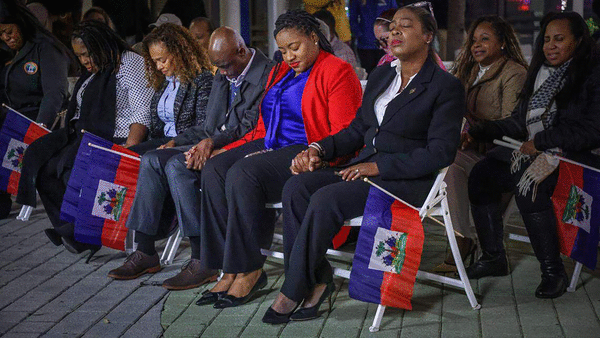
The Trump administration on Friday filed a doubled-barreled appeal of a federal judge’s ruling that blocked the Department of Homeland Security’s order terminating deportation protections for hundreds of thousands of Haitians.
Justice Department lawyers asked U.S. District Judge Ana C. Reyes in Washington, D.C., to lift her stay of the DHS order, saying they want a decision by Monday. But the government attorneys also filed an appeal of her ruling with the Court of Appeals for the District of Columbia Circuit.
On Monday, Reyes halted DHS’s order to end Haitians’ temporary protected status, or TPS, designation, which was set to expire at 11:59 p.m. Tuesday. Her ruling shields more than 300,000 Haitians — at least 158,000 of them living in Florida — from deportation back to their volatile country while an ongoing lawsuit proceeds. The suit was filed by five Haitian plaintiffs challenging the administration’s termination, saying they would suffer irreparable harm if they are forced to return to their homeland.
Reyes said in her 83-page ruling that she believed the plaintiffs are likely to succeed on the merits. She concluded that DHS Secretary Kristi Noem failed to follow the requirements of the law when she made the decision and that the outcome appeared to have been preordained, citing comments Noem has made against Haitian and nonwhite immigrants.
The administration said this week that it “vehemently disagrees” with the ruling and was consulting with the Justice Department on its next steps. The appeal doesn’t necessarily rule out a parallel track to seek a ruling from the U.S. Supreme Court to quash Reyes’ order while the appellate court reviews the merits of the lawsuit. Twice last year the Supreme Court expedited review of the government’s request for a reversal of a stay while the case is under review by lower courts.
In May, for example, Supreme Court justices lifted a federal judge’s stay that had blocked the government’s plan to cancel deportation protections and work permits for hundreds of thousands of Venezuelan immigrants living in Florida and other states. The unsigned, two-paragraph order allowed DHS to revoke Venezuelans’ TPS, even as they challenge the government’s revocation policy in federal court in San Francisco. In their request to Reyes Friday, government lawyers cited the Supreme Court’s action, saying the justices have already weighed in.
Advocates and elected officials across the U.S. has been appealing to the Trump administration to reverse course on ending Haitian TPS, citing the widespread violence in Haiti spread by gangs the administration has labeled as foreign and global terrorists. They also argue that contrary to Noem’s assertions that keeping Haitians in the United States is not in the national interest, the community contributes billions to the U.S. economy.
TPS provides protections and work permits to people in the United States from countries in turmoil. Haitians were first granted the status by President Barack Obama following the deadly 2010 earthquake that killed more than 300,000 people.
On Tuesday, an Immigration and Customs Enforcement flight returned 132 Haitian nationals to Haiti. The aircraft landed in Cap-Haïtien because the main international airport in Port-au-Prince remains off limits to U.S. flights due to the gang violence. As recently as last month gangs fired upon two Brazil-bound charter airplanes as they landed to pick up passengers.
The political situation in Haiti remains volatile as well. On Saturday, the mandate of the country’s nine-member Transitional Presidential Council is scheduled to end, but without the planned transfer of power to an elected president. Efforts by some members of the council to remain in power and the ensuing political uncertainty as Haiti approaches its third transition in five years prompted the Trump administration to deploy three vessels, including a Navy destroyer, to the Bay of Port-au-Prince.
The transitional presidential council is expected to transfer power to the prime minister and a council of ministers, but there are still uncertainties about who will lead Haiti ahead of the planned general elections on Aug. 30.
_____
Miami Herald staff writer Jay Weaver contributed to this report.
_____
©2026 Miami Herald. Visit miamiherald.com. Distributed by Tribune Content Agency, LLC.





Comments