First-responders network faced with calls for change
Published in News & Features
WASHINGTON — As lawmakers begin working toward a potential reauthorization of the post-9/11 program that provides emergency communications services for first-responders, they will have to navigate calls for a revamp of its structure and for more competition.
A House Energy and Commerce subcommittee is headed toward a markup Tuesday after holding a hearing this week on a bipartisan bill that would make structural changes to the public-private First Responder Network Authority, known as FirstNet. Meanwhile, a Senate Commerce subcommittee also held its first hearing on the issue, though it does not yet have a draft bill.
Authority for FirstNet is set to expire in February of 2027, which committee witnesses said could lead the Federal Communications Commission to revoke the spectrum license that undergirds the network.
The authority was created in 2012 in response to recommendations after the 9/11 terrorist attacks, during which public safety agencies using different radio systems and overloaded phone lines struggled to adequately communicate.
FirstNet’s initial $7 billion funding came from the sale of spectrum by the FCC. The law requires that the network be permanently self-sufficient by collecting fees from public safety agencies.
Both hearings, and the House bill by Reps. Neal Dunn, R-Fla., and Jennifer McClellan, D-Va., focused on problems brought to light in reports from the Commerce Department’s Office of the Inspector General.
Those included findings that the AT&T-run FirstNet service was not sufficiently available during the Maui wildfires in 2023 and that senior officials of the FirstNet Authority attempted to interfere with audits.
Sen. Deb Fischer, R-Neb., who leads the Senate Commerce, Science and Transportation Subcommittee on Telecommunications and Media, lauded the network but also urged senators in their reauthorization work to prioritize making sure FirstNet is transparent and resilient.
“This is an achievement, but it should not be confused with a blank check. In fact, the scale and importance of the public safety assets that AT&T now operates makes stronger oversight more essential, not less,” Fischer said at the hearing last week.
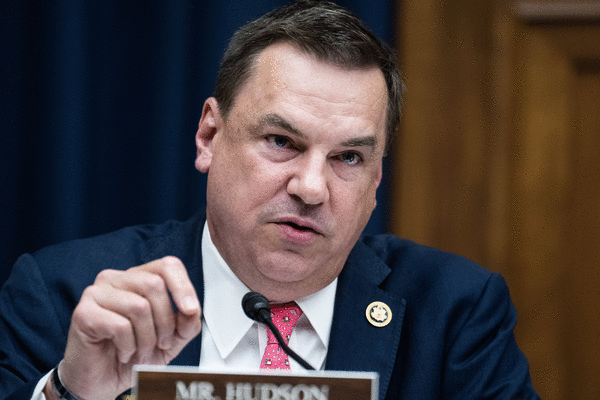
Rep. Richard Hudson, R-N.C., chairman of the Energy and Commerce Communications and Technology panel, similarly offered his support for the network, but also pointed to possible changes to the structure of its authority.
“This committee’s work over the last several months has also identified a consistent and troubling finding: The ambiguous language regarding FirstNet’s independence — while simultaneously placing it directly within an executive branch agency — has created confusion and strife for all parties involved when trying to manage this program,” Hudson said.
The draft House bill would remove language in current law that established FirstNet as an “independent authority” within the National Telecommunications and Information Administration, part of the Commerce Department.
It would also give NTIA approval of FirstNet’s actions other than those on a specified list developed by NTIA and create an associate administrator position within the department to oversee the FirstNet Authority and liaise between the authority and NTIA.
Additionally, it would require NTIA to report annually to Congress on cybersecurity and outages, as well as adoption of FirstNet by profession and geographic area.
Competition questions
While the oversight and transparency changes appeared to have broad support in both subcommittee hearings, the more complicated issue could be competition in public safety communications.
Cory Davis, vice president of Verizon’s public safety network, told the Senate subcommittee that many public safety agencies rely on a system other than FirstNet or employ more than one company in order to avoid a single point of failure. Verizon and T-Mobile both offer their own first responder priority services.
Current law requires that fees paid by public safety agencies for the use of FirstNet be reinvested in the network including for construction, operations and improvement. Davis argued that because FirstNet was originally founded using federal funds, reinvested fees should benefit users across services, not just those who use the AT&T-based FirstNet.
“If the authority uses federal funds to procure physical infrastructure like towers in a rural area, access to those assets should be available to all public safety providers, and federal funds should support all first responders regardless of what commercial carrier they choose,” Davis said.
Fischer said in the Senate Commerce panel hearing that “competition, where feasible, can be a safeguard for the public and that includes driving innovation and choice for government partners.” She pressed witnesses for details on how FirstNet has influenced competition, opportunities for additional competition in the future, and the possibility of network security tradeoffs for having more providers as part of FirstNet.
A Democratic Senate staffer speaking on condition of anonymity said that competition still “needs to be looked at further” and noted that members on both sides of the aisle discussed the issue at the hearing.
They also said that they anticipate further Senate hearings on the FirstNet reauthorization and that conversations with the House have not yet started.
The House bill would not change how FirstNet fees are used, but lawmakers acknowledged that the market for this type of service has changed.
The House subcommittee’s ranking member, Rep. Doris Matsui, D-Calif., said that some agencies in her district use FirstNet, some use another service, and some use more than one.
“No matter what network a responder is on, they should be able to connect instantly with partners on the ground, even when conditions are at their worst,” Matsui said. “We should look for ways to enable innovation, spur competition, and meet local needs while maintaining interoperability and reliability nationwide.”
The House bill does include language to address outages. In February of 2024, according to an OIG report, an AT&T outage led to the network being down for around three hours. That report also found a lack of communication from FirstNet to first responders about the outage and that agencies were forced to rely on their own contingency plans.
The bill would require AT&T to submit a continuity and recovery plan to NTIA for how the network would be restored following a natural disaster or other emergency. It would also require AT&T to notify the FirstNet authority of any outages within 30 minutes and provide a network status tool for public safety agencies.
The House bill would stagger terms for board members and require that at least five members of the board have backgrounds in public safety, changes supported by the current acting chair of the FirstNet Authority, Michael Adkinson, who testified at both hearings. He joined the board in 2024 along with six other new members.
“That’s an incredibly difficult way to maintain continuity of government, when you have six new people who have no history on that board itself,” said Adkinson, who also works as a county sheriff in Florida and advocated that there “should be a public safety mindset on this board.”
_____
©2026 CQ-Roll Call, Inc., All Rights Reserved. Visit cqrollcall.com. Distributed by Tribune Content Agency, LLC.






Comments