Thailand's royalists set for surprise election victory as progressives concede defeat
Published in News & Features
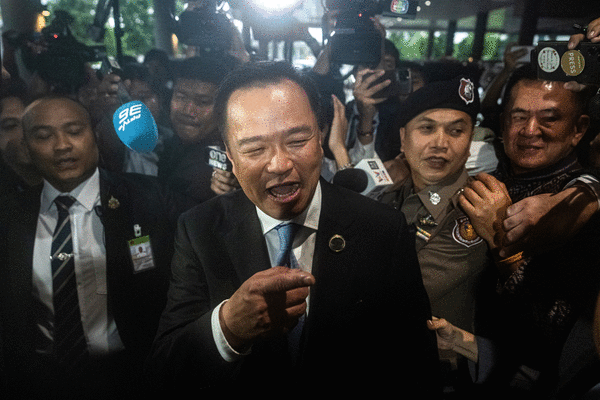
Thailand’s ruling conservative party headed for a convincing election win Sunday night, the first victory this century for a party aligned with the country’s royalist establishment and a clear defeat for an emerging progressive movement.
The Bhumjaithai Party, led by incumbent Prime Minister Anutin Charnvirakul, is set to secure 195 seats out of a possible 500, according to preliminary results from the country’s Election Commission, with votes from about 30% of the polling stations counted. The pro-democracy People’s Party, which had been leading in the pre-poll surveys, was on track for 92.
Anutin told reporters at the party’s headquarters in Bangkok that he was certain the party had secured victory, but said he would await official results before seeking to form a coalition. He spoke shortly after People’s Party leader Natthaphong Ruengpanyawut conceded the party had lost.
The race was cast as a referendum on the People’s Party’s reform agenda, set against the pro-establishment Bhumjaithai as champion of the status quo.
The loss is a dramatic turnabout for progressives, who surged onto the scene in 2023 after a wave of post-pandemic frustration following nearly a decade of military-aligned rule. It also underscores the resiliency of the conservative establishment that the People’s Party and its predecessors have been targeting — broadly seen as the overlapping interests of the military, royalists and economic elite.
Anutin was also able to ride a surge in nationalism spurred by recent border clashes with Cambodia, tapping public concerns over security and sovereignty and pledging strong support of the military.
A clear victory may be a relief for markets, as investors have more often been rattled by uncertainty than who’s in charge. “Investors are likely to focus more on signs of post-election clarity rather than the outcome itself,” Bloomberg Intelligence strategists Sufianti Sufianti and Chunyu Zhang wrote ahead of the vote.
A hefty victory for Anutin and Bhumjaithai will help the country avoid a fresh political deadlock. Pheu Thai, aligned with the influential Shinawatra family and a natural ally to block the progressives, was on track for 83 seats. Anutin-aligned Klatham was heading for 61.
The Southeast Asian nation has seen 10 prime ministers since 2005, the last time a single party government was formed. That instability has been credited with creating a parallel paralysis in the economy, which has lagged behind its neighbors despite earlier promise as a standout success in Asia.
Those two decades of chronic political instability have seen Thailand go from an aspiring economy on track to join the ranks of rich nations to a regional laggard beset by stagnant growth, soaring debt, widening inequality and a shrinking workforce.
A referendum that asks whether the current military-drafted constitution should be replaced, a proposal promoted by People’s Party but supported in broad terms by almost all parties, was on track for approval, with almost 60% voting yes.
Sunday’s election follows a crisis that saw the previous prime minister, Paetongtarn Shinawatra, ousted in August over an ethics violation related to her handling of the border clash with Cambodia. Her successor, Anutin, took office with the backing of the People’s Party on the condition he would call a snap election.
There were signs that Anutin and his party’s apparent success is partly due to its strategic maneuvers in an election system that favors first-past-the-post constituencies rather than the popular vote. Of the 100 seats up for grabs nationwide along party lines, the People’s Party was on course to win the most at about 22.
Bhumjaithai’s move to consolidate local political families under its banner also helped it win more seats. The strategy reflected lessons learned from 2023, when conservative votes were split among multiple candidates.
People’s Party had tempered some of its political aims since its predecessor, Move Forward, was dissolved after the 2023 vote for campaigning to amend the country’s controversial lese majeste law. It also sought to widen its appeal promoting seasoned technocrats and civil servants as possible cabinet members.
“They’ve tacked a little bit toward the realities of Thai politics,” said Andrew Shaw, Southeast Asia managing director for The Asia Group in Bangkok, who spent 25 years in the US Foreign Service, most recently as an economic counselor in Thailand.
At the People’s Party headquarters in downtown Bangkok on Sunday night, a small number of supporters were seen following the results in a somber mood. Phattaranan Saengsrichai, a 21-year communications student, reflected a common desire for change among younger voters.
“Thailand has made no progress and actually regressed compared with other neighbors because of old political groups,” she said. “They have dominated Thai politics for so long and protect their own interests.”
_____
(With assistance from Emma Clark, Randy Thanthong-Knight, Pathom Sangwongwanich, Suttinee Yuvejwattana and Anuchit Nguyen.)
_____
©2026 Bloomberg L.P. Visit bloomberg.com. Distributed by Tribune Content Agency, LLC.





Comments