NATO allies warn Russia playing for time in Ukraine peace talks
Published in News & Features
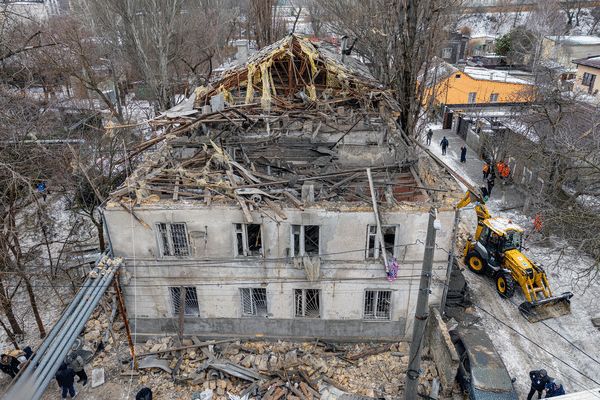
Russia has no intention of ending its war in Ukraine, according to assessments by eastern NATO member states Poland and Estonia that offer a warning to Washington that Vladimir Putin is likely buying time in peace talks.
The Kremlin is exploiting negotiations as a “tool for manipulation” as it aims to restore relations with the U.S., Estonian foreign intelligence said on Tuesday. Russia is “playing games” in the talks and its goal remains unchanged — to subjugate Ukraine and potentially attack other countries, according to a top foreign policy aide to the Polish president.
“Russia is absolutely not ready to negotiate in good faith,” Marcin Przydacz told Bloomberg News in an interview at his office in Warsaw. “For 600 years this has been the perpetual engine of this country — Russia — to continue expanding its territories, not seeing the problems of their inhabitants.”
The matching assessments from two U.S. allies on NATO’s eastern flank cast a shadow over U.S. President Donald Trump’s effort to end the four-year war, as his envoys seek to bring together Russian and Ukrainian negotiators. While Kyiv has secured commitments for guarantees designed to prevent a further Russian attack, talks have stalled over other issues including territory.
“Russia is setting long-term operational objectives in its war against Ukraine,” the Estonian Foreign Intelligence Service said in its annual report. “This confirms that the recent uptick in peace-talk rhetoric is merely a tactic to buy time.”
Wolfgang Ischinger, the German diplomat who chairs the Munich Security Conference this week, said he agreed with Estonia’s assessment, noting that talks over “many, many weeks, months, have not produced a meaningful ceasefire.”
“A lot more pressure needs to be applied on Russia,” he told Bloomberg Television in an interview. “Russia needs to understand that the United States and European allies will not allow Russia to conquer Ukraine, not now and not in the future.”
The pressure to end hostilities is growing, though, as U.S. faces midterm elections in November. Ukrainian President Volodymyr Zelenskyy told reporters last week — after another round of trilateral talks in Abu Dhabi — the U.S. is proposing to finish all necessary negotiations to end Russia’s invasion of Ukraine in June.
The Kremlin has instructed Russia’s state institutions to “project openness” to cooperate with the U.S., the Estonian report said. The main objective is to restore full relations with Washington, a path that would open the possibility of direct flights and visas for the business elite — as well as easing the path for espionage, influence operations and sanctioned goods, it said.
Sanctions relief is essential for sustaining Russian President Vladimir Putin’s power system as a deteriorating economy stemming from falling oil production sows division among the ruling elite.
That’s why the response should be to bring more economic pressure to bear, including on countries that continue to buy Russian oil and to target Russia’s shadow fleet, Przydacz said. “The only way to change that is to try to weaken Russia economically in a way that would affect its elites,” he said. “They are not yet weak enough.”
Russia has been dangling a potential for multi-trillion dollar economic deals to soften the U.S. position during the talks.
“The Kremlin merely feigns interest in peace talks, hoping to restore its bilateral relations with the United States to their previous level and formalize Ukraine’s defeat,” the Estonian spy agency said.
Russia is also seeking to collaborate with the U.S. on nuclear arms safety — a process that helps the country retain its great power status. “Presenting itself as a responsible nuclear power” is part of a strategy to open broader security talks, aimed at potentially imposing restrictions on NATO activity, the report said.
According to the Baltic nation’s spy service, one option for Moscow is to establish a postwar reconstruction fund financed by Russian assets frozen in the West, enabling Moscow to effectively impose its will on Ukraine and pay for propaganda campaigns.
The report from Estonia said that Moscow’s military-industrial complex will continue to be a danger to its neighbors even after a peace deal might be agreed. Moscow still hopes to restrict NATO activity along its border — and “Russia is highly likely preparing for future conflict even as its war against Ukraine continues,” it said.
Military production is expected to stagnate this year as an increasingly dire economic outlook sows division among the ruling elite, the report said, citing higher borrowing costs and low investment as factors driving the economy into recession.
Oil production, a major source of Russian government funding, has steadily declined and is unlikely to rebound in coming years, the report said. Higher taxes and spending cuts to cover the cost of war — combined with Ukrainian drones strikes reaching deeper into Russia — have dampened consumer sentiment. But total economic collapse is unlikely, according to the spy agency.
“Divisions within the ruling elite over economic policy have also sharpened, resulting in disagreements spilling into the public domain over the state of the economy and the central bank’s monetary policy,” the report said.
©2026 Bloomberg L.P. Visit bloomberg.com. Distributed by Tribune Content Agency, LLC.





Comments