EPA to roll back finding tying emissions to public health
Published in News & Features
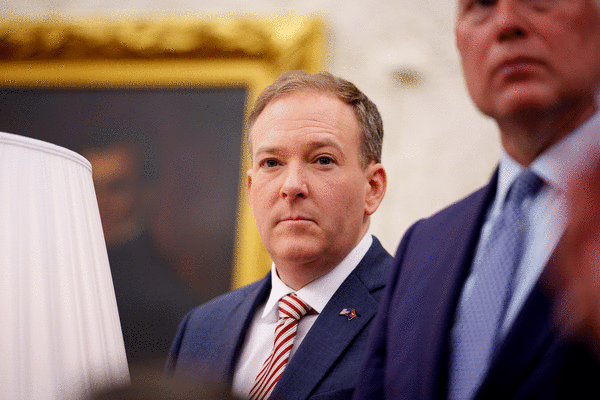
WASHINGTON — The EPA said Tuesday it would rescind the agency’s 2009 endangerment finding and all regulations based on its determination that greenhouse gas emissions are a threat to public health requiring regulation under the Clean Air Act.
The final rule is still under interagency review and hasn’t been made public or signed by Administrator Lee Zeldin. But the agency said in an email that the forthcoming final rule would be a “historic action” and that the finding was used to “justify trillions of dollars of greenhouse gas regulations covering new vehicles and engines.”
“EPA is actively working to deliver a historic action for the American people, ” EPA spokesperson Brigit Hirsch said in an email. “Sixteen years ago, the Obama Administration made one of the most damaging decisions in modern history — the 2009 Endangerment Finding. In the intervening years, hardworking families and small businesses have paid the price as a result.”
The news was first reported by The Wall Street Journal.
Rescission of the finding also would invalidate regulations made on its basis — perhaps most notably, vehicle tailpipe emissions standards. The agency said that without the endangerment finding it would lack the statutory authority under the Clean Air Act to enforce the standards.
The agency first proposed rescission of the finding last July, prompting months of pushback from environmental and health organizations and activists who said the new rule, if finalized, would be a detriment to Americans’ health and well-being by adding to greenhouse gases.
“This action will only lead to more of this pollution, and that will lead to higher costs and real harms for American families. The evidence — and the lived experiences of so many Americans — tell us that our health will suffer,” Environment Defense Fund President Fred Krupp said in a statement.
The EPA finding in 2009 that greenhouse gases are a pollutant that pose a risk to health and welfare gave the agency the authority to regulate them. The Clean Air Act requires such a finding before the EPA can adopt regulations.
Lawsuits expected
Environmental organizations have vowed to challenge the new EPA final rule in court.
The EDF “will challenge this decision in court, where evidence matters, and keep working with everyone who wants to build a better, safer and more prosperous future,” Krupp said.
Calling the EPA proposal “a gift-wrapped package for the fossil fuel industry,” Natural Resources Defense Council President Manish Bapna said during a Jan. 14 press call that “if the EPA tries to repeal the endangerment finding, we will see them in court and we will win.”
Hundreds of advocates and private citizens appeared in the EPA’s series of virtual public hearings in August, saying the agency was proposing to abdicate its own authority to regulate greenhouse gas emissions. A much smaller contingent in support of the proposal said that rescinding the finding would end the economic harm to some businesses and consumers as a result of stricter emissions standards.
In Congress, members are divided over the proposal, with Democrats calling it dangerous and harmful to constituents’ health and Republicans applauding what they called the proposal’s potential to aid affordability and consumer choice.
“This attack on the endangerment finding is a clear and present danger to the public. We are facing unprecedented attacks on our health and environment. These attacks need to be met with an unprecedented response,” Sen. Edward J. Markey, D-Mass., said in September. “We all deserve better, and together we won’t stop demanding better from them until Trump, Zeldin and his cabinet cartel are removed from office.”
Senate Environment and Public Works Chairman Shelley Moore Capito, R-W.Va., said in a July social media post that she applauded the “effort to end damaging and illegal regulations like the attempted EV mandate” — an apparent reference to stricter tailpipe emissions standards implemented by the Biden administration.
“The Clean Air Act has been weaponized by Democrat administrations for years, and this action takes initiative to prevent regulations that limit affordability, energy security, and consumer choice across our country,” she said.
In proposing to rescind the finding, the EPA said it no longer had the statutory authority to regulate greenhouse gas emissions because of changes in understanding of both science and the law since 2009. The agency’s move to that determination involved in part a July Energy Department report questioning the science behind climate change and its impact on human health.
That report, which is part of a lawsuit alleging violations of a 1972 law governing federal advisory committees, was referenced multiple times in the EPA’s proposal as challenging the science the endangerment finding was based upon.
Environmental and scientific advocacy groups say the report was “cherry picking” the science to help advance a policy agenda. They have called efforts to repeal the endangerment finding, based at least in part on the DOE report, “fundamentally flawed.”
But in an emailed statement in January, EPA’s Hirsch said the endangerment finding rescission proposal and DOE report were separate actions that came out on the same day and were announced together.
“EPA has been nothing but transparent and is following the rulemaking process required by the Clean Air Act. We will not allow the loudest voices to silence the hundreds of thousands of other commenters who participated in the reconsideration of these important issues,” she said.
©2026 CQ-Roll Call, Inc., All Rights Reserved. Visit cqrollcall.com. Distributed by Tribune Content Agency, LLC.






Comments