Merz cites nuclear talks in call to reorder Trump-era relations
Published in News & Features
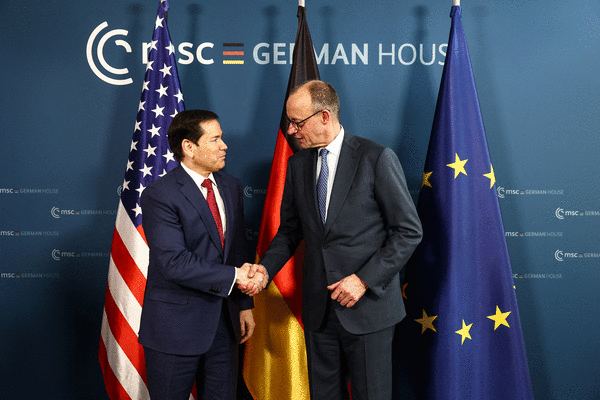
German Chancellor Friedrich Merz said he’s in talks with France over potential European nuclear defense as he made a call to reorder the transatlantic relationship amid the turmoil of Donald Trump’s second term.
Kicking off the Munich Security Conference, Merz warned against a new era of great power politics and said that Germany and Europe need to bolster their security and independence together, while seeking partnerships with other regions to buoy the liberal order. But, he said, leaders must come to terms with the fact that the world has changed.
“This order, as incomplete as it’s been even at the best of times, no longer exists as it did,” Merz told an audience of leaders and security experts on Friday in the Bavarian capital. As part of European efforts, Merz said he’s in “confidential talks” with French President Emmanuel Macron on nuclear deterrence.
Still, the German leader warned the audience not to “reflexively write off” the U.S., saying such positions were short-sighted and failed to take into account the potential that can still be realized by engaging with Washington.
A year after U.S. Vice President JD Vance delivered a broadside against Europe on the stage in Munich over migration and freedom of speech, the leaders gathering in southern Germany have been searching for ways to salvage the post-World War II alliance. At the same time, officials are contemplating the fact that they may instead need to carve out their own path in an increasingly dangerous world.
Merz made reference to Vance’s speech as an unmistakable breech in the transatlantic relationship. He drew a sharp line over Trump-style politics, saying that the “culture wars of the MAGA movement are not our own.”
Citing Europe’s “enormous” military, economic and technological potential, Merz said Germany had no other choice than to move forward by building alliances — and foregoing trade restrictions and protectionism.
“We Germans know that a world in which only power is taken into account is a dark place,” Merz said. “Our country took this path in the twentieth century all the way to its bitter and evil end.”
Nuclear deterrence
Merz’s confirmation that he’s discussing nuclear deterrence — Germany has no nuclear weapons and has phased out atomic power — underscores the scale of the shakeup in the region. Bloomberg reported earlier that, for the first time since the end of the Cold War, European capitals are discussing how to develop their own nuclear deterrent.
“We Germans are adhering to our legal obligations,” Merz said of the nuclear talks. “We consider this strictly within the context of our nuclear sharing in NATO — and we will not allow zones of differing security to emerge in Europe.”
Merz was among European leaders including Macron, Prime Minister Keir Starmer and Ukrainian President Volodymyr Zelenskyy attending the conference, as well as U.S. Secretary of State Marco Rubio. A delegation of more than 50 members of the U.S. Congress also made their way to Germany, including many Democrats proclaiming their adherence to transatlantic ties.
While Merz’s speech took to task Trump’s roiling of world politics, it was a counterpoint of sorts to one given last month at the World Economic Forum by Canadian Prime Minister Mark Carney. Carney shook up the diplomatic establishment by saying that the rules-based international system was effectively dead, calling on middle powers to reinforce their ties to push back on predatory powers.
“Call the system what it is: a period where the most powerful pursue their interests using economic integration as a weapon of coercion,” Carney told WEF delegates in Davos, Switzerland. The comments triggered a rebuke by Trump.
The Munich conference delivered a report that laid bare one of the bleakest moments in transatlantic ties in the last eight decades, referring to the “wrecking ball politics” across the globe as Trump seeks to dismantle some of the main pillars of a system that the U.S. helped build.
German diplomat Wolfgang Ischinger, who chairs the meeting, told Bloomberg this week that Trump is among world powers — including Russia and China — contributing to a “disintegrating international order.”
“More than 80 years after construction began, the U.S.-led post-1945 international order is now under destruction,” the Munich report concluded.
©2026 Bloomberg L.P. Visit bloomberg.com. Distributed by Tribune Content Agency, LLC.



Comments