Rubio hints that Cuba can reform its economy as a way to ease US pressure
Published in News & Features
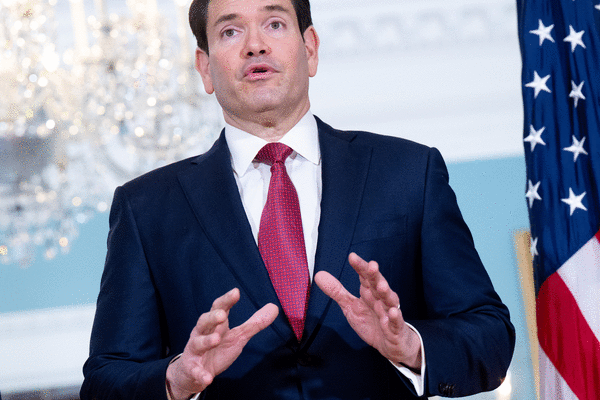
Secretary of State Marco Rubio signaled Saturday that economic reforms could offer the Cuban government a path to easing U.S. pressure even as the Trump administration’s oil blockade pushes the island deeper into crisis.
Speaking on the sidelines of the Munich Security Conference, Rubio declined to spell out specific conditions but suggested the regime must allow Cubans greater economic freedom — not just political reforms — if it wants relief from Washington’s tightening grip.
“It is important for the people of Cuba to have more freedom, not just political freedom but economic freedom,” Rubio told Bloomberg News Editor-in-Chief John Micklethwait, describing the regime’s unwillingness to loosen control as the root of the island’s collapse. “So I think there has to be that opening, and it has to happen, and I think now Cuba is faced with such a dire situation. I think certainly their willingness to begin to make openings in this regard is one potential way forward. “
The comments, after a question about off-ramps that the U.S. could offer to the government in Havana, mark the clearest signal yet from the Trump administration about potential terms for negotiations even as the president’s oil embargo leaves Cuba facing what United Nations officials have warned could be a humanitarian collapse.
Since the Jan. 3 U.S. military operation that captured Venezuelan President Nicolás Maduro, no oil has flowed from Cuba’s main supplier. President Donald Trump later threatened tariffs on any country that provides fuel to the island, effectively cutting off shipments from Mexico as well. Cuba’s energy crisis has deepened and daily blackouts sometimes last more than 24 hours at a time on some parts of the island. Several international airlines canceled flights after the island’s authorities warned they ran out of jet fuel. The entire country could run out of oil within days, experts say.
“This is a regime that has survived almost entirely on subsidies — first from the Soviet Union, then from Hugo Chavez,” Rubio said in the interview. “For the first time, it has no subsidies coming in from anyone, and the model has been laid bare.”
Rubio painted a picture of a government that doesn’t understand basic economics and has alienated foreign investors who “lose money in Cuba” because “they never pay their bills.”
“Put aside for a moment the fact that it has no freedom of expression, no democracy, no respect for human rights,” Rubio said. “The fundamental problem Cuba has no economy, and the people who are in charge of that country, in control of that country, they don’t know how to improve the everyday life of their people without giving up power over sectors that they control. They want to control everything. So they don’t know how to get themselves out of this. And to the extent that they have been offered opportunities to do it, they don’t seem to be able to comprehend it or accept it in any ways.”
“They would much rather be in charge of the country than allow it to prosper,” said Rubio, who is the Miami-born son of Cuban immigrants and has long advocated for regime change in Havana.
The secretary of state stopped short of outlining a formal road map for easing sanctions or opening dialogue, saying such announcements require “space and time to do it in the right way.” But his emphasis on economic freedoms suggested Washington sees the current crisis as leverage to push for market reforms that would loosen the military’s grip on the economy.
Rubio’s comments come as the Trump administration appears to be replicating its Venezuela playbook in Cuba — using economic pressure to force leadership changes while holding out the possibility of a “deal” without specifying terms.
Trump posted on Truth Social last month: “THERE WILL BE NO MORE OIL OR MONEY GOING TO CUBA — ZERO! I strongly suggest they make a deal, BEFORE IT IS TOO LATE.”
Cuban officials have sent mixed signals in response to the pressure, with the Foreign Ministry expressing willingness for “respectful and reciprocal dialogue” while also insisting the country won’t negotiate its political system.
What Rubio is offering “is the most sensible, prudent, and humane path: to drive change through an economic solution,” said former Congressman Joe García, a South Florida Democrat who has tried to mediate between the two governments in the past. “In some ways, this is what the Cuban regime has tried to implement, but has failed due to ineptitude and fear of losing control.”
There is no guarantee that the government would take the offer, however.
“Those are the same reforms allies of the regime, supporters of engagement with Cuba, Cuba’s own economists and everyone on the island who can’t afford basic goods have urged for years, and that Havana’s rulers have stubbornly resisted,” said Ric Herrero, the executive director of the Cuba Study Group, in a post on X. The group is based in Washington, D.C.
Rubio did highlight one area of U.S. engagement: humanitarian aid delivered through the Catholic Church. Washington provided assistance after recent hurricanes and “just recently announced an increase,” he said, though he acknowledged “that’s not a long-term solution to the problems on the island.”
©2026 Miami Herald. Visit miamiherald.com. Distributed by Tribune Content Agency, LLC.





Comments