4 issues to watch as Minnesota Legislature convenes in wake of ICE surge, Hortman slaying
Published in News & Features
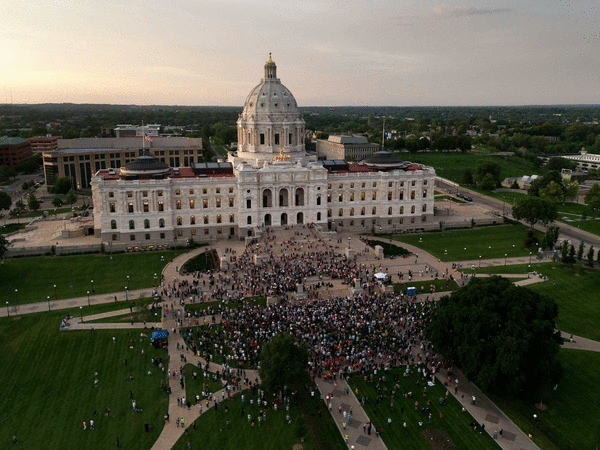
MINNEAPOLIS — The Minnesota Legislature returns to St. Paul on Tuesday, Feb. 17, after a break marked by violent tragedies and the monthslong surge of immigration agents that threatens to further tensions between Democrats and Republicans.
It’s the first session Minnesota lawmakers will hold without House DFL Leader Melissa Hortman, who was assassinated last summer, and since a shooter killed two children and injured 28 more at Annunciation Catholic Church and School in Minneapolis.
And it comes as the federal surge ordered by President Donald Trump is expected to wind down. The surge was spurred, in part, by the state’s struggle to tamp down on social services fraud.
Lawmakers are expected to grapple with the fallout of all of those issues this year, but agreement could be hard to reach between Democrats and Republicans in the narrowly divided Legislature.
All 201 lawmakers are also up for reelection this fall, making bipartisanship more difficult as the two sides try to force votes on issues that can be used as attacks on the campaign trail.
House DFL Leader Zack Stephenson predicted an “unproductive” session, noting that three members of the GOP caucus are running for governor.
“I wanna make the best of it and try and get as much done as possible,” Stephenson said. But he said he wanted to be “realistic” about what he thinks the session will hold. “It’s not conducive to a lot of progress,” Stephenson said.
GOP House Speaker Lisa Demuth, one of the three House Republicans running for governor, said the House proved last year that it could work together despite the tie. She quoted Hortman, saying she wasn’t speaker for Democrats or Republicans “but speaker of the Minnesota House” and would continue that work despite her campaign.
“I think we can still work together and be collaborative this year,” Demuth said.
Here’s a look at the top issues lawmakers will weigh this session:
—Immigration
Democrats say they will push for bills to rein in federal immigration agents who have arrested thousands of people across the state and killed two Minnesotans, Renee Good and Alex Pretti.
Coming proposals include measures that would ban agents from wearing masks, require them to provide medical aid if they shoot someone and allow Minnesotans to sue the federal government when an agent violates their constitutional rights.
But those bills could struggle to find enough Republican support to become law. Demuth backed immigration agents’ use of masks.
“I would trust that the federal agents are going to do their work that they need to get done as they are trained as professional law enforcement is,” she said.
Even if the Democratic proposals were passed, they could be challenged in the courts. A judge recently struck down a California law that banned federal agents from wearing face masks.
Senate Majority Leader Erin Murphy, DFL-St. Paul, admitted that Democrats will be “testing the boundaries of state sovereignty” in trying to rein in the federal government. But she said such bills are important because of what she’s seen on the streets of the Twin Cities.
“We have seen countless infractions on people’s constitutional and human rights,” Murphy said.
Demuth said she would have to see the language in some of the Democrats’ proposals before offering her support.
Republicans will seek to prohibit local law enforcement from refusing to cooperate with immigration enforcement. They have blamed the unrest during the immigration surge on what they see as a lack of cooperation from local Democratic officials.
GOP lawmakers last year proposed a bill that would have prevented local and state governments from enacting policies restricting cooperation with immigration enforcement. The legislation also would have mandated reporting to Immigration and Customs Enforcement, or ICE, any undocumented immigrants arrested for violent crimes.
Demuth acknowledged that some law enforcement agencies already cooperate with immigration agents, but she said the bill would make cooperation “uniform across the state.”
—Guns
Gov. Tim Walz had vowed to bring an assault weapons ban up for a vote last fall after the Annunciation shooting and assassination of Hortman and her husband, Mark, who were shot and killed in their home in June. That effort stalled as lawmakers, including some Democrats, balked.
Now, Democrats say they will try again.
“We cannot walk away from the gun issue, and we will not,” said Stephenson, a Hortman protege.
Democratic proposals will include a ban on assault weapons and high-capacity magazines, funding to advertise the state’s red flag law and improve school safety, and changes to the state’s mental health system, Murphy said.
While school safety and mental health reform may generate some bipartisan backing, Senate Minority Leader Mark Johnson said he didn’t believe any Republicans would support new limits on guns.
Demuth wouldn’t say whether there were firearm restrictions that Republicans could support, saying she would need to see bill language.
—Fraud
Legislators from both parties say they will bring bills aimed at clamping down on fraud in state benefits programs. So far, 15 people have been charged in federal court with stealing a total of at least $34.2 million from Medicaid programs meant to help seniors and people with disabilities. Federal prosecutors say the total is likely much higher.
Stephenson said his caucus would support anti-fraud measures, such as updating software so claims data are easier to check, adding more Medicaid fraud investigators to the Attorney General’s Office and adding more site visits to providers.
“The people responsible (for the fraud) should be in prison,” Stephenson said. “And then we should tighten the programs up.”
Beefing up the Attorney General’s Office is needed even more since the mass exodus of prosecutors from the local U.S. Attorney’s Office, Murphy said.
There will also be another push to create an independent Office of Inspector General that would investigate state agencies, programs and funding receipts. The Senate passed a bipartisan bill to create the office last session, but the bill did not clear the House.
Murphy was hopeful the House would take up the bill again this year.
It will be “in the mix,” Stephenson said, but was skeptical of the idea. He suggested that another investigative body would duplicate the legislative auditor, the Bureau of Criminal Apprehension and the Department of Human Services’ own inspector general.
Democrats, including Walz, also talked up the anti-fraud measures they’ve taken in recent months, including the hiring of an outside firm to analyze claims and the termination of some problematic programs.
“We expect there to be significant conversation about anti-fraud proposals this year and we’re open to all ideas,” a Walz spokesperson said.
Johnson said Senate Republicans would soon release a package of their own anti-fraud bills but declined to detail them ahead of the announcement.
“You’re going to see a lot about accountability and transparency that needs to happen,” he said.
Johnson added that he’d like to see Walz administration officials appear before legislative committees for questioning.
—Bonding
Democrats want to pass a large bonding bill this year to pay for roads, bridges, housing and other public works projects across the state. The Walz administration has already proposed a $907 million package. Meanwhile, Murphy has suggested a $1.1 billion to $1.2 billion package, and Stepheson said his caucus has an appetite for the “biggest bonding bill we can get.”
Johnson, the Senate Republican leader, said legislators should wait for the February budget forecast before deciding how much to borrow. He said bonding bills are always subject to negotiation.
“Everything is political here, but we want to get stuff done for Minnesotans,” he said.
A three-fifths majority is needed to pass a bonding bill, requiring buy-in from both parties. Craig Johnson, a senior government relations representative for the League of Minnesota Cities, said a bonding bill will be “a hard sell” but his organization supports passing one this year.
If it happens, Johnson said, it’ll probably come together at the last minute.
“Everybody’s posturing for the session right now,” he said. “They’re saying what they think they need to say to make the case for the position they think is the one they’re going to take for how to get to the end of this. And it’s an election year for everybody.”
———
(Bill Lukitsch and Christopher Magan of the Minnesota Star Tribune contributed to this story.)
———
©2026 The Minnesota Star Tribune. Visit startribune.com. Distributed by Tribune Content Agency, LLC






Comments