Minnesota released a report about social services fraud. Most of it is blacked out
Published in News & Features
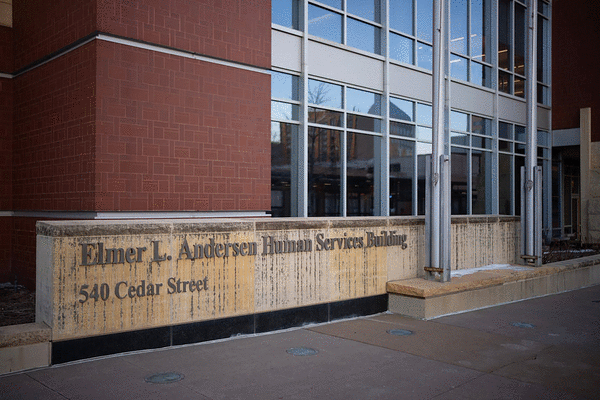
MINNEAPOLIS — Minnesota officials are touting a recently released review of billing across the state’s social services as a key step in identifying — and improving — the systems that allowed widespread fraud.
But the long-awaited third-party audit was heavily censored by the Department of Human Services, and officials have refused to share an unredacted version with lawmakers as they enter a legislative session that promises to focus on the embattled agency’s struggle with fraud.
That has frustrated state lawmakers who had hoped the full report, prepared by UnitedHealth Group subsidiary Optum, could offer a road map for policy changes to prevent misconduct in Medicaid programs.
The complaints add to mounting criticism of the social services agency as it struggles to rehabilitate its reputation.
Minnesota’s distinct system of benefits allowed some providers to steal money that prosecutors say could total $9 billion, though the Minnesota Star Tribune has found that alleged fraud uncovered so far is closer to $200 million. The issue has thrust the state into the national spotlight and already dominated the governor’s race.
“I was disappointed,” Rep. Steve Elkins, DFL-Bloomington, said of the decision to obscure much of the report’s major findings. While headings are visible, blacked-out sections block many important details.
“They’re identifying, in the parts that you can read, that there are a combination of technical issues and policy issues,” Elkins said. “So if a lot of it is policy-related, there’s probably things in state law that need to be corrected.”
Optum didn’t respond to questions from the Star Tribune, including whether the company requested the redactions or made its representative available for lawmakers who want to understand the complete report.
A Department of Human Services spokesperson said the redacted sections include trade secrets from the agency’s “business partners” and security information that could jeopardize the state’s ability to safeguard taxpayer money from wrongdoing.
“We are sharing as much of the report as possible in the interest of transparency and have redacted those portions that would breach privacy, security and legal or contractual requirements,” agency spokesperson Jen Amundson said.
The report, which the agency released Feb. 6, is part of its renewed effort to root out fraud. Wrongdoing in Minnesota social programs came to light after dozens of people were charged with bilking a pandemic-era benefit meant to provide meals to children in need. Similar schemes in autism, housing and transportation programs followed, pushing the Trump administration to threaten to withhold $2 billion in Medicaid funding to Minnesota.
John Connolly, the agency’s deputy commissioner and state Medicaid director, said during a news briefing earlier in February that the agency would share unredacted policy recommendations with lawmakers if it opts to suggest legislative fixes.
But Amundson recently told the Star Tribune the agency doesn’t plan to provide the full report to lawmakers before or during the session, which began Feb. 17.
“The two statements are not in conflict,” Amundson said, noting that the agency won’t share sensitive, unredacted reports with the public, but will work with lawmakers if findings from the report “necessitate changes to state law.”
At the news briefing, Connolly drew attention to a startling finding from the review: Ninety percent of claims that Medicaid-funded autism intervention providers billed the state over a four-year period veered from acceptable standards.
The autism treatment program is one of several that stand out in the Optum review for suspect claims, which the agency said doesn’t necessarily indicate fraud.
Other high-risk programs include Housing Stabilization Services, which the state shuttered last fall amid widespread misconduct, and an initiative that ferries Minnesotans to medical appointments.
Optum estimated that $1.03 billion could be recovered if the agency modernized its policies, though the report notes that figure isn’t a measure of confirmed misconduct. The company also concluded that the Department of Human Services could save some $52 million by fixing policy violations.
Large black boxes obscure the most anticipated aspects of Optum’s review, including sections that detail what makes programs vulnerable to fraud and suggested solutions.
Rep. Patti Anderson, R-Dellwood, said she and her colleagues were eager to glean some insights from Optum’s report. Aside from confirming some of the widespread concerns already raised about fraud, she said, the document is useless.
“It really gives us no guidance,” Anderson said. “And it’s frustrating that the Walz administration redacted almost the entire report. It makes you wonder what they’re hiding.”
“We’re all frustrated,” she added. “Unfortunately, it’s not a surprise.”
On Feb. 17, Rep. Joe Schomacker, R-Luverne, introduced a bill that would force the Department of Human Services to release to the public a version of the report that only includes redactions requested by Optum to protect its proprietary information. Anderson said she supported the legislation.
The Department of Human Services attributed the redactions to a state statute that protects entities from releasing information that could jeopardize security or reveal trade secrets.
Matt Ehling, the founder of Public Record Media, a nonprofit committed to obtaining government documents through public records requests, questioned that broad-brush explanation. Ehling noted that some redacted sections appear to have little to do with sensitive information, including Optum’s assessment of the social services agency’s claims review process and a high-level summary of system weaknesses.
“None of that is security information or implicates the security of state systems or practices,” he said. “The fact that there’s concerns or allegations raised in this time, where we’ve seen literally billions of dollars in fraud, should be available to the public.”
Ehling asked how a report full of redactions could offer guidance for reform.
“If you cannot understand what the regulator is doing, you can’t understand how the regulator may be failing in its oversight,” he said. “And it clearly is failing, if you look at the amounts of fraudulent activity that are happening.”
Amundson, the Department of Human Services spokesperson, said the agency doesn’t plan to release additional reports summarizing Optum’s findings.
©2026 The Minnesota Star Tribune. Visit at startribune.com. Distributed by Tribune Content Agency, LLC.





Comments