Miami had a language law before English-only driving tests. See what happened
Published in News & Features




MIAMI — Florida is having a language moment in 2026. But what language is it?
A new state law requires driving tests to be English-only. Florida, the state with the third largest foreign-born population, behind California and Texas, enacted the English-only driving tests in February. The law banished tests in Spanish and Creole.
Then there is a new play in Miami, “English Only,” which looks back at the language wars in Miami-Dade County in the 1980s amid the Mariel boatlift, and an English-only law on the books for 13 years. The Miami New Drama play wraps up its run Feb. 22 at South Beach’s Colony Theatre as Miami continue to communicate in many languages.
And finally, Bad Bunny’s all-Spanish performance at the Super Bowl had some celebrating with watch parties at Miami bars, and others seething around the country about a language they don’t understand.
So, where does the language divide this year leave us? Will the return of an English-only requirement in Florida lead to other official language laws?
Don’t expect immediate change, at least at the ballot box, legal experts say. You can still vote in the language of your choice — in South Florida, that’s English, Spanish and Creole.
A section of the Voting Rights Act from 2024 says that that federal voting‑rights law supersedes local law in elections. And that act requires that local jurisdictions offer all election‑related “notices, forms, instructions, assistance, or other materials or information … including ballots” in other languages when Census thresholds are met.
Multi-language ballots are required “regardless of whether the jurisdiction has declared English as its official language,” the act says.
“The driver’s license law ... could support a movement that may try to pass state and/or federal laws applying the same reasoning to ballots,” Florida-based transportation attorney Doug Burnetti said in a Miami Herald interview. “Indirectly, it could have an influence if laws are changed to require that you have a driver’s license to vote. Then theoretically, an indirect effect would be that there will be less Spanish fluent voters.”
How history has repeated in Florida
“We’re really telling the story of 1980 with the mirror to 2026,” Miami New Drama Artistic Director Michel Hausmann told arts site ArtBurst Miami of the play “English Only.” “It’s impossible not to. Maybe had we done this play in 2015 it would have read completely different. Hopefully in 10 years, this is not an issue we have anymore, but it sure as hell is an issue we have right now.”
“If English was good enough for Jesus Christ in the Bible,” a Hillsborough County School Board member said, “it’s good enough for me.”
That was December 1983. Alongside the 3-year-old English-only Miami ordinance of the time, the Miami Herald reported a House committee’s 10-8 vote to repeal a newly enacted foreign language requirement for students entering Florida’s universities.
Fast-forward to 2026: American-born Benito Antonio Martínez Ocasio, 31, conceived a Puerto Rican-themed Super Bowl show. He performed the entire 13 minutes atop a Puerto Rico flag-festooned platform, with gyrating dancers in character spilling onto the football field.
Bad Bunny sang and rapped entirely in Spanish.
“To get up there and perform the whole show in Spanish is a middle finger to the rest of America. Who gives a damn that we have 40 million Spanish speakers in the United States? We have 310 million who don’t speak a lick of Spanish. This is supposed to be a unifying event for the country, not for the Latinos.”
That’s former Fox commentator Megyn Kelly, arguing on Piers Morgan’s “Uncensored” talk show after the Feb. 8 Bad Bunny Super Bowl performance. She continued: “We don’t need a non-English speaking, non-English performer or ICE- or America-hater featured as our prime time entertainment.”
Miami Herald sports columnist Greg Cote opined after the broadcast: “I’m not a Bad Bunny expert, am not versed in the language, didn’t know the songs ... and loved it. I loved it first for the rhythm and pulse, the vibe, what you feel in music. Whatever you call it, reggaeton, Latin trap, música urbana, I call it music that made it impossible to stand still.”
English-only driver’s tests
Just two days before the Super Bowl, on Feb. 6, the English-only rule for driving tests went into effect. Floridians must now take their driving tests “exclusively” in English, according to an announcement by Gov. Ron DeSantis’ administration.
“Previously, knowledge exams for most non-commercial driver license classifications were offered in multiple languages,” the Florida Department of Highway Safety and Motor Vehicles announced. “Under the updated policy, all driver license knowledge and skills will be conducted in English.” Printed exams in languages other than English are no longer being used.
According to U.S. Census data, about two-thirds of Miami-Dade’s households speak Spanish at home.
While the state sets the rules for driving tests, locally elected tax collectors administer the tests. Dariel Fernandez, Miami-Dade’s Republican tax collector, a Cuban American, said he supports the change.
“Every single road sign is in English,” he said. “It’s about safety.”
Miami-Dade Commissioner Oliver Gilbert, a Democrat, called the English-only testing rule a bad idea from a safety standpoint because it will discourage some people who don’t speak English from pursuing driver’s licenses.
“While I would love for everyone to learn English, it’s not necessary for you to know English to operate a motor vehicle safely,” he said. “I think it’s a bad idea to have public policy that may unintentionally discourage people from taking the test and inadvertently encourage them to drive unlawfully.”
Florida transportation attorney Burnetti said that the “obvious real danger is that the state could wind up with more people driving without driver’s licenses.”
“Imagine there are thousands and thousands of drivers that were allowed to take the test and get a driver’s license who may not have been able to pass the English-only test,” Burnetti said. “As those licenses renew, those who cannot pass the English only test, may have jobs that they need drivers licenses for. There is a risk that many of those people will continue to drive without licenses, which means potentially two things: one, we won’t know if they are still proficient enough to pass a test. Therefore, safety could be affected in that way.
“Two,” Burnetti said, “without a license, those people will most likely have no insurance, thereby causing potentially injured people to have no recourse against a negligent party. I’m not saying I agree or disagree with the law. I’m just pointing out the obvious potential risk and how it may affect highway safety.”
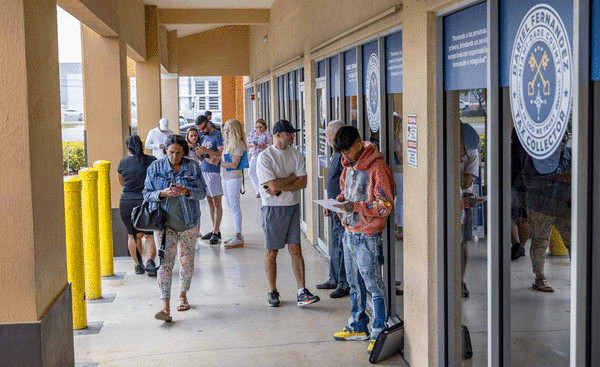
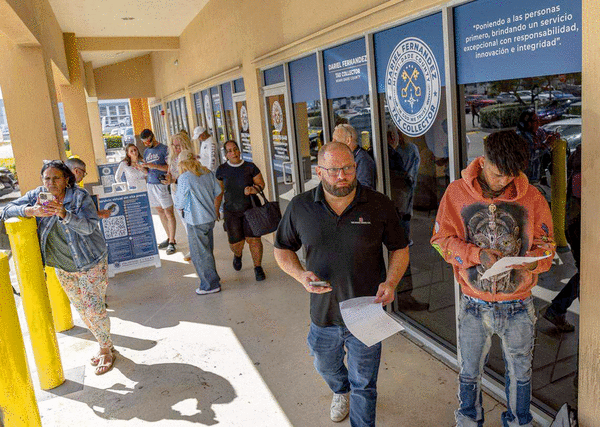
On Feb. 10, a steady flow of people aimed to renew their drivers licenses at the state Department of Motor Vehicles’ office in Hialeah Gardens. Many Spanish-speaking applicants required translation assistance to communicate with tax collector staff, determine which protocols applied to them, what documents they needed to prove their legal status, how to schedule an appointment.
“If I were taking the test now, I couldn’t do it,” a Cuban man told the Herald as he scrolled through his phone searching for a last-minute appointment to renew his driver’s license. Another driver said he had taken the test twice before and passed it in Spanish. He would have had no chance if it had been in English, he said.
The law changed then. What about now?
From 1983: Even as critics of the Dade County anti-bilingualism ordinance are warming up to criticize it — some as too weak and others contending it is too overpowering — a coalition of Latins and non-Latins is getting ready to try to repeal the law.
That repeal effort failed, the same year local Miami leaders refused to grant key permits to “Scarface” filmmakers over fears that Brian DePalma’s bloody, set-in-Miami crime drama remake would fuel anti-Cuban sentiment.
A decade later, in 1993, the County Commission voted unanimously to overturn Miami-Dade’s 13-year-old English-only law, capping years of acrimony and confirming the dawn of a new political era, the Miami Herald reported at the time.
Four Black commissioners, three white non-Hispanics and six Hispanics found common ground, voting 13-0 for repeal after a boisterous public debate that sometimes dissolved into shouts, jeers and catcalls.
“Dade County has finally shed its last symbol of adolescence,” Commissioner Alex Penelas said. “We have matured as a community.”
In 2026, “It’s impossible to predict when or if a repeal of any law will occur,” Burnetti said, reflecting on the 1993 repeal of the county English-only law.
“Unless there is a drastic change in the political climate, who knows when the law could be repealed, if ever. Especially if further similar English-only laws are passed by both the state and federal government,” he said.
No U.S. official language
What about the push to make English the official language of the United States?
ProEnglish, a Washington‑based advocacy group, which calls itself, “the nation’s leading advocate of making English the official language of government at all levels,” is urging supporters to pressure members of Congress to sponsor bills pushing for English as an official U.S. language.
The group recently praised Florida’s English-only decision and said, “Momentum is building in Congress to finally make English the official language of the United States.”
President Donald Trump issued an executive order in March 2025 designating English as the official language of the United States, a significant but largely symbolic gesture.
Congress, so far, hasn’t passed such a law.
--------
—Alexandra Glorioso of the Herald/Times Tallahassee Bureau and El Nuevo Herald staff writer Verónica Egui Brito contributed to this report.
©2026 Miami Herald. Visit at miamiherald.com. Distributed by Tribune Content Agency, LLC.





Comments