California mother with legal permission to live in US deported in under 24 hours
Published in News & Features



SACRAMENTO, Calif. — Maria de Jesus Estrada Juarez confidently walked to her green card appointment in downtown Sacramento on Wednesday morning.
She had seen the reports of other immigrants arrested at similar check-ins. Estrada Juarez believed her case would be different.
In her hands, she carried a white binder chronicling 27 years in California — her high school diploma, years of tax filings, vaccine records and paperwork showing she had repeatedly obtained federal permission to remain in the country.
But the appointment meant to secure her American future instead ended it. Federal agents arrested her less than one hour after she arrived in the U.S. Citizenship and Immigration Services Sacramento field office. By the next morning, she was in Mexico.
“Basically, my life was ended,” Estrada Juarez, 42, told The Sacramento Bee. “I have to reinvent myself in a country that, even though it’s mine, I don’t know.”
The deportation underscores how aggressively President Donald Trump’s administration has moved to crackdown on immigrants, including those without criminal records and following the established legal pathway to live in the country. Still, several immigration lawyers and experts said Estrada Juarez’s swift removal is particularly unusual and likely has the grounds for a legal challenge.
“It sounds like this poor woman was basically railroaded out of the country in the dead of night with barely a whimper,” said Kevin Johnson, the former dean of UC Davis’ School of Law and a legal leader in immigration law.
Estrada Juarez is a recipient of Deferred Action for Childhood Arrivals, a program that began under President Barack Obama’s administration that has shielded people from deportation if they arrived in the U.S. as children and have not been convicted of a crime. In 2014, the federal government also granted her permission to leave and re-enter the country to visit a sick family member in Mexico.
Last year, after her daughter turned 21 — the minimum age at which a U.S. citizen can sponsor a parent — Estrada Juarez applied for lawful permanent residency, or a green card. She has no criminal history and is a regional manager for Motel 6.
“We tried to do things the right way,” said her daughter Damaris Bello, who also attended Wednesday’s appointment.
During the appointment, Estrada Juarez and her daughter said immigration agents cited a prior expedited removal order issued in 1998 when she entered the country alone at 15. Estrada Juarez said she was unaware of the order and would have not applied for permanent residency or attended the appointment if she had known about it.
Department of Homeland Security spokesperson Tricia McLaughlin, in a written statement on Sunday, said “DACA does not confer any form of legal status in this country” and encouraged those with the status to self-deport. She added that Estrada Juarez received “full due process,” was previously issued “a final order of removal from a judge” in 1998 and “illegally re-entered” the U.S.
Estrada Juarez denied ever standing in front of a judge or receiving an order of removal.
DHS did not respond to follow-up questions attempting to clarify the discrepancy, including a request for documentation of the removal order. A search of Estrada’s Juarez’s record in a federal immigration database did not garner any results. The Sacramento Bee reviewed her available immigration documents, including DACA renewals, her legal residency application and a previous approval to reenter the country.
DACA recipients, at least publicly, have largely avoided the brunt of the Trump administration’s anti-immigration agenda. The president, who tried to end the program in his first term, has more recently said he would seek ways to spare these immigrants from deportation.
Last year, the Home is Here campaign — a coalition to protect DACA recipients — documented 65 cases of detentions by immigration agents nationwide. Deportations of people with the status, particularly without due process, are less common. One DACA recipient deported last year returned to the country weeks later.
Per USCIS’s own definition, DACA is an exercise of prosecutorial discretion “to not pursue the removal of an individual.” The agency is also required to follow a process for terminating DACA that includes a “notice of intent to terminate” and “an opportunity to respond,” according to federal regulations. DHS did not respond to a question asking why this process was not followed.
“This is mandatory by a clear and unambiguous reading of the regulations,” said Sacramento immigration attorney Brian Lopez.
‘Person with determination’
Estrada Juarez was born in Atlixco, a city in the Mexican state of Puebla. She spent much of childhood helping her mother work a fruit stand and her grandparents in the fields.
At 15, she decided to leave her hometown and travel to Southern California, where some of her family had immigrated.
“I’ve always been a person with determination,” Estrada Juarez said.
She arranged her travel with a coyote, people who escort immigrants across the border and often control every part of the journey, including when people eat, sleep and what they do and say.
Estrada Juarez said she arrived at the border in December 1998. What happened next could have led to her deportation 27 years later, Lopez said.
On her first time trying to cross the border, she was stopped by a federal agent and detained for roughly a few hours. Estrada Juarez recalled the agent asking a few questions and then letting her go. She remembers no mention of an expedited removal, an order issued by immigration officers that allows for a fast-track deportation without a court hearing.
Soon after, she reconnected with the coyote. They crossed the border successfully a few days later.
Lopez said expedited removals are a permanent mark on an individual’s immigration record, except in rare circumstances.
The order, which carries a five-year bar on reentry, is often up to the discretion of the federal immigration agent at the border. In other instances, Lopez said agents will issue a voluntary removal order which returns the person to Mexico but comes with no legal punishment.
Lopez said it’s common that people are unaware that they have been given expedited removal orders. These conversations are sometimes not explained well or completed in a language that the immigrants are not fluent in, Lopez added.
“It could be that it was done, and she just didn’t understand what was going on, especially given her age, or it wasn’t explained to her,” Lopez said.
Estrada Juarez initially planned to return to Mexico. Then, she began working.
She secured jobs at a Los Angeles swap meet, a pizzeria and a 7-Eleven. Most years, she worked multiple jobs at the same time.
Estrada Juarez said she soon realized that the U.S. offered “opportunities for every type of person” as long as they took advantage of them. She decided that the country offered her the best chance to succeed in life.
“In Mexico, you will be born poor and always be poor,” she said. “In the United States, you can have a decent life.”
At 20, Estrada Juarez gave birth to her only daughter. In 2005, the two moved to Sacramento where again she picked up several jobs — from a gas station cashier to auto insurance seller. She now helps manage multiple motels in California and Oregon.
‘Immigration history is clearly available’
Estrada Juarez was granted DACA in 2014, two years after the program launched. It intended to protect undocumented children, often referred to as Dreamers, who arrived in the country before turning 16 and prior to 2007. Recipients must renew the status every two years. Participation in the program comes with a range of benefits including authorization to remain in the country, work permits and health insurance from employers who offer it.
Trump has provided mixed messaging on the program over the years.
He moved to revoke the program just months after taking office in 2016 — a decision that faced immediate pushback with several states, including California, suing over the directive. As of 2023, roughly 160,000 DACA recipients lived in California, according to data from the Migration Policy Institute.
The case made its way to the Supreme Court. In 2019, the court sided with DACA recipients and found that the Trump administration failed to provide a reasoned explanation for ending the program.
More recently, Trump has been publicly supportive of the program. A poll in 2020 showed nearly 75% of Americans support providing a legal status to undocumented immigrants who arrived to the country as children.
“In many cases, they become successful,” Trump said in December 2024 on NBC’s "Meet the Press." “They have great jobs. In some cases, they have small businesses, in some cases they might have large businesses. And we’re going to have to do something with them.”
When asked if he wanted DACA recipients to stay, Trump said “I do.”
“I want to be able to work something out,” he added.
Despite Trump’s comments, César Cuauthémoc García Hernández, an immigration law professor at Ohio State University, said the administration remains hostile to DACA and other immigrants seeking legal pathways. He noted that this administration has ended several protections previously given to migrants and arrested people attending routine immigration check-ins across the country.
Immigration arrests and deportations have surged under Trump’s second term, with ICE on track to deport nearly 13,000 people from California by the end of 2025. Detentions have also spiked nationally. About 74% of those have no criminal conviction, according to Syracuse University’s Transactional Records Access Clearinghouse.
“DACA is yet another example in which the Trump administration is quite clear that they’re not only concerned about people who are violating immigration law,” he said. “They’re concerned about migrants, generally.”
For her part, Estrada Juarez has renewed her DACA five times. She used the status in 2014 to request advance parole, a USCIS-issued travel document that allows foreigners to leave and reenter the country. Estrada Juarez visited her mother, who was recovering from surgery for three weeks, before returning through a border checkpoint where she said no official mentioned her expedited removal order.
“We’re talking about an expedited removal that occurred in the computer age, so that immigration history is clearly available to DHS ... The reason for that as a legal matter is that people rely on promises that the government makes,” García Hernández said.
Last April, Estrada Juarez applied for her legal residency in part for the desire to travel more with daughter. The two had hoped to plan a trip to Vatican City in Italy following the issuance of her green card. They received notice of the appointment last month.
‘Never had a chance’
Estrada Juarez woke up Wednesday feeling optimistic.
The nerves from the days prior had calmed after a conversation with Bello, who assured her mother that she was a taxpaying resident without a criminal record who had already left the country once.
With that in mind, Estrada Juarez prepared for what she called an “achievement.”
“Today calls for a good-looking woman,” Estrada Juarez recalled thinking. She put on makeup for the first time in years and had her daughter pick out a formal outfit. Together, they arrived at the appointment at 10:30 a.m.
The first few minutes of the interview went well, they recalled. At one point, an immigration official brought up an expedited removal order on her record. Estrada Juarez responded by saying she was unaware of the order.
At the end of the interview, the official handed her a form that stated “USCIS is unable to complete your case at this time. Your case is being continued until a final decision is made.” The official then explained that the order would likely bar her from ever securing residency, but he would like to “double check” with his supervisor, Estrada and Bello said.
He left and, within minutes, three immigration agents arrived. They called her name and said she would be deported because of her expedited removal order.
The mother and daughter, both in tears, exchanged a quick hug before Estrada Juarez was taken away.
“It felt like truly she never had a chance, like she walked into this and deported herself,” said Bello, who is attending Sierra College.
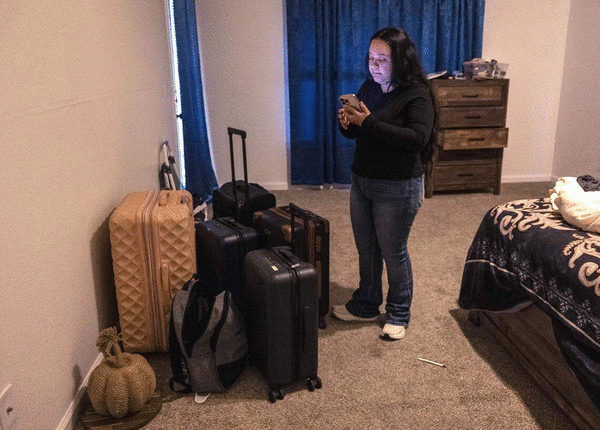
Bello, who said the experience left her feeling like she “couldn’t breathe,” headed outside the Capitol Mall building. Once there, a federal agent came to inform her that Estrada Juarez had requested Bello head to their house and return with clothing and her medication for diabetes.
Her van to Mexico would leave later that afternoon.
Johnson compared Estrada’s Juarez swift removal to that of Kilmar Armando Ábrego García, a Salvadoran man illegally deported last March in what was later called an administrative error. He came back to the country months later after the Supreme Court ruled that the federal government must facilitate his return.
DACA recipients wrongfully deported have returned as well. In March, a DACA recipient in Missouri was allowed to return two weeks after he was deported.
“This administration seems to push the legal envelope whenever they get a chance,” Johnson said.
Estrada Juarez texted her daughter at 8:14 a.m. Thursday.
“Hello, sweetheart,” she wrote in Spanish. “I’ve arrived in Mexico. Don’t call me. I’ll call you. I can’t use my phone where I’m at right now. How are you?”
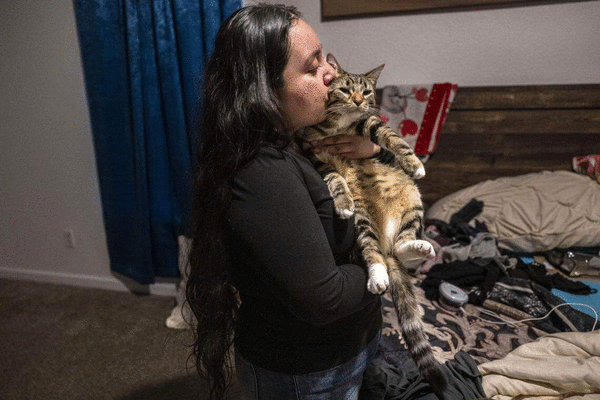
Back at their Natomas home, Bello was still reeling from the day before. She woke up to traces of her mother everywhere.
The makeup Estrada Juarez had carefully applied for what she thought would be her crowning American achievement still sat on the bathroom counter. Her Wednesday morning pot of coffee remained on the stove.
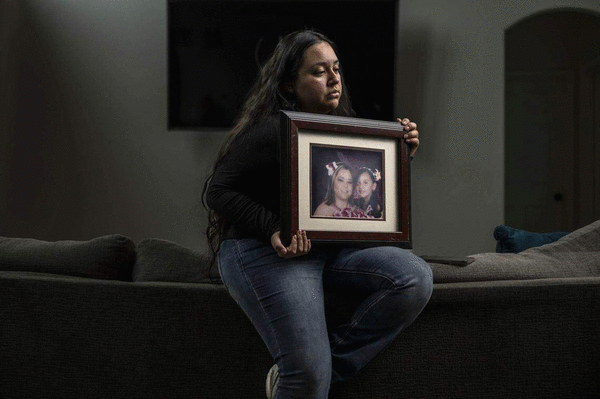
In the living room, the walls were plastered with photos of the mother and daughter. One is from Bello’s quinceañera and another was gifted by Estrada Juarez’s on her 16th birthday. The frame reads “My dear Damaris, I love you to the moon and back.”
_____
©2026 The Sacramento Bee. Visit sacbee.com. Distributed by Tribune Content Agency, LLC.






Comments