Minnesota farmers resist 'new normal' of bird flu that's killed 10M birds
Published in News & Features
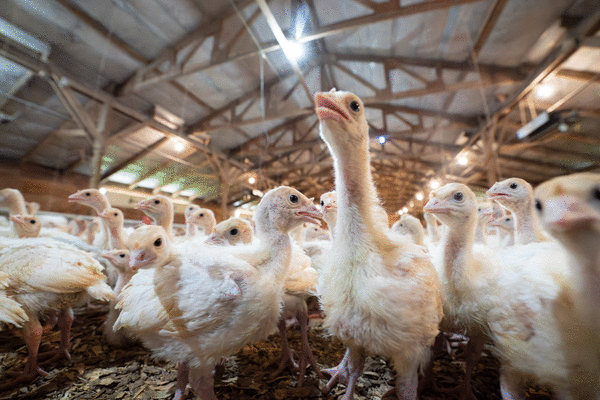
Avian influenza has now killed more than 10 million birds in Minnesota since 2022, as farmers and state officials continue to deal with a disease that just won’t stop.
The virus, highly pathogenic avian influenza, is no longer inflating egg prices at the grocery store like a year ago. But the virus is still hammering turkey flocks, challenging Minnesota, the leading turkey producer in the U.S. Confusion about federal funding as the White House attempts to crack down on fraud in Minnesota has also complicated management of the costly disease, state officials said.
Dr. Shauna Voss, who oversees poultry programs for the Minnesota Board of Animal Health, said the now eight-digit figure of dead birds speaks to “the longevity of this outbreak” that first ballooned in 2022.
“That number is going to continue to go up because there’s really no end in sight,” Voss said.
The virus does not pose a broad risk to the public, but it is fatal for turkeys and chickens. Birds can die from the illness but farmers also must cull infected flocks to prevent further spread.
Poultry farmers also endeavor to stop wild birds, which carry the virus, from interacting with their flocks. Some have to patch up holes in their barns. Others beam automated green lasers into the sky from towers above their facilities to scare away wild animals. But these efforts haven’t fully curtailed the disease.
The annual rate of bird deaths has fallen since 2022 in Minnesota, but more than 1.1 million birds still died because of the virus in 2025. Several outbreaks on central Minnesota turkey farms in January resulted in nearly 400,000 deaths and pushed the total toll past the grim milestone.
Minnesota produced 32 million birds in 2024, the U.S. Department of Agriculture reported.
Ashley Kohls, executive director of the Minnesota Turkey Growers Association, said the virus feels “a little bit like the new normal” for the industry, although farmers do not “necessarily want it to be normal.”
The virus has a “robust” financial toll, Kohls said. Indemnity payments, which the USDA provides to farmers whose flocks die to make up for lost revenue, “only covers that moment in time,” she said. These funds don’t cover other expenses farmers face when their flocks die, such as electric bills or labor costs, she added.
Thom Petersen, Minnesota’s agriculture commissioner, said bird deaths can have downstream effects on Minnesota’s economy. The 10 million birds that died, he said, could have eaten through corn and soybeans grown in the state. A trade war with China has stoked fears that Minnesota soybeans will go unsold.
“The more we can have a healthy flock, the more we can continue to drive Minnesota’s economy through our crop system,” Petersen said.
Outbreaks among hens in spring 2025 left grocery store shelves empty of unusually expensive eggs. The price of eggs has since fallen back to 2023 levels.
Caitlinn Hubbell, a market research analyst at Purdue University’s Center for Food Demand Analysis and Sustainability, said hen flocks have rebuilt to a point where an “opposite problem” is occurring. There is an oversupply in the market, yet consumers aren’t willing to buy extra eggs.
“If eggs are on sale, I’m probably not going to buy more,” the analyst said.
Turkey prices haven’t fluctuated as there’s no surplus nor shortage, and retailers are willing to sometimes take a loss on birds bought around the holidays to keep shoppers from switching to competitors, Hubbell said.
Vaccines in birds could help prevent outbreaks, industry representatives such as Kohls have said. But officials worry other countries might not buy these birds, as they could fear importing vaccinated birds not showing infection signs could spread the virus across borders.
“All those conversations are happening in a way that they haven’t before,” Kohls said. “It’s always just been a non-starter, and so we’re thankful that folks are actually willing to have those conversations now on the federal level.”
In early January, U.S. Agriculture Secretary Brooke Rollins announced a freeze in nearly $130 million in federal agriculture support to the state, which temporarily cut off funding for a poultry lab in Willmar that helps to parry the outbreak through diagnosing cases.
“We’ve worked through it all ..., but it’s an added challenge that, frankly, shouldn’t need to be there when we’ve been in this this long,” Voss said.
A USDA spokesman said the notion the threat of funding freezes is complicating the disease’s mitigation “is simply false. Animal disease programs have and continue to run uninterrupted in Minnesota at this time.”
Voss said she hopes farmers aren’t feeling the effects of the funding confusion. Petersen, the commissioner, worries about the “emotional toll” they’ve felt overall addressing bird flu.
Kohls said some farmers have chosen to leave the turkey industry after outbreaks.
“Our members are resilient, but resiliency has limits,” Kohls said.
_____
©2026 The Minnesota Star Tribune. Visit startribune.com. Distributed by Tribune Content Agency, LLC






Comments