A maze of revisions and reviews stalled Alligator Alcatraz reimbursement request
Published in News & Features
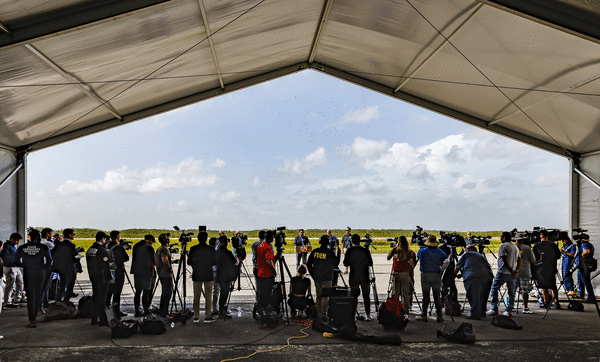
MIAMI — As Florida continues to press the Trump administration in federal court to cover $608 million in spending on its controversial “Alligator Alcatraz” immigration detention center, newly released records show Washington voiced concerns about the state’s budget proposals for reimbursement of the Everglades facility months ago.
The cache of roughly 3,000 pages of documents and emails, spanning late June through mid-December, reveals that federal officials paused reimbursement for the remote detention center in the final weeks of 2025, citing administrative flaws in Florida’s grant applications and an incomplete environmental review.
The records also show the DeSantis administration’s estimated cost for transforming 6,000 acres of the Dade-Collier Training and Transition Airport into a temporary tent detention facility stood in stark contrast to federal estimates. While the Federal Emergency Management Agency projected an annual cost of $450 million, the newly released documents show the state’s operations were much more expensive, steepening the price to a projected $1.4 billion.
The bulk of the billion-dollar tab went towards contractual services, including holding facilities, as well as clothing and bedding for roughly 4,000 detainees.
The correspondence offers the clearest explanation yet for Washington’s refusal to pay, injecting fresh uncertainty into questions about whether any of the $608 million Florida is seeking will ever materialize — and what part of the bill Florida taxpayers will have to foot.
Within the first months of the Everglades facility operating, the DeSantis administration had already burned through $390 million, according to the records. The expenses were tied to payments to private vendors that the administration had awarded lucrative contracts without any bidding process. This included contractors who had previously donated to the state’s Republican Party.
Whether those funds will land in Florida’s coffers has become one of the most contentious issues this legislative session. State lawmakers are debating the renewal of a controversial emergency fund — one designed to provide natural disaster relief that has since become one of the most flexible tools in Gov. Ron DeSantis’ campaign against illegal immigration.
An immigration state of emergency renewed by DeSantis 20 times since 2023 has allowed his administration to sink at least $573 million on immigration enforcement efforts. Florida Attorney General James Uthmeier and the state’s private lawyers conceded in a recent court filing that “the State took the risk (and still does) that federal funding will not materialize.”
Still, the DeSantis administration continues to insist that federal reimbursement is coming. Uthmeier on Friday said he had “no reason to believe” that Washington will fail to cover the costs.”
In June, when the Alligator Alcatraz facility was hastily erected, Friends of the Everglades and other environmental groups said the site would harm the ecosystem of the Everglades wetlands and argued in a lawsuit that the construction of the site bypassed key federal regulations that required an environmental impact assessment.
The environmental groups had argued that the exchange of cash between the state and federal government made the site a federal project and should have triggered federal environmental review. The groups also accused the state of not being transparent about its reimbursement discussions with its federal partners.
The new documents, released after a circuit judge’s order in the case, show a coordinated effort by state and federal agencies to avoid triggering a need for an environmental review.
“The records confirm what Friends of the Everglades has maintained from the outset: This is a federal immigration detention facility, conceived and constructed on the promise of federal funding. Attempting to delay federal reimbursement to sidestep compliance with federal environmental law is gamesmanship — and will not work,” said Paul Schwiep, attorney for Friends of the Everglades.
Behind the scenes, Florida Division of Emergency Management officials had spent nearly half of last year navigating a byzantine process in an attempt to secure reimbursement for its immigration operations, according to the emails. The Trump administration regularly revised its grant program guidance, effectively saddling Florida administrators with updating sprawling line-item budgets and inmate statistics.
The Florida Division of Emergency Management did not respond to questions on Tuesday about the emails and status of Florida’s reimbursement request.
Despite the setbacks, talks with state and federal officials appeared cordial. In several instances, federal officials offered assurances that they wanted to “make sure we’re not making this more complicated than it needs to be,” and, at one point, that “the finish line is in sight!”
Late in the process, on Nov. 5, an executive FEMA deputy director said his agency remained “committed to working with FDEM to expedite the release of the award and to provide any necessary support to ensure the successful completion of this grant.”
That didn’t happen.
‘Those costs will not be reimbursed’
Florida’s money problems began almost as soon as the DeSantis administration hurriedly constructed the pop-up Alligator Alcatraz facility this past summer.
The state’s top emergency management official, Kevin Guthrie, had projected the state would spend more than $1.2 billion to operate multiple immigrant detention centers, according to a draft grant application dated June 24, one week before the Everglades facility opened.
Guthrie, the director of Florida’s Division of Emergency Management, estimated the federal government would reimburse $1 billion of that amount, leaving taxpayers responsible for roughly $200 million.
By August, however, the numbers had shifted dramatically.
In its formal grant application to FEMA, Florida increased its total cost projection to $1.4 billion while lowering its reimbursement request to $608 million — seeking the full amount of the Department of Homeland Security’s state detention grant program.
FEMA rejected that application, citing the sweeping scope of Florida’s request and the absence of a completed environmental site review.
A month later, in September, Florida revised its projections again — to $1.7 billion while keeping the $608 million reimbursement request intact. The increase was largely attributed to another newly established detention facility known as “Deportation Depot.”
FEMA signed off on the $608 million grant award later that month — with caveats: Florida would have to provide detailed cost justifications and wait for the completion of a federal environmental review of Alligator Alcatraz before receiving funds.
By late October, Florida again revised its budget for the Everglades facility — this time projecting $1 billion in operating costs through July 2026.
Around the same time, the state submitted its own environmental assessment of the site. The report, prepared by a Texas-based environmental consulting firm, concluded the detention center would not cause significant long-term ecological harm.
But FEMA’s own environmental review remained pending — and continued to dog Florida emergency officials.
In early December, FEMA delivered some good news: It could release roughly $89 million tied to portions of the project not subject to environmental restrictions. Emails show Florida officials sought to bypass the broader environmental review to unlock additional funds, but federal officials declined. FEMA similarly rejected a $30 million reimbursement request, citing the incomplete federal review.
The most consequential development came that next week.
According to updated grant guidance shared with Florida officials, FEMA stated it would not reimburse any costs associated with modifications to the “South Florida Soft Sided Facility, commonly referred to as ‘Alligator Alcatraz.’”
“In the event that the recipient applies for the grant to request reimbursement for costs for modifications” at the facility, the agency wrote, “those costs will not be reimbursed.”
What the pause means for Florida’s $608 million claim
The emails suggest that while communications between state and federal officials remained outwardly friendly, Washington in court filings began hinting it will not fund the full cost for the Everglades site. The denial by the federal government to pay for the construction cost places Florida in a precarious financial position with its taxpayers.
DeSantis has aligned closely with President Trump’s immigration agenda, aggressively expanding the state’s detention infrastructure last year in anticipation of federal support. Both the state and federal government had touted the first-of-its-kind detention center as a model example of states aiding the Trump administration mass deportation mandate.
But the newly disclosed correspondence and confusion around funding showcases a limit on what the federal government is willing to pay for in its partnership with the states.
And the possibility that Florida taxpayers might be left to pay the full bill.
_____
©2026 Miami Herald. Visit miamiherald.com. Distributed by Tribune Content Agency, LLC.






Comments