California, Arizona and Nevada press Trump administration to rethink Colorado River water cuts
Published in News & Features
Leaders of California, Arizona and Nevada are criticizing the Trump administration’s proposals for water cutbacks along the Colorado River, urging it to take a different approach and avoid a court battle.
The three downstream states said in letters to the Interior Department this week that the agency’s preliminary outline of five options for cuts ignores the foundational “Law of the River” that has underpinned how seven western states operate for more than a century.
Federal officials have so far failed to examine whether their options comply with the 1922 Colorado River Compact, and this is “a fundamental deficiency that must be corrected,” JB Hamby, California’s lead negotiator, wrote in a letter to the Trump administration.
That agreement split the water among four upstream states — Colorado, Wyoming, Utah and New Mexico — and those downstream — Nevada, Arizona and California.
It required the water released from Upper Basin dams for Nevada, Arizona and California to average at least 7.5 million acre-feet over any decade, plus an allotment for Mexico — a legal “ tripwire” that some state officials argue could soon be breached, clearing the way for a lawsuit claiming violation of the compact.
The Colorado River provides water for farms, cities and tribal communities from the Rocky Mountains to northern Mexico. The 1922 agreement promised more water than the river could provide, and now climate change is contributing to dry conditions and shrinking the river flow.
Monday was the deadline for water agencies and individuals to submit comments to the Trump administration on its options for dealing with severe water shortages. The current rules expire in late 2026.
Indigenous leaders, academic researchers and environmental advocates all sent in comments.
Officials from California, Arizona and Nevada said the Trump administration’s current five options would put the burden of cuts solely on them while sparing the Upper Basin states, and even allowing them to use more water.
If the Upper Basin states fail to deliver the required water, the Lower Basin states could make a “compact call” by suing, top Arizona water official Tom Buschatzke said in his letter to the Trump administration. If that happens, he said, a court will enforce the agreement’s terms.
“There is no legal outcome where reductions … are imposed almost entirely on the Lower Basin,” Buschatzke said. Each of the five proposed federal options, he said, wrongly “requires the Lower Basin states to accept disproportionate and inequitable reductions.”
The letters give a hint of what states would argue in court if the Trump administration imposes cuts they disagree with. The legal battle could take years and be decided by the U.S. Supreme Court.
Leaders of the Upper Basin states also are raising objections, saying the Interior Department’s current options rely on flawed assumptions, fail to impose large enough cuts on the Lower Basin and go beyond the federal government’s authority. They argue officials should be counting not only the water states take from the river but also the water that evaporates from reservoirs and along the river.
Colorado water officials Rebecca Mitchell and Lauren Ris wrote that all the federal options would “prioritize” water use in the Lower Basin “at the expense” of the Upper Basin. This would violate the “equitable division of the river” under the 1922 compact, they said.
Ris called for a federal framework “that recognizes the hydrologic reality of a shrinking river.”
The U.S. Bureau of Reclamation’s initial options would cut water for Arizona between 33% and 69%, and Nevada between 24% and 67%. Under some options, California could see reductions of between 29% and 33%.
Such cuts would likely prompt Arizona cities to drill more wells and pump more groundwater, which is declining in many areas. California farmers, who already have been leaving some fields dry part of the year in exchange for federal funds, are under pressure to conserve more.
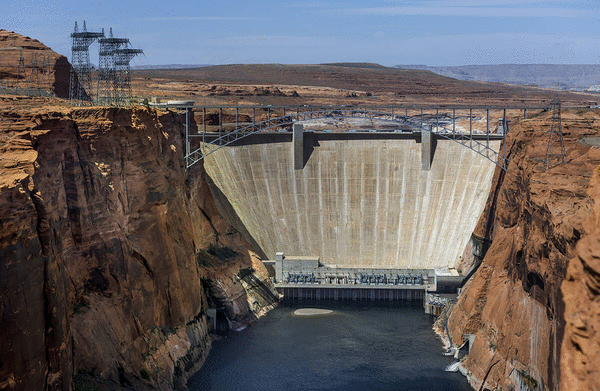
One key complaint by California, Arizona and Nevada centers on Glen Canyon Dam, the reservoir that forms Lake Powell on the Utah-Arizona border. The three states have urged the federal government to fix or overhaul the dam to address design flaws that create problems when the reservoir is low.
If Lake Powell’s level declines to a point that water can only pass through four 8-foot-wide bypass tubes, that would limit how much can reach California, Arizona and Nevada.
Nevada water officials John Entsminger and Eric Witkoski wrote that trying to prop up water levels at Glen Canyon Dam rather than repairing it is “shortsighted” and would harm the three states by “slashing the water available to our farmers, communities, and economies.”
They called for “some combination of straight-forward engineering fixes, moving water to Lake Powell from upstream reservoirs,” and imposing cuts in the Upper Basin states.
Another concern raised by California officials is how cutbacks would affect the Salton Sea. Water running off farmlands flows into the saline lake, and less water would shrink the lake faster, affecting wildlife and nearby communities where windblown dust brings high asthma rates and other health problems.
California’s Imperial Irrigation District, which uses the single largest share of Colorado River water, said the federal government needs to examine how water cuts would affect the Salton Sea. IID General Manager Jamie Asbury said not considering the effects on the Salton Sea is a “fundamental flaw.”
Representatives of the seven states have been unable to agree on a plan for water cuts, but negotiations are continuing.
©2026 Los Angeles Times. Visit at latimes.com. Distributed by Tribune Content Agency, LLC.





Comments