Chicago appeals court vacates judge's use-of-force injunction on immigration agents
Published in News & Features
A Chicago federal appeals court on Thursday vacated a lower court’s injunction placing use-of-force restrictions on immigration agents during Operation Midway Blitz, calling it “constitutionally suspect” and questioning the manner in which the district judge dismissed the underlying suit.
The three-judge panel of the 7th Circuit U.S. Court of Appeals was split 2-1, with Chief Judge Michael Brennan and Judge Michael Scudder in the majority and Judge Frank Easterbrook dissenting.
The ending of the Trump administration’s appeal was a foregone conclusion after U.S. District Judge Sara Ellis in January granted a motion by the plaintiffs to dismiss the underlying lawsuit.
But the 7th Circuit went beyond a mere dismissal of the appeal and ordered what’s known as “vacatur,” which essentially treats Ellis’ preliminary injunction ruling as though it never existed. In the 15-page majority opinion, the judges wrote that Ellis, “working on a highly compressed timeline … granted an overbroad, constitutionally suspect injunction.”
The majority was particularly critical of Ellis for dismissing the lawsuit “without prejudice” even though the parties didn’t ask for it, leaving the door open for plaintiffs to refile the case at some point down the road.
“Because the district court dismissed this case without prejudice — against the plaintiffs’ unopposed request for a dismissal with prejudice — any class members or the lead plaintiffs could refile these claims tomorrow,” the majority opinion stated. “They could ask the district court to reinstate a near-identical preliminary injunction, adopting the facts and legal reasoning from the district court’s order.”
The majority opinion said they “can help avoid that pitfall by vacating the order that depends on these conclusions.”
In his three-page dissent, Easterbrook said he shared in some of the concerns of his colleagues about how the case played out, but that “dissatisfaction with the district court’s handling of a suit should not matter unless at least one of the parties is dissatisfied.”
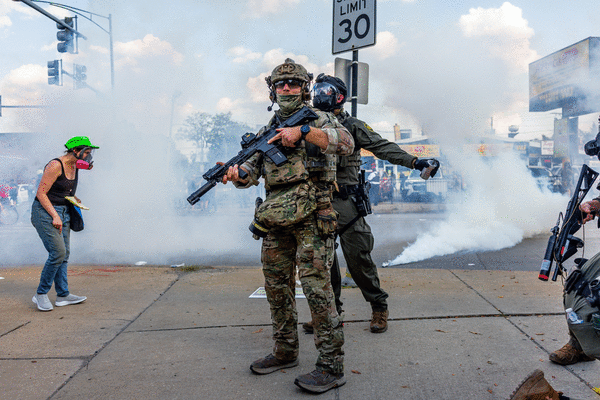
The ruling officials ends a case brought by the Chicago Headline Club and other media groups, leading to a sweeping preliminary injunction by Ellis in November limiting the use of tear gas and other chemical munitions against members of the media and protesters, and also requiring agents to wear body cameras and clear identification.
The case came to symbolize the havoc Midway Blitz caused in Chicago and shed light on how the operation was carried out, through sworn depositions by Border Patrol Cmdr. Gregory Bovino and other leaders as well as the release of body-camera footage showing agents deploying tear gas, pointing guns from passing cars and tackling civilians on the street.
The plaintiffs moved to drop the suit in December following ominous signs from the 7th Circuit, which called Ellis’ order overbroad and a potential infringement on the separation of powers.
In the request, the plaintiffs claimed victory, saying Bovino and his surge of agents left town soon after Ellis’ injunction was entered on Nov. 8 and that there had been no reports of any unconstitutional behavior by agents in the weeks that followed.
Much has changed since then. Bovino was reassigned in January after agents under his command shot and killed two U.S. citizens during an immigration enforcement surge in Minneapolis.
On Thursday, hours before the 7th Circuit’s ruling came down, the lead defendant, Kristi Noem, was removed as the Department of Homeland Security secretary by President Donald Trump.
____
©2026 Chicago Tribune. Visit at chicagotribune.com. Distributed by Tribune Content Agency, LLC.





Comments