Funeral for Rev. Jesse Jackson draws former presidents, throngs of Chicagoans to send off civil rights icon
Published in News & Features
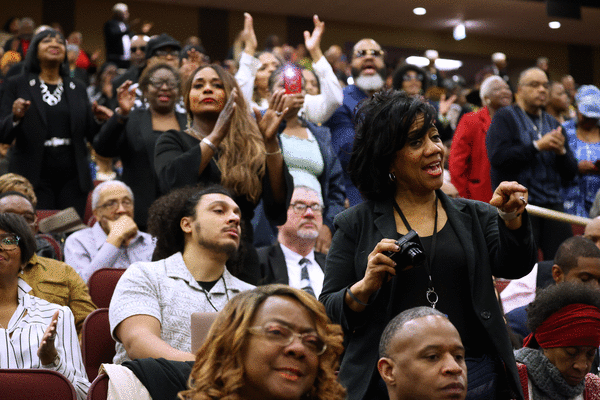
CHICAGO — A crescendo of voices from the worlds of religion, politics, business, sports and entertainment converged Friday at the South Side’s House of Hope, providing a requiem to the vast reach of the leadership, inspiration and teachings that made the Rev. Jesse L. Jackson a national civil rights icon.
More than 1,000 people attended the public celebration of life ceremony for Jackson, including former presidents Bill Clinton, Barack Obama and Joseph Biden, who were accompanied by former first ladies Jill Biden and Hillary Rodham Clinton, as well as Gov. JB Pritzker, Chicago Mayor Brandon Johnson, NBA Hall of Famer Isiah Thomas and Chicago Cubs owner Tom Ricketts.
Award-winning singer and actress Jennifer Hudson was set to perform “A Change Is Gonna Come” and gospel singers Benjamin “Bebe” Winans and his older brother, Marvin Winans, contributed to the hours-long music-filled event.
Jackson, a Baptist minister whose charismatic rhetoric made him a key leader in the nation’s civil rights movement for more than six decades — picking up the baton of civil justice and equality left by the assassination of Dr. Martin Luther King Jr. — as well as a two-time contender for the Democratic nomination for president, died Feb. 17 at age 84.
A private homegoing service, set to include a special musical tribute by Stevie Wonder, will conclude the memorials for Jackson on Saturday.
Religion and politics often mixed throughout the ceremony with speakers frequently citing Jackson’s mantras of “I am somebody” and “Keep hope alive” as a counterbalance to the turbulent, divided political times under President Donald Trump.
The Rev. Dr. Otis Moss III of the South Side’s Trinity United Church of Christ called Jackson a “Son of the South, practitioner of good trouble and acolyte of holy mischief” who was a “spiritual artist who painted upon the canvas of democracy with a rainbow coalition of colors that had been marginalized by antebellum myths that dismissed human dignity.”
“May we honor him by daring to keep hope alive? May we honor him by daring to speak truth to power? May we honor him by daring to call out corruption, moral malfeasance, political narcissism, autocratic action, authoritarian behavior and cult-like oligarch spirits masquerading as civic duty?” Moss said. “We offer these prayers of farewell this day and all those who gather in this space, who seek to keep hope alive and know you are somebody may say, ‘Amen.’”
The Rev. Michael Pfleger, pastor of St. Sabina Catholic Church in the Auburn Gresham neighborhood, referenced the Trump movement, saying “While some proclaim ‘Make America Great Again,’” Jackson “fought to make America achieve the greatness that she promised but always fell short of.”
“Jackson not only called us to keep hope alive, but showed us what hope looked like every day,” Pfleger said.
Johnson delivered a rousing sermon-like tribute that recounted a visit he made with Jackson to the Edmund Pettus Bridge in Selma, the site of violent police action against peaceful protesters in 1965 seeking voting rights. He said Jackson understood the bridge was a metaphor for “what’s waiting for us on the other side.”
“We are in the midst of a choice to choose hope over despair, light over darkness, love over hate, because he knew there was too much to gain on the other side of the bridge,” Johnson said.
“On the other side of the bridge, affordable housing as a human right. On the other side of the bridge, health care for all. On the other side of the bridge, safe and affordable cities, accessible transportation, finally, fully funding our public education system,” he said as the crowd jumped to its feet. “It is time to cross the bridge, to build an economy that works for all, Black, brown, white, Asian, young, old. It is time for the ultra rich to pay their fair share in taxes. … Reverend, you cross your bridge. We know our assignment. We’ll see you on the other side.”
Pritzker said that for Jackson, “each day, each day, was a new opportunity to bring justice in a too often unjust world.”
“Now to the world. Jesse Jackson was an ambassador of hope for the oppressed, who met with kings and queens and presidents and dictators and clergy of all the great religions, but here in Chicago, he was our neighbor. He was our friend,” the state’s two-term Democratic governor said.
“He was politically connected. He knew he shared an affliction common to all those in this room. He loved the political game all the way to the end, and while we know that we shared him with the whole world, Rev. Jackson belonged to Chicago, and Chicago belonged to him. He was ours and we were his,” Pritzker said.
Also in attendance was former Vice President Kamala Harris, the unsuccessful 2024 Democratic presidential nominee, as well as California Gov. Gavin Newsom and Gov. Wes Moore of Maryland, who, like Pritzker, are considered potential contenders for the 2028 Democratic presidential nomination.
Actor and filmmaker Tyler Perry was also in attendance along with television’s Judge Greg Mathis. Mr. T, who was wearing clothing displaying the American flag, said, “I’m here to honor the Rev. Jesse Jackson, the preacher’s preacher.”
Donna David of Burnham said she woke up at 5:30 a.m. to attend the services. Usually part of the church’s choir, she said she wanted to sit in the audience to take in the event.
“My father raised me under the mantra, ‘I Am Somebody.’ I carry that around in my spirit,” she said. “”We got enough of everything else out here, but we don’t have enough love and togetherness. That’s what he stood for.”
Videos of Jackson attending conventions, rallies and protests were shared on the screen inside the sanctuary and a photo montage played on a loop showing Jackson with notables including presidents, sports stars and entertainers. They were interspersed with black and white images of the Jackson family through the years — with wife Jacqueline at his side.
Jotaka Eaddy, social impact strategist, founder/CEO of Full Circle Strategies, and creator of the #WinWithBlackWomen collective, said it was special “to honor such a giant.”
“When I think about Rev. Jackson, I think about how he moved through the world. He went all over the world but never forgot where he came from,” she said.
Conrad Coleman of Kankakee County brought his 6-year-old son Terrell to the event to witness history. He said his son may not feel the impact now, but will remember that his father brought him to something so memorable. Kamila Whitman of Oak Park brought her 12-year-old son Brian for the same reason.
Jackson was born and raised in South Carolina and it was during his attendance at North Carolina Agricultural and Technical College in Greensboro that he launched his role in the growing civil rights movement of the early 1960s when he helped lead local demonstrations and sit-ins with a goal of integrating public institutions.
It was during his time at the Chicago Theological Seminary that Jackson organized students to take part in protests in Selma, Alabama, where he met King, joined the Southern Christian Leadership Conference and became a King protege.
In Chicago, he opened the SCLC’s Operation Breadbasket with the aim of encouraging Black employment and entrepreneurship using pickets and boycotts as negotiating tools.
It was after King’s assasination on the balcony of the Lorraine Hotel in Memphis in 1968 that Jackson rose to national attention in seeking to become the civil right’s leader’s successor. In 1971, he split with the SCLC’s leadership and launched Operation PUSH, organizing boycotts against national firms as he also looked to raise his personal visibility with an eye toward politics.
His efforts to free a Navy pilot who was shot down in Syria in 1983 helped feed attention to his first presidential bid in 1984 where he sought to lead a “Rainbow Coalition” of disaffected racial and ethnic voters as well as rural residents and backers of gay rights and other progressive causes. Written off initially as a fringe candidate, he finished third for the nomination behind Vice President Walter Mondale and Colorado Sen. Gary Hart.
Four years later, Jackson was back, his earlier run having gave his candidacy for president credibility, finishing second behind nominee Michael Dukakis and ahead of future nominee Al Gore and future President Biden.
Jackson played an international troubleshooting role for Clinton, serving as a special overseas envoy.
In later life, Jackson was diagnosed with Parkinson’s disease in 2017 and in April of last year, he was diagnosed with progressive supranuclear palsy, a neurological disorder.
____
©2026 Chicago Tribune. Visit at chicagotribune.com. Distributed by Tribune Content Agency, LLC.






Comments