Wife of Haiti's slain president sobs as she testifies about his assassination
Published in News & Features
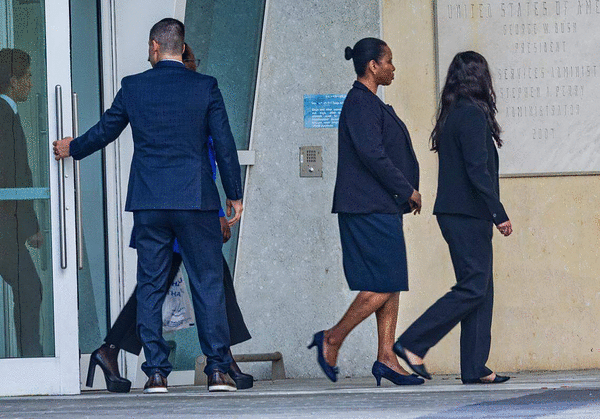
MIAMI —Wearing a black dress, the wife of Haiti’s slain president immediately began to sob on Tuesday as the U.S. government’s star witness testified against four South Florida men standing trial on charges of conspiring to kill her husband more than four years ago at the couple’s home outside Port-au-Prince.
“I am Martine Moïse, I am Mrs. Jovenel Moïse, who was assassinated at our house,” she testified in Miami federal court, as she burst into tears in mid-sentence.
“I am the First Lady of Haiti. Please forgive me. ... I’ve been waiting so long, it’s been over four years since I’ve been waiting. Please forgive me if I’m crying,” who spoke through a Creole interpreter.
Moïse, 51, who took the witness stand after opening statements in the assassination trial, described how she and her 53-year-old husband were awakened by gunfire outside their hilltop home after 1 a.m. on July 7, 2021 — the initial sign that they might be killed in an ambush.
“I was very afraid. I was in shock as well by so many gunshots,” she testified. “I looked in his eyes and I saw the same feelings.”
Kids, dog hid in the bathroom
Moïse said she crawled downstairs on her hands and knees to check on the couple’s daughter and son, and found them in the son’s room. She said she instructed them to hide in a bathroom along with one of the family’s dogs.
Then, she crawled back upstairs to the master bedroom, where she found her husband lying near the bed. He told her to hide on the other side of the bed to avoid stray bullets. She said she could not fit under the bed frame because it was low.
“I put my head and shoulders under part of the bed,” she said, describing how she lay on her stomach on the bedroom floor.
She asked her husband if he had called any officials in charge of protecting the couple’s home. He told her that he called Dimitri Herard, head of presidential security; Jean Laguel Civil, a top security official; and Leon Charles, the Haitian nation police chief.
At that dramatic point, her testimony ended because the 12-person jury had to adjourn early on Tuesday. On Wednesday, she will resume her testimony, which is expected to describe how a team of former Colombian soldiers hired by a Doral-based security firm fatally shot her husband and wounded her arm.
Four men on trial
The defendants standing trial are Arcángel Pretel Ortiz, 53, a former FBI informant, Colombian national and U.S. permanent resident; Antonio Intriago, 62, the Venezuelan-American owner of a Doral security company that hired Pretel; James Solages, 40, a Haitian-American handyman who also worked for Intriago and was close to Sanon; and Walter Veintemilla, 57, an Ecuadorian American who helped finance the plan targeting Moïse. All have been in custody in the Miami federal detention center since their arrests.
On Tuesday, federal prosecutor Sean McLaughlin said the four men conspired with others to plan, fund and carry out the kidnapping and killing of Moïse at meetings in South Florida and Haiti. Their goal was to remove him from power and replace him with a political candidate who would hire Intriago’s security company for future government contracts.
“He was brutally shot and killed at point-blank range by a team of Colombia mercenaries,” Assistant U.S. Attorney Sean McLaughlin told the jury, saying they were driven by “greed, arrogance and power.”
But defense attorneys countered that a senior Haitian government official, Felix Badio, and several national police officers carried out the deadly assault on that July night, arguing that Moïse was already dead when the Colombian crew arrived at his home with intentions of only arresting him.
“When the Colombians got there, it was for a legitimate arrest,” said Intriago’s lawyer, Emmanuel Perez. “When the Colombians went into the room, the president was dead.”
“This was clearly an orchestrated effort for the Colombian men to take the blame for the assassination of President Moïse,” said Ortiz’s lawyer, Orlando do Campo. “My client was set up, he had no reason to believe that his efforts to apprehend an illegitimate president were anything outside the law.”
“He thought he was going to Haiti and that he was going to arrest the president,” said Solages’ attorney, Jonathan Friedman, pointing out that all of the defendants were relying on an arrest warrant for Moïse that was signed by a Haitian judge in early 2021.
“Everyone at trial here relied upon that warrant,” he said.
Although it took years for the Miami case to go to trial because of the voluminous amount of evidence, more than half of the 11 defendants charged in the case have already admitted to playing a role in the conspiracy to kill Moïse or to a lesser charge.
Five defendants pleaded guilty to the main conspiracy charge and were sentenced to life in prison. The sixth pleaded guilty to a lesser charge of smuggling ballistic vests to the Colombian commandos hired by Intriago’s company, Counter Terrorist Unit Security, to execute the hit job, according to court records.
All but one are expected to be called as witnesses for the government during the two-month trial.
©2026 Miami Herald. Visit at miamiherald.com. Distributed by Tribune Content Agency, LLC.






Comments