Delcy Rodríguez recognized as 'sole' Venezuela leader by US in court
Published in News & Features
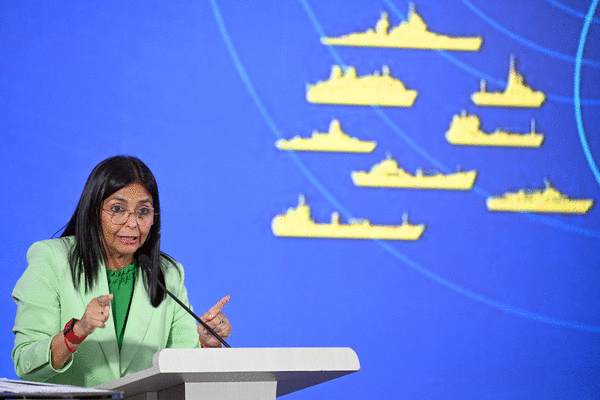
The government of Venezuela’s acting president, Delcy Rodríguez, was recognized by the U.S. government in ongoing litigation related to the South American nation — another step by Washington toward legitimizing her authority.
The clarification came as part of a “statement of interest” filed in federal court on Wednesday by Manhattan U.S. Attorney Jay Clayton. He pointed out other recent moves by the U.S. to recognize Rodríguez’s authority and attached a letter from a senior State Department official on the American position.
The explanation that came as part of ongoing disputes over Venezuelan assets, including one related to compensation for victims of an armed conflict, could be replicated in dozens of U.S. court fights involving Venezuela. It’s a concrete step following President Donald Trump’s comments last week that the U.S. had formally recognized Venezuela’s government.
Clayton submitted the filing in response to a request from Magistrate Judge Sarah Netburn, who asked for clarification on the matter in light of Maduro’s ouster by U.S. forces. Maduro is now facing drug-trafficking charges brought by Clayton’s office.
Previously, the U.S. recognized opposition leader Juan Guaidó as Venezuela’s legitimate president since 2019 as Nicolás Maduro remained in power in Caracas. Since then, the opposition has stood in for Venezuela in U.S. legal disputes, many brought by foreign investors claiming they suffered losses under Maduro or his predecessor, President Hugo Chávez.
Michael Kozak, senior bureau official in the State Department’s Bureau of Western Hemisphere Affairs, explained why the U.S. considered it important to recognize Rodríguez’s government in the litigation in Manhattan federal court. He laid out the reasoning in a March 10 letter that Clayton then filed with the court as an attachment to the “statement of interest.”
Head of state
“Pursuant to the Court’s request, I write to address the U.S. government’s recognition posture with respect to Venezuela,” Kozak wrote to Clayton in that letter. “Our engagement is focused on helping the Venezuelan people move forward through a phased process that creates the conditions for a peaceful transition to a democratically elected government. In order to facilitate this transition, the United States is recognizing Delcy Rodriguez as the sole Head of State, able to take action on behalf of Venezuela.”
If replicated, such a shift could have implications for other cases. Venezuela’s largest foreign asset, Citgo Petroleum Corp., which is owned by state-owned Petroleos de Venezuela SA but was placed under the control of an opposition-controlled subsidiary, has been embroiled in court fights for years. After a lengthy court fight, Citgo was ordered auctioned off to satisfy over $20 billion in claims.
The auction winner, Elliott Investment Management’s subsidiary Amber Energy, is currently waiting for a final green light from the Treasury’s Office of Foreign Assets Control, which still has a license in place protecting Citgo’s parent, as well as any other PDVSA property, from transfer or attachment.
The Venezuelan opposition has appealed the decision approving Amber’s Citgo purchase. It’s unclear if Rodríguez’s government will take a different approach if it steps into the opposition’s shoes.
In Wednesday’s filing, Clayton added that the U.S., “otherwise respectfully declines to opine on the pending dispute regarding ‘which counsel is authorized to represent certain Venezuelan state-owned entities.’”
“It is a conditional recognition, but recognition nonetheless,” said José Ignacio Hernández, senior specialist at consultancy Aurora Macro Strategies. “Indeed, Delcy Rodríguez was recognized as head of state for legal purposes, but the exercise of those powers in the United States is contingent upon the enforcement of sanctions. It is noteworthy that they did not want to enter into the discussion about who can represent Venezuela as a lawyer.”
Venezuela’s opposition is trying to clarify doubts on the implications and scope of the decision, according to Dinorah Figuera, current head of the legislature that was recognized from 2019 as the legitimate authority of Venezuela. They’re scheduling “urgent meetings” to address the situation, she said. Still, she added that they will “facilitate the transition process.”
_____
(With assistance from Anthony Lin.)
_____
©2026 Bloomberg L.P. Visit bloomberg.com. Distributed by Tribune Content Agency, LLC.





Comments