Why are Alligator Alcatraz guards wearing a Grim Reaper patch?
Published in News & Features
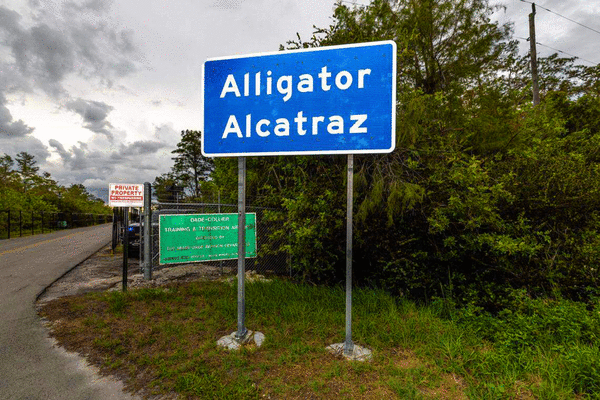
MIAMI — Outside a remote immigration detention facility in the Florida Everglades known as Alligator Alcatraz, an activist was handed something unusual by a departing guard: a patch from his uniform.
The patch shows a large alligator skull with its jaws open wide next to a hooded skeleton holding a scythe. The skeleton, depicted with red eyes and resembling the Grim Reaper, stands before silhouettes of guard towers and fencing that resemble a prison compound. Red banners frame the image with the words “Alligator Alcatraz” on top and “You Can’t Hide” on the bottom.
The guard, who identified himself as “Officer Martinez” and was wearing a Special Housing Unit uniform, told an activist that he had the patches made and distributed them to other guards.
“He told me he made the patches and that he gives them to people — including other guards,” said Courtney Prokopas, 41, an activist with Witness at the Border, a volunteer advocacy group that organizes demonstrations outside immigration detention centers across the country. She had traveled from St. Petersburg and camped out for several days outside the facility.
To verify whether guards inside the facility wore the patch, a detainee recently released from the center was asked over the phone whether anything about the guards’ uniforms stood out to him.
Without being shown the patch, he described the insignia.
“What I saw was ‘Alligator Alcatraz,’ a skeleton dressed in black holding a hatchet and a crocodile underneath,” said Lewis Ortigoza, who had been detained at the facility. “It looked like something demonic.”
On March 7, during a FaceTime call, Ortigoza was shown the patch obtained from the guard and confirmed it matched the one he had seen worn by officers inside the facility.
“Yes,” he said. “That one.”
When reached by phone, a man who said he was Officer Martinez hung up after being told the call was about an altercation and the patches.
Mike King, an emergency-management consultant and emergency manager at the Florida detention site affiliated with Critical Response Strategies, identified the guard as “Steven Martinez.”
“I can confirm that he and another officer were both demobilized following an altercation between the two,” King said, noting that he had not seen the patch before and that it is not an authorized part of the uniform.
Guard discharged
Prokopas said she was standing outside the facility on March 3 holding a cardboard sign that read “SHAME” when Martinez stopped his truck near the entrance gate while waiting for a break in traffic to pull onto U.S. 41. The two began speaking through the open window of his vehicle.
During the exchange, Martinez told her he had just been fired after fighting with another officer. He had fresh gashes on his face.
Prokopas said Martinez was wearing the patch on his uniform. She said he then removed it from his shoulder and handed it to her.
An upset Martinez told Prokopas that he previously worked for the Bexar County Sheriff’s Office in Texas. He said he had just been discharged from Critical Response Strategies, the private contractor that provides security at the detention center, after a physical altercation with another guard.
Martinez told Prokopas he planned to report the incident to the Miccosukee Police Department because the detention center sits on tribal land.
Later that day, he returned to the facility after Miccosukee police told him the matter was outside their jurisdiction.
“He told me to keep the patch. I told him ‘No, it’s OK,’ ” Prokopas said. “He insisted and said he had plenty.”
When Martinez returned, she said, he was wearing another of the same patch on his shoulder.
On March 7, an officer with the Miccosukee Police Department confirmed that a man had walked into the department on Tuesday, March 3, seeking to report a physical altercation with another guard at the detention center. The officer said he was turned away because the facility falls under the state’s jurisdiction, not the tribe’s.
The facility sits on land associated with the Miccosukee Tribe but is operated by federal immigration authorities, creating overlapping jurisdiction between tribal, state and federal agencies.
The Florida Highway Patrol, which investigates incidents on the premises, said it is “looking into this.” So is the Florida Department of Law Enforcement and the Bexar County Sheriff’s Office.
Remote facility
The detention center — located deep in the Florida Everglades — houses migrants detained by U.S. Immigration and Customs Enforcement while they await immigration proceedings. The site is widely known as Alligator Alcatraz, a name introduced by Florida officials when it was announced and later embraced by President Donald Trump.
The facility sits in a remote stretch of the Everglades surrounded by wetlands and wildlife — including many alligators — miles from major population centers.
On any given day, tens of thousands of migrants are held in immigration detention facilities across the United States while they await immigration proceedings and deportation.
In the past year alone, at least 40 people have died while in immigration detention, according to data compiled from federal records and watchdog groups that track deaths in custody. The deaths have intensified scrutiny over detention conditions and the oversight of facilities operated by private contractors.
Immigration-enforcement actions have also drawn heightened attention following several high-profile incidents involving U.S. citizens. At least three U.S. citizens have died in encounters tied to immigration-enforcement operations in the past year.
Many immigration detention facilities are staffed in part by private contractors responsible for security, transportation and other operations. Critics have long raised concerns that the use of private contractors can complicate oversight and accountability when incidents occur inside detention facilities.
The Everglades detention center relies on security personnel from Critical Response Strategies, the contractor that Martinez said he worked for when he distributed the patches. Prokopas said the guard who approached her was wearing a uniform bearing the company’s logo.
U.S. Immigration and Customs Enforcement and the Department of Homeland Security did not immediately respond to requests for comments.
The symbol
Ortigoza said the patch always made his heart race.
He said the patches were worn by guards throughout the facility.
“It felt like they were meant to make us even more afraid than we already were,” he said. “I always felt haunted by it, but I never said anything because I was so afraid.”
“I was paying attention to everything, and I noticed it,” he said, noting that guards sometimes removed and reattached the patches. “They had it attached to their shoulder. They had more than one type, but the one that impacted me the most was that one. … It made me feel like I was bound to die.”
Ortigoza said he spent 21 days inside the detention center before being released in late February on bond — an outcome that is relatively rare in immigration-detention cases.
Custom “morale patches” have become increasingly common among some military and law-enforcement units, often featuring aggressive imagery or slogans intended to build camaraderie among personnel. In recent years, however, several departments have moved to prohibit unofficial patches after public criticism that some designs glorify violence or intimidation.
For Ortigoza, the patch was difficult to ignore.
“When you’re in there,” he said, “you notice everything.”
©2026 Miami Herald. Visit at miamiherald.com. Distributed by Tribune Content Agency, LLC.






Comments