University of Florida sued by College Republicans for deactivating club over Nazi salute
Published in News & Features
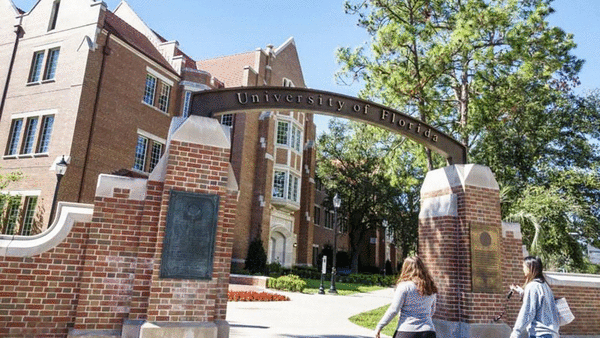
TALLAHASSEE, Fla. — The University of Florida’s College Republicans chapter filed a federal lawsuit Monday accusing the university of violating the First Amendment after administrators abruptly shut down the student group last week over antisemitic remarks attributed to one of its members.
In the lawsuit, filed in federal court in Gainesville, the student organization argues the university unlawfully “deactivated and shut down” the club in retaliation for protected political speech. The suit seeks an emergency court order forcing the university to reinstate the organization and restore its access to campus facilities, funding and event privileges.
The College Republicans are asking a federal judge to declare the university’s action unconstitutional and award damages and legal fees.
UF announced on Saturday that it was deactivating the student club because “members engaged in a pattern of conduct that violated its rules and values, including a recent antisemitic gesture.” An image of a club member performing a Nazi salute had been circulating social media last week.
The university also cited a recent resolution by the Florida Federation of Young Republicans — the collegiate arm of the state Republican Party — to dissolve and “reorganize” the group. The UF chapter, however, has said it is not affiliated with the state organization.
None of UF’s public comments about the situation identify any specific remarks made by College Republicans members.
The dispute is unfolding on a campus that’s home to one of the largest Jewish student communities in the country. UF is widely considered to have the largest undergraduate Jewish student population in the United States, with thousands of Jewish students and a robust network of Jewish campus organizations.
The university’s order does not prevent the College Republicans from continuing to operate. In practice, however, losing recognition can sideline a student organization from campus life, stripping it of the ability to reserve meeting space, promote events through university channels or bring speakers to campus — all key tools for political groups trying to reach students.
Recognized groups at UF can also apply for student government funding, be listed in the university’s official student-organization directory and recruit members at university-sponsored events such as involvement fairs.
The lawsuit argues the university acted after a member of the group expressed views off campus that critics said were antisemitic. The remarks — described in the complaint as “contested expression” — were political speech about current events and did not constitute threats or incitement, the filing says.
University officials deactivated the organization because of the viewpoint expressed by the member, the lawsuit alleges.
The lawsuit also claims the university attempted to justify its decision after the fact by saying it acted at the request of the Florida Federation of College Republicans — a third-party organization that the plaintiffs argue has no authority over the UF chapter. The chapter says it is not affiliated with the state organization and instead operates under the College Republicans of America.
The group further alleges selective enforcement, saying other student organizations have remained recognized despite controversial speech by their members. According to the complaint, the university did not provide advance notice, a hearing or evidence that the group violated campus policies governing student organizations before deactivating the College Republicans.
The lawsuit also argues that university administrators were politically motivated, noting that the group hosted James Fishback, a Republican gubernatorial candidate who has drawn criticism for racist and antisemitic rhetoric, at a March 11 event attended by more than 500 students. None of UF’s public comments about the situation mention Fishback.
The attorney for the UF chapter is Anthony Sabatini, a former Republican state lawmaker known for sparring with members of his own party. He is also representing Preston Damsky, the UF law student who sued the university after it expelled him over antisemitic social media posts.
In an interview with the Miami Herald/Tampa Bay Times, Sabatini alleged that the state Republican Party targeted UF’s College Republicans chapter for promoting what he described as an “aggressive ‘America First’” agenda.
“These guys are squarely in the Zoomer, more hard-edged, what I would call the true right, and they wanted to punish them for that,” Sabatini said.
According to Sabatini, he is in contact with UF’s private attorneys from the boutique law firm Schaerr Jaffe. The firm did not respond to requests for comment. A UF spokesperson, Steve Orlando, said in a statement that the university does not comment on active or pending litigation.
The College Republicans case is the second lawsuit the university has faced in roughly the past year over disciplinary actions tied to allegations of antisemitic conduct by students. In the earlier case, Damsky sued the university after it expelled him over social media posts that included a statement saying Jews “must be abolished by any means necessary.”
A federal judge initially ordered the university to allow Damsky to return to class, finding the posts were likely protected speech under the First Amendment, though the ruling has since been tied up in appeals.
_____
©2026 Miami Herald. Visit at miamiherald.com. Distributed by Tribune Content Agency, LLC.






Comments