Chicago public health officials report unusually high RSV activity for this late in the winter
Published in News & Features
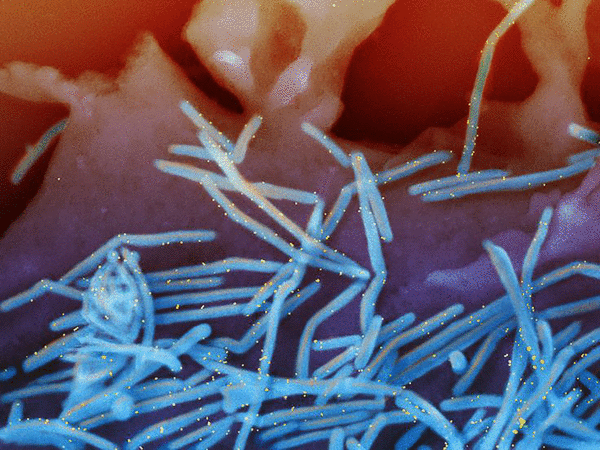
CHICAGO — The respiratory illness RSV is still going strong in Chicago — an unusually late showing for the virus, which can strike infants especially hard.
RSV activity has moved from moderate to high in Chicago, according to the Chicago Department of Public Health. Though it’s typical for RSV to spread more widely in the winter — along with illnesses like the flu and COVID-19 — it’s often more prevalent earlier in the season.
RSV activity in Chicago is still not as high as it was at its peaks in recent years, but it’s stubbornly elevated for this time of year.
“This is not the typical pattern we see,” said Dr. Larry Kociolek, an attending physician of pediatric infectious disease at Lurie Children’s Hospital. “We’re not seeing a ton of it, we just keep seeing it for a prolonged period, and now that we’re heading into spring, it seems a bit more unusual.”
RSV, which stands for respiratory syncytial virus, can cause a runny nose, coughing and fever, and in most people is mild and resolves within a week or two. But the illness can be more severe in babies and young children, causing pneumonia and inflammation of the small airways in the lung.
Each year, about 2% to 3% of babies younger than 3 months old are hospitalized with RSV, according to the Centers for Disease Control and Prevention.
So far, two children with RSV have died this season in Chicago, according to the city health department.
For the week that ended March 7, emergency department visits by babies and children up to 4 years old for RSV in Chicago were more than three times higher than during the same week last year, according to the city health department.
RSV concentrations in wastewater were “very high” for the week that ended March 7, according to the health department.
The percentage of positive tests for RSV for the week that ended March 7 was also more than double the percentage for the same week during each of the last six years.
Across the state as a whole, RSV activity is moderate, according to the Illinois Department of Public Health.
“It certainly has not slowed down,” said Dr. Colleen Nash, associate professor of pediatric infectious diseases at Rush University System for Health. “There are still quite a few young infants coming to the general (hospital) floor and also requiring ICU level care as well.”
It’s unclear exactly why RSV activity is still so high in mid-March. It may have to do with the weather (colder weather makes people crowd indoors more) or a later start to this RSV season, said Dr. Daniel Johnson, a pediatric infectious diseases specialist at UChicago Medicine.
“Historically, the RSV season ends sometime in March, but this year looks like it’s going to be prolonged,” Johnson said. “This is unusual but certainly not unprecedented.”
Another change is the increasing availability of relatively new vaccines and monoclonal antibodies to protect against RSV. In 2023, the U.S. Food and Drug Administration approved RSV vaccines for pregnant women and for older adults, as well as a monoclonal antibody for babies.
Monoclonal antibodies are proteins made in laboratories that mimic the immune system’s ability to fight off certain illnesses.
The American Academy of Pediatrics recommends that pregnant women receive an RSV vaccine from weeks 32 through 36 of their pregnancies, from September through January, which can help protect their babies after they’re born. If a pregnant mother doesn’t get the vaccine, the AAP recommends babies receive a monoclonal antibody injection, if they’re younger than 8 months old and were born during RSV season or heading into their first RSV season.
The percentage of babies protected against RSV has been rising in Chicago since the products were approved.
About 17% of Chicago infants born between April 1, 2023, and March 31, 2024, were immunized against RSV, either because their mothers got vaccines while pregnant or because they received monoclonal antibodies, according to the city health department.
That number jumped to 58% for Chicago babies born during the following year.
Preliminary data suggests that percentage might be very similar or slightly higher by the end of this season, said Dr. Brian Borah, medical director of vaccine preventable disease surveillance at the Chicago Department of Public Health.
“I think it’s encouraging they’re continuing to increase year over year,” Borah said of the protection rates against RSV. “I do think, however, there is a big gap in the number of infants that are not protected against RSV that I think needs attention as well. The health department is working really hard to close that gap.”
One challenge doctors are contending with are moves by the administration of President Donald Trump to scale back vaccine recommendations for children. Though many medical groups, including the American Academy of Pediatrics, have criticized those actions, the attempted changes have sowed even greater doubt about vaccines among some parents.
Earlier this week, a federal judge temporarily halted the Trump administration from scaling back the vaccine recommendations, in response to a lawsuit filed by the American Academy of Pediatrics and other groups.
“What’s exciting is that people are asking questions and that’s overall a good thing,” said Johnson with UChicago Medicine of how parents have reacted to the national discussion over vaccines. “What I hope is that they’re not only asking questions but then willing to hear the answers that are available to them based on data rather than based on politics.”
Given the ongoing prevalence of RSV, it’s important for families not to let their guard down just yet — even as signs of spring begin to appear, said Nash with Rush University System for Health.
Parents who are bringing home newborns or who have infants at home, should still be “very vigilant about all the things everyone thinks about in the dead of winter, washing hands, not being around those who are sick, considering wearing masks and covering your cough,” Nash said.
State and city health officials are now considering whether to recommend continued immunization for infants even beyond the end of March in response to the unusual RSV activity at the moment, Borah said.
“It’s important for folks with babies or who are expecting a baby soon to realize the level of activity is still high, and they should very strongly consider getting these products to protect their babies,” Borah said.
_____
©2026 Chicago Tribune. Visit chicagotribune.com. Distributed by Tribune Content Agency, LLC.




Comments