Kenyan troops start Haiti withdrawal as Gang Suppression Force deployment nears
Published in News & Features
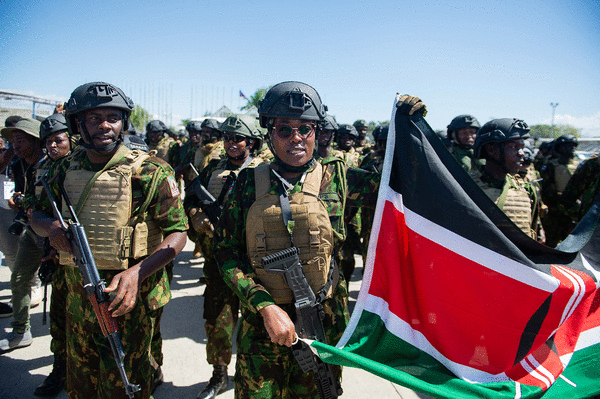
After 21 months of struggling to help Haiti’s security forces reign in armed gangs, the international security mission led by Kenya is beginning to draw down, signaling the troubled Caribbean nation’s transition to a new phase of international intervention.
A group of 215 Kenyan police officers who formed the second contingent of the Multinational Security Support Mission arrived in Nairobi earlier this week, Kenya’s Ministry of Interior confirmed in a statement. Last Friday, a smaller contingent of troops from The Bahamas and Jamaica that made up the Caribbean component also departed Port-au-Prince.
“The mission has now entered a transition and drawdown phase that will see more officers gradually return home from their tour of duty,” the Kenyan interior ministry said in a statement.
Jack Mbaka, who served as spokesman for the Kenya-led mission, told journalists in Haiti on Thursday that Kenya is currently reducing troop levels in preparation for the arrival of a larger number of personnel under the Gang Suppression Force. Backed by the United States, that force was authorized by the United Nations in late September and is expected to start deploying in April with a small contingent of soldiers from Chad.
A number of Kenyan police officers will remain in Haiti to serve as a bridge during the transition, though Mbaka declined to give a timetable for the full departure of the Kenyan troops. The ongoing process, he said, “aims to ensure a smooth transition” to the new force’s expected 5,500 troops.
Caribbean troops participation unclear
The Kenyan-led mission was designed to deploy about 2,500 personnel, but at its peak only had about 1,100 officers. Meanwhile, three Kenyan police officers lost their lives in Haiti during anti-gang operations.
Though Kenya is among a “Standing Group of Partners” charged with overseeing the new mission, the east African nation is not expected to be part of the new mission, whose personnel will draw from other African nations and consist mostly of soldiers. As for the future of Caribbean troops’ participation, that remains unclear.
Under the original Kenya-led mission, Jamaica served as deputy command and its soldiers were instrumental in providing expertise in cybersecurity and tracking gang leaders’ movement on social media. But the recent hurricane that devastated Jamaica in October has added a new wrinkle to its ability to deploy members of its defense force. Meanwhile, The Bahamas, which is gearing up for elections and never fully deployed its promised assistance, has not said whether it will send troops to Haiti.
Like Jamaica, the Bahamas is among the Standing Group of Partners, which in addition to Kenya includes Canada, El Salvador, Guatemala and the United States. Jack Christofides, a longtime U.N. expert on peace building, will spearhead the overall effort as special representative.
Last week, as Bahamian officials welcomed their five military officers back home from Port-au-Prince, the country’s ambassador to Haiti, Jerusa Ali, said that following the redeployment exercise, The Bahamas will maintain an active role in supporting security and stability in Haiti through political and diplomatic engagement at the United Nations, the Organization of American States and CARICOM, “as well as through training support to members of the Haitian National Police and the Coast Guard Commission.”
Kenya’s offer to help
Kenya’s offer to help Haiti tackle its gang crisis dates back to 2023, when it became the only country to volunteer to lead the effort after Canada declined and Caribbean governments, led by The Bahamas, argued the crisis should be solved by the Haitian police.
A legal challenge in Nairobi delayed the initial deployment. Meanwhile, Republican opposition in Washington and lukewarm support from the Pentagon slowed access to equipment needed to confront Haitian gangs, giving them time to unite into a more powerful force by the time the first 200 Kenyan police officers arrived in June 2024.
Once on the ground in Haiti, the mission faced a lack of international financing, internal conflicts within the Haitian National Police, broken equipment and an inability to deploy more than 300 officers at a time. Meantime, gangs rapidly expanded their attacks outside the capital into the Lower Artibonite and Central Haiti regions.
Faced with a country where armed groups controlled the majority of the capital, the Trump administration threw its support behind a proposal by U.N. Secretary General António Guterres to establish a new U.N. support office to help fund the effort, while also pushing within the U.N. Security Council for a more robust, military-oriented intervention force of about 5,500 troops, along with a 50-member civilian corps.
Last month, while attending a gathering of Caribbean Community leaders in Saint Kitts and Nevis, U.S. Secretary of State Marco Rubio said the new force is “building.”
“We’re very happy with the commitments we’ve gotten in terms of personnel,” Rubio told journalists on the sidelines of the visit, where he had meetings with a number of the Caribbean leaders, including interim Haitian Prime Minister Alix Didier Fis-Aime. “We feel like we’ve gotten more commitments than spots we’ve got available for the Gang Suppression Force. We need to do a little bit better on the funding. We’re still looking for donor countries to fill in gaps but we think we’ll get there.”
The force, though authorized by the U.N., is not a traditional peacekeeping mission. Still, Rubio is placing a lot of pressure on the U.N. “to show they can solve” a problem.
“The goal of this entity will be to get on the ground and allow the Haitian authorities to hold territories from these gangs,” he said.
U.S.-Dominican meeting
That remains a tall order. Though Haiti’s security forces have seen recent success in pushing back armed groups from some neighborhoods in the capital, more than 1.45 million Haitians remain internally displaced after being forced to flee their homes. On Thursday, following a change in leadership inside the Haitian national police, a fire broke out inside the headquarters of the police headquarters located on the Champ-de-Mars, across from the presidential palace grounds.
In anticipation of the arrival of the new force, U.S. and Dominican officials met Monday on the border of the Dominican Republic and northeast Haiti. The discussions took place inside the Codevi Industrial Complex and were led by Dominican Foreign Minister Roberto Álvarez. He was joined by the U.S. chargé d’affaires to Haiti, Henry Wooster and the U.S. ambassador to Dominican Repubulic, Leah F. Campos. Though not among the troop contributing nations, the Dominican Republic had been a leading advocate for getting an international force deployed to Haiti to assist with the gang crisis.
Meanwhile, the Organization of American States this week also held a two day conference in Panama City, Panama, to discuss maritime security in Haiti, where gangs have taken to the country’s waterways.
©2026 Miami Herald. Visit at miamiherald.com. Distributed by Tribune Content Agency, LLC.






Comments