In the Senate, Thune resurrects idea of reconciliation
Published in News & Features
WASHINGTON — For Senate leaders, pursuing another budget reconciliation bill this year was once considered a no-go. But in a matter of days, it’s become a distinct possibility.
Using the often arduous budgetary maneuver would represent a shift for both ends of Pennsylvania Avenue, necessitated by Republican needs to reopen the Department of Homeland Security while passing some of their legislative priorities, key among them a voter ID bill.
But using reconciliation remains an uphill battle, as rank and file resist the idea of a process that would require broad consensus within the GOP.
The idea became even more attractive for Senate GOP leaders Monday, when President Donald Trump tied funding DHS — which has been shut down for four weeks — to passage of the GOP’s election security legislation.
Doing both would represent a herculean task for Senate Majority Leader John Thune, who faces both a slim majority and Senate rules requiring 60 votes to pass legislation. Plan B: passing some of the voter ID bill, nicknamed the SAVE America Act by Republicans, with a reconciliation bill, which would only require a simple majority to pass.
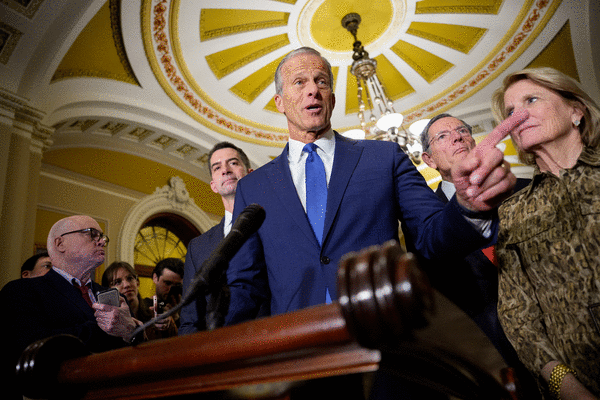
“I think with budget reconciliation, as I’ve said before, you have to have a reason to do it … And we (very) well may,” the South Dakota Republican said Tuesday. He said that inside the Senate Republican Conference, “there’s a lot of support for a budget reconciliation bill.”
“We have two legislative vehicles available to us, so we could tee one of those up and that’s an option, and we’ll see if that’s what it takes to get some of these things across the finish line, and if we can do it with simple majorities, we’ll take a hard look at that,” Thune said.
Previously, Thune and leadership had been reluctant to go through another reconciliation process this year, pointing to last year’s reconciliation measure, nicknamed the One Big Beautiful Bill, which aimed to address expiring tax cuts and other GOP priorities.
But Tuesday, Trump also seemed open to the idea.
“We’ll see about reconciliation,” he said. “We’re certainly talking about reconciliation.”
Such a stance would mark a shift in Trump’s position: He has said for months that no more major legislation is needed after Republicans passed their “big, beautiful bill” last summer.
While reconciliation would bypass the risk of a Democratic filibuster, it would require near-unanimous support among Republicans because of their razor-thin majorities.
Byrd rule
And it’s unclear which portions of the election bill could be included in a reconciliation bill and would survive a scrub of the chamber’s parliamentarian; provisions that don’t touch upon spending or revenue and are just about policy are usually expunged under the Byrd Rule, which requires reconciliation bills to focus on fiscal issues.
Sen. James Lankford, R-Okla., told reporters he would not be willing to override the parliamentarian’s rulings when asked Tuesday.
Homeland Security Secretary Markwayne Mullin, who was sworn in Tuesday to the role, said that Budget Committee Chairman Lindsey Graham, R-S.C., is “committed to making sure we get reconciliation through.”
“If that is in some form with funding ICE, possibly backfilling from the One Big Beautiful Bill, but also, more importantly, the SAVE America Act,” he said. “There’s a framework that we can do through reconciliation, paying for it, (putting) some of the policies that cost money in, because there’s nothing more important.”
Senate Budget Republicans are meeting this week to begin conversations on the topic.
But some of Mullin’s former colleagues remain skeptical of the idea and worry the legislation would become watered down to abide by the reconciliation process’ guardrails.
Sen. Mike Lee, R-Utah, posted, “It’s hard to imagine how the SAVE America Act could be passed through reconciliation. And by ‘hard’ I mean ‘essentially impossible.’”
Lee, a member of the Budget Committee, has led the push for the chamber to debate SAVE and even pursue a so-called talking filibuster to pass the bill via a simple majority.
Leadership has, so far, held firm against that, and instead has allowed an extended debate to happen on the Senate floor last week, over the weekend and into this week. Still, the legislation is not expected to pass because it would not receive the required 60 votes.
Other GOP concerns
Sen. Rick Scott, R-Fla., said that “I don’t see any way that any part of the SAVE America Act of any teeth gets included in a reconciliation package.”
“On top of that, I think it’s very difficult to pass a reconciliation package. We don’t have big tax cuts coming. That’s really what got the last one done,” Scott said. “I think it’s going to be very difficult to get, you know, 50 of us to agree on something.”
Sen. Thom Tillis, R-N.C., who opposed last year’s reconciliation measure, said, “It would seem on its face, because there’s so much policy involved, that it would be difficult to do.”
“It’s kind of interesting to see if they’re just going to be pushing maybe some of the funding that could fit within reconciliation. But I don’t know how the policy fits in there.”
Senate Appropriations Chair Susan Collins, R-Maine, who has been part of hashing out the agreement between Democrats and the White House to reopen DHS, also declined to support reconciliation, saying “I don’t think that’s a good approach.”
That hesitation extends to the House, where Speaker Mike Johnson will have to grapple with his own narrow majority to get any bill across the finish line.
The chamber’s conservative House Freedom Caucus called the idea “gaslighting” from Senate Republican leadership.
“The problem is that it’s almost impossible under Senate rules,” they said, saying if they could pass the election bill via reconciliation, they would have done so last year.
Rep. Eric Burlison, R-Mo., said, “Leaving the fate of the Save America Act up to the Senate parliamentarian is like going all in on triple-zero at the roulette table.”
“It’s not even an option.”
Other priorities could also potentially ride on a reconciliation bill or package, like supplemental funding for the conflict in Iran, but questions are already swirling over a price tag.
Sen. Ron Johnson, R-Wis., said he supports pursuing a reconciliation bill related to homeland security, saying “we’ll keep this one focused” so it “passes fast.”
He said the first step will be to find the pay-for and then “Look at what we want to fund in terms of election integrity, because that’s the real focus of this effort right here, whatever (we can do budgetary, to encourage and enforce election integrity.
“Once we have that in place, how many pay-fors and what is left over to pay for funding DHS, ICE, CBP,” Johnson said.
_____
(John T. Bennett contributed to this report.)
_____
©2026 CQ-Roll Call, Inc., All Rights Reserved. Visit cqrollcall.com. Distributed by Tribune Content Agency, LLC.





Comments