US puts bounty on finances of Haiti's most powerful gangs
Published in News & Features
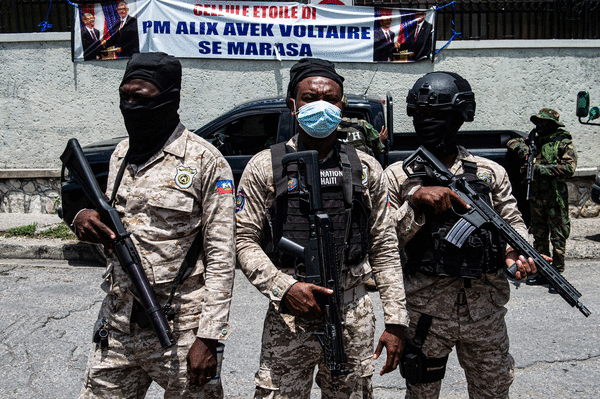
The United States is offering a reward of up to $3 million and possible relocation for information on the financial activities of Haiti’s most powerful gangs.
The Viv Ansanm gang coalition and Gran Grif were designated as Foreign Terrorist Organizations and Specially Designated Global Terrorists by Secretary of State Marco Rubio last year.
Despite that, the armed groups have continued to wreak havoc, collecting millions of dollars in extortion fees from toll roads and their control of strategic corridors leading to the country’s seaports and land border with the neighboring Dominican Republic.
On Wednesday, Rewards for Justice, a State Department program, issued social media posts seeking help to disrupt the gangs and curb their violence.
“You could be eligible for relocation and a reward of up to $3,000,000,” the notice said. “Send your alert in complete confidentiality, today.”
In the request to help cut off the “lifeline” of Haitian gangs, Reward for Justice lists some of their crimes: extortion, kidnapping, arms and drug trafficking as well as hijacking. In the country’s rural Artibonite valley, Gran Grif has also been tied to the theft of crops and livestock, contributing to Haiti being among the world’s top hotspot for hunger.
In addition to hunger, the violence has also been driving record numbers of displacements as Haitians are forced to flee their homes. The United Nations’ International Organization for Migration recently reported that 1.45 million Haitian are now internally displaced. With that have come worsening conditions for families living in displacement sites, Mercy Corps., a nonprofit said Wednesday in an analysis of the impact of the gang violence it released.
A report published by the U.N. Office of the High Commissioner this week showed that the violence is not only endemic and expanding out of the capital, but its spillover effects continue to affect basic human rights in the country.
The U.N. notes that over the last year, Viv Ansanm’s members have expanded their territorial control into the outskirts of Haiti’s capital and into the central region where they rapidly took control of the localities of Saut-d’Eau and Mirebalais and caused the displacement of most of the population.
“Despite security operations, at times supported by self-defense groups, gangs remained entrenched in the area, launching further attacks to expand eastward, toward Lascahobas,” the report said.
The report also noted that in the Artibonite, where Gran Grif is entrenched in the lower parts of the rice-growing region, gang attacks have multiplied.
“In September 2025, the communes of Arcahaie and Cabaret – located north of the capital and bordering the Artibonite department – were also targeted by gangs. Although the police repelled the attacks, they underscored the growing risk of gangs expanding their reach toward Saint Marc, one of the principal cities in Artibonite and home to one of the main ports of the country,” the report said.
U.S. Embassy assurances
Recently more than 200 police officers from Kenya, along with military personnel from Jamaica and The Bahamas, departed Haiti as part of the drawdown of the Kenya-led Multinational Security Support mission as it transitions into the U.S.-backed Gang Suppression Force.
On Tuesday, the U.S. Embassy in Port-au-Prince sought to reassure Haitians that despite the recent departure of the Kenyan officers, joint operations between Haitian police and foreign forces would continue.
The country will soon receive “troops from around the world,” the embassy said in reference to the anti-gang force.
“The United States will continue supporting the Haitian National Police.... We stand with the Haitian people in their aspirations for a safer, more prosperous country,” the embassy said.
The embassy commended “the brave efforts” of the police officers and military personnel from the countries that comprised the Kenya-led force, among them The Bahamas, Jamaica, El Salvador and Guatemala. The latter two are expected to remain as part of the anti-gang force’s 5,500-strong personnel, with El Salvador anticipated to deploy helicopters for operations.
“Terrorist gangs continue to cause suffering to Haitian communities, exploit women and children, and coerce boys and girls into a life of violence,” the embassy said. “They use women and children as human shields every day. Even one civilian death is too many. Gang brutality is indefensible, and they will never be seen as heroes or revolutionaries.”
Humanitarian impact
On Wednesday, Mercy Corps. released a report showing that 95.6% of respondents recently surveyed do not feel safe inside their displacement camp and that 3 in 10 women say they have experienced physical or sexual violence inside the sites.
“Nearly all respondents report suffering economic collapse after their displacement (99.1% have no income) and now face severe food deprivation (96.5% of women and 87.5% of children eat fewer than two meals a day),” the nonprofit said.
The data has huge humanitarian ramifications, said Laurent Uwumuremyi, Mercy Corps’ country director for Haiti.
“Families in Port-au-Prince are facing an impossible situation — without safety, without reliable access to food, and without opportunities to earn an income. When people cannot meet their basic needs or see a path forward, the impacts do not stay contained; they ripple outward, affecting stability far beyond any one community,” she said.
“At a time when global attention and funding are stretched, it is critical that Haiti is not overlooked. Investments in safety, livelihoods, and basic services are essential to support communities urgently, and to help prevent deeper and more widespread instability,” Uwumuremyi added.
©2026 Miami Herald. Visit at miamiherald.com. Distributed by Tribune Content Agency, LLC.






Comments