Artemis II astronauts arrive at Kennedy Space Center ahead of next week's launch
Published in News & Features
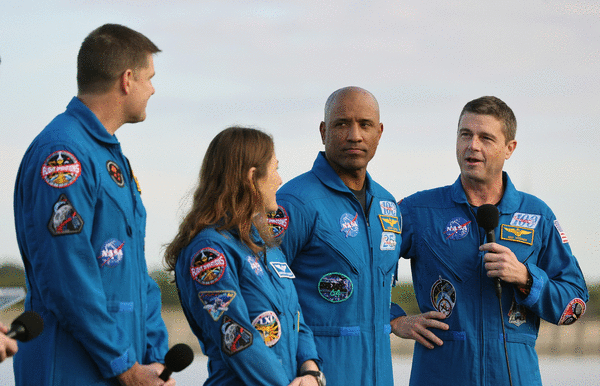
ORLANDO, Fla. — Before the four astronauts of the Artemis II mission travel farther from Earth than any human ever has, they first had to get to the launch site.
NASA astronauts Reid Wiseman, Victor Glover and Christina Koch along with Canadian Space Agency astronaut Jeremy Hansen arrived from Houston at 2:15 p.m. to Kennedy Space Center as they target a launch as early as Wednesday evening.
The quartet along with their backups, NASA astronaut Andre Douglas and Canadian Space Agency astronaut Jenni Gibbons, have been in quarantine since March 18. All six arrived to the former Space Shuttle Landing Facility flying in on NASA T-38 jets where they were joined on the tarmac by NASA Administrator Jared Isaacman and other officials.
“Hey, let’s go to the moon!” Wiseman said to hoots from the crowd of media gathered at the site.
This is their third time having entered quarantine with February and March launch opportunities that fell through.
“I think for the crew, we focus on training, readiness, safety, and so, we’ve known that that was a possibility the entire time,” Glover said. “But our families we have really turned to to make it possible. … I really just wanted to focus on them and say thank you to them for making it, for supporting us through all the different iterations.”
Artemis II is the first crewed mission of the nation’s moon-to-Mars program following the uncrewed Artemis I flight of 2022. The astronauts have planned a 10-day mission that will fly by, but not land on, the moon to prove the Orion spacecraft’s safety.
“Allons-y,” added Hansen, which is French for “let’s go.”
One reveal the astronauts brought to the event was the zero-gravity indicator, usually a plush item that astronauts use to let them know when they have made it to space. The little moon with a smiley face sporting a blue-and-green Earth baseball cap, named “Rise,” was submitted by a second grader in California.
“The crew personally participated in selecting our buddy, our stowaway, to fly with us,” Koch said. “This little guy, ‘Rise,’ really resonated with us, because the theme is actually the Earthrise photo taken on Apollo 8, which is inspirational to all of us. It is a mission that sort of mirrors our own, and we’ve incorporated it into our mission patch and also into our ethos and values as a crew. So welcome aboard ‘Rise.’ It was a great first flight with you. We look forward to the next one.”
The flight plan calls for Orion to remain close to Earth for one day before heading to the moon. It will fly by the moon on the sixth day of the mission, coming within 4,000 to 6,000 miles of the surface.
This is the same day that the crew could surpass the record set in 1970 for farthest distance from the Earth ever traveled by humans. Depending on the exact launch day and time, Orion could carry them farther than 248,655 miles away, which was the distance from Earth the Apollo 13 crew flew during their problematic flight.
The crew would then spend three days on the return flight, with a parachute-assisted splashdown in the Pacific Ocean.
“Every day that passes is a day closer to launch,” Koch said. “That’s something that I keep in mind. As for things I’m looking forward to afterward, just splash down and being back on Earth. I haven’t thought a whole lot past that.”
They will finish out their prelaunch quarantine at KSC’s astronaut quarters prepping for the first of six launch opportunities through April 6.
“It’ll go when the engines light at T-0, and so that, we totally understand that and we still have some some weather updates and some technical things to get through between now and when the launch window opens,” Glover said.
Liftoff for the Wednesday launch would be at 6:24 p.m. with Thursday, April 2’s backup at 7:22 p.m., Friday, April 3’s at 8 p.m., Saturday, April 4’s at 8:53 p.m., Sunday, April 5’s at 9:40 p.m. and Monday, April 6’s at 10:36 p.m. If NASA can’t make any of those options, the next launch window opens on April 30.
“April 1 is not a guarantee. April 6 is not a guarantee. We’ve got to go feel this whole thing out,” Wiseman said.
Orion sits atop NASA’s Space Launch System rocket at KSC’s Launch Pad 39-B. The rocket and spacecraft returned to the launch pad on March 20 after having missed out on launch opportunities in February and March that required it to be rolled back for fixes at the Vehicle Assembly Building.
With those in place, teams have been prepping it at the pad for the April window.
“In the days leading up to launch, technicians will conduct pad-specific engineering tests for ordnance connectivity on the flight termination system, radio frequency testing for the core stage and Orion spacecraft and complete final closeouts of the rocket and spacecraft before getting into launch countdown,” according to a NASA website update.
Wiseman said the crew gained the confidence that there would be a good launch after the most recent flight readiness review.
“There was not a single surprise in that entire flight readiness review. So when you look at something as complicated as the Artemis II architecture across industry, across government agencies, it just told me that our leadership is communicating very well,” Wiseman said. “They’re communicating well at the top, all the way down to the crew level and the training team in between. So for me, that was like a confirming cue that this team is ready to go fly this mission.”
---------
©2026 Orlando Sentinel. Visit at orlandosentinel.com. Distributed by Tribune Content Agency, LLC.






Comments