Fidel Castro's grandson criticizes Cuba leader Díaz-Canel, says Cubans want capitalism
Published in News & Features
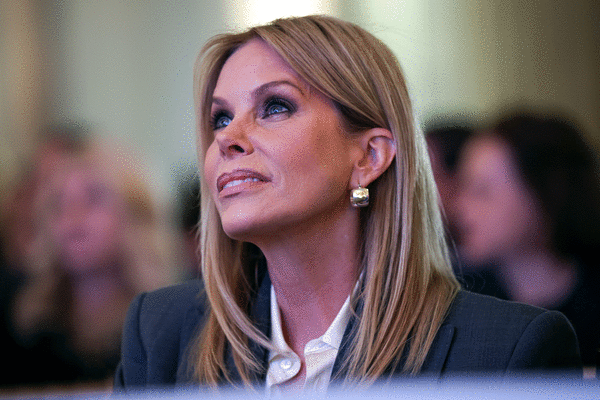
Amid ongoing talks between the Trump administration and Cuban leaders, Sandro Castro, the controversial grandson of Fidel Castro, told a major U.S. television news network that most Cubans on the island want to embrace capitalism and that the country’s handpicked president, Miguel Díaz-Canel, has done a poor job.
His statements to CNN’s Havana correspondent, Patrick Oppmann, echoed earlier calls by Secretary of State Marco Rubio for a change of leadership in Havana, and seem to suggest that some people in the government would be in favor of striking a deal with the Trump administration.
“There are many people in Cuba who think in a capitalistic way. There are many people here who want to do capitalism with sovereignty,” Castro said. “I think the majority of Cubans want to be capitalist, not communist.”
That’s the opposite of the official government line, which has communism enshrined in the country’s constitution and has refused to open up the country’s economy. Castro’s comments contrast with the array of recent interviews by Cuban officials, including Díaz-Canel, on U.S. media and other international outlets, trying to convey the message to the Trump administration that Cuban leaders are united and unwilling to negotiate political changes.
Asked about Díaz-Canel, who has vowed to resist U.S. pressure, Castro said, “I would not say he is doing a good job. For me, he is not doing a good job because he should have done many things a long time ago that he didn’t do well.”
Sandro Castro Arteaga, 33, has no official position in the Cuban government. He is the son of Alexis Castro Soto del Valle, a telecommunications engineer and one of Fidel Castro’s five children with Dalia Soto del Valle. His cousin and grandson of Raúl Castro, Raúl Guillermo Rodríguez Castro, 41, met with members of Rubio’s team on the Caribbean island of St. Kitts last month in back-channel talks.
Sandro Castro owns a popular bar in Havana and is an aspiring influencer, with over 140,000 followers on Instagram, who usually enrages Cubans on the island and abroad for his lavish lifestyle, which he often boasts about on social media. In 2021, he caused such an uproar when he posted a video of himself driving a Mercedes-Benz, a luxury car rarely seen on Cuban streets, that he publicly apologized, apparently under pressure from family members.
While he claims in the CNN interview that he does not enjoy special benefits because of who he is, he is seen enjoying a cold beer in his air-conditioned apartment in the Havana residential neighborhood of Kohly amid a citywide blackout, powered by an EcoFlow power station. He told CNN that his bar, named EFE and located on Havana’s central 23 Street in the upscale Vedado area, “only” cost him $50,000, a sum “beyond the wildest imagination of most Cubans,” the report notes.
Even so, Castro complained about the effects of the ongoing crisis in Cuba, complaining that the situation was “so difficult. You suffer thousands of problems. In a day, there might not be electricity, no water. Goods don’t arrive. It’s so hard, really hard.”
But it’s the timing and his wading into politics that make the rare interview even more remarkable.
It is unclear whether his views represent those of other family members, who perhaps wanted to send a signal to the United States through one of the family’s most public figures, though his bizarre and at times crass social media videos make him an unlikely messenger. CNN reported that he was on the phone with his father discussing talking points for the interview when the media crew arrived at his Havana apartment. Castro had questioned the government’s economic policies on Twitter, now X, before he stopped posting last year.
But at a moment of high stakes and in a country where criticizing the government or the communist party lands people in jail, it is unlikely that the younger Castro agreed to speak about politics – and disparaged the beleaguered Cuban leader – on U.S. news network without agreen light from more powerful members of his family.
Just last week, Ana Bensi, a young Christian influencer who is critical of the government, was placed in home detention. Ernesto Ricardo Medina and Kamil Zayas Pérez, content producers working with El 4tico, a social media outlet, have been detained since February.
Castro, however, is unlikely to meet similar punishment because of his surname, though he told CNN he has received warnings from state security agents.
According to CNN, Castro said in the interview that he favored a deal with Trump. On his Instagram account, he published a satirical skit in which he fictitiously negotiates with an actor playing Trump and takes him around Havana. But in an unpublished version that ended up being leaked, Castro lures Trump with the sight of a Trump tower in Havana’s famous Malecon and is offered in return a mansion in Miami.
In a twist, Castro rejects the offer and says he wants “liberty, the Statue of Liberty. You know why?” he asks the fake Trump. “Because I want peace.” They then shake hands on the deal as reggaeton music plays in the background.
Shortly after Castro’s interview aired Monday, Cuban exiles and activists complained on social media that the network gave him a platform to whitewash his grandfather’s legacy or to pitch an economic deal with the Trump administration that would leave the family in power.
Others noted that the rare interview was a signal of changes in the country.
“Before casting stones, consider the signal: a Castro in Havana tells @CNN_Oppmann he supports a capitalist Cuba, wants a deal with Trump, and thinks the current president is doing a bad job,” Ric Herrero, the executive director of the Cuba Study Group, said on X. “This is a net positive.”
_____
©2026 Miami Herald. Visit miamiherald.com. Distributed by Tribune Content Agency, LLC.





Comments