Kash Patel visited Pennsylvania to tout Trump's fight against fentanyl
Published in News & Features
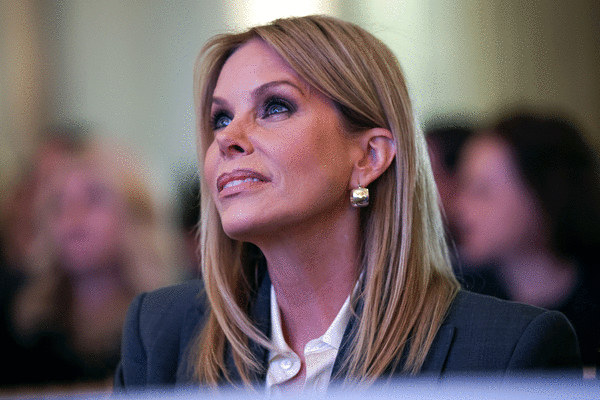
FBI Director Kash Patel joined U.S. Sen. Dave McCormick, R.-Pa., at a roundtable event in Allentown, Pennsylvania, on Wednesday to tout state and federal efforts to combat Pennsylvania’s fentanyl crisis, as well as a declining number of overdoses from the synthetic drug.
Attorney General Dave Sunday, U.S. Attorney David Metcalf, and district attorneys from Philadelphia’s collar counties also attended the meeting at the Edward N. Cahn U.S. Courthouse.
Officials largely attributed the decline in overdose deaths — from an average of around 4,000 per year in 2020-2024 to around 1,000 in 2025 — to White House policies, in addition to increased efforts from the FBI, DEA, and other law enforcement agencies.
“This is a very big focus, because it’s such a poison that destroys families and destroys communities,” McCormick said.
The roundtable saw McCormick, Patel, and other officials meet several Pennsylvanians who had lost loved ones to fentanyl. That included Jim Ott, the Blair County sheriff who lost his 33-year-old son, Josh, to fentanyl.
The conversation was not open to the media. Patel said the families urged leaders push for programs that educate school children at a younger age about the harmful effects of the drug.
Patel said President Donald Trump had emboldened the FBI to attack the fentanyl crisis since returning to office, though there was “still work to be done.”
The FBI director suggested the president’s immigration crackdown at the U.S. southern border was helping stem the flow of deadly drugs into the country. And he said his trip to China last fall, where he spoke with counterparts about restricting the production and export of drug-making chemicals, had addressed the “root cause” of the problem.
Asked how nation’s approach to drug enforcement had changed, Patel said he had directed 1,000 agents from the FBI’s Washington, D.C. office and placed them in the field — including in Pennsylvania.
“Before last year, one third of the FBI’s entire workforce was housed inside the National Capitol Region,” Patel responded to an Inquirer reporter. “That’s bureaucracy. We eliminated that.”
The FBI director’s last major appearance in Pennsylvania was in October, when the FBI director announced the results of a large-scale investigation into a Kensington-based drug gang.
The event came as the Trump administration continues to prioritize stopping the flow of fentanyl and other deadly drugs into the country.
The White House has pressured other countries to stem the flow of drugs across borders, and has extrajudicially blown up boats in the Caribbean it said were operated by cartels. While former President Joe Biden treated the fentanyl crisis as a public health issue, Trump has cast his efforts to reduce impact more like a militarized drug war.
2023 marked the beginning of a decline in opioid overdose deaths nationally, according to the C.D.C., and they experienced a significant drop in 2024.
With continued collaboration between federal and Pennsylvania officials, Patel said Thursday, “we’re going to continue to see this drastic decline and drastic drop” in fentanyl.
AG Sunday’s busy day
Sunday, the attorney general and one of the state’s top Republican officials, said in Allentown that the fentanyl crisis made him fearful as a father, and that “one mistake” a child makes with drugs “can equal death.”
He said his office had helped seize more than 5 million doses of the drug in 2025.
Earlier in the day, Sunday spoke at a news conference in Northeast Philadelphia to announce the arrest of more than a dozen men who police said were part of a North Philadelphia drug trafficking group — and who sold crack and cocaine out of a coffee shop that served as a front for their operation.
Sunday called the arrests an ‘organizational takedown," saying 17 people would face charges including conspiracy, corrupt organizations, and a variety of drug and gun offenses.
The men were longtime drug dealers in the neighborhood, Sunday said, and many were past the age typically associated with such activity. The gang’s purported leader, Louis Alexander, is 56, and Sunday said some others facing charges were in their 60s or 70s.
At Wednesday morning’s briefing, Sunday said Alexander and his accused coconspirators used a purported coffee shop at the intersection of W. Cumberland and N. Cleveland Streets — dubbed Cumberland Coffee and Snacks — as a base for their operation.
The group cooked crack on the shop’s second floor, Sunday said, and sold drugs to customers on the first floor. They also sold drugs on neighborhood streets, and group members performed a variety of tasks to support the organization, Sunday said.
Senior Deputy Attorney General Michael Barry said the gang had been known around the neighborhood for “well over a decade.” And although authorities did not announce any charges in connection with acts of violence, Sunday said the men had a stockpile of weapons, and that the investigation into how or when they used them was ongoing.
Barry said the coffee shop was a poorly designed front. When police served search warrants in recent days, he said, the shop had some snacks and sodas available, but “there were no coffee pots” inside.
Alexander, the gang’s purported leader, was taken into custody last week, court records show. He did not have an attorney listed in court documents.
Sunday said police also recovered dozens of guns, cash, and drug paraphernalia while serving warrants — part of what he said was an attempt to “obliterate” the group and prevent any members from continuing to sustain its operations.
“Our goal is not just to arrest the one person they caught dealing that day,” Sunday said. “The goal is to do it right and be able to remove an entire organization, because the impact on the community will be vastly greater.”
_____
©2026 The Philadelphia Inquirer. Visit inquirer.com. Distributed by Tribune Content Agency, LLC.




Comments