Courts likely to block Trump's effort to curtail mail-in voting
Published in News & Features
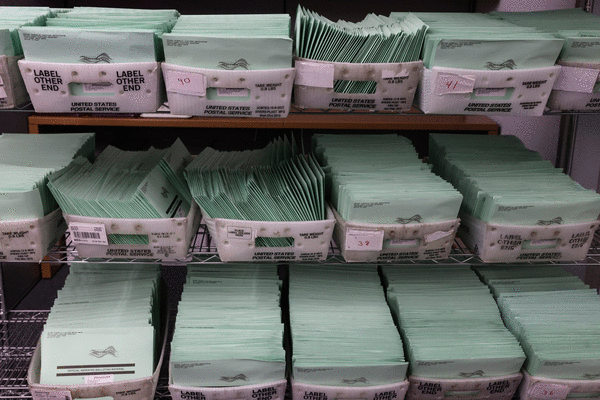
WASHINGTON — President Donald Trump’s effort to curtail mail voting through executive order will likely be ruled illegal in at least one of several lawsuits filed this week, experts said, the latest in the president’s long-running effort to assert federal control of elections.
Democratic party groups and civil rights organizations have already filed three lawsuits over the executive order that Trump issued Tuesday entitled “Ensuring Citizenship Verification and Integrity in Federal Elections.”
The order dovetails with Trump’s broader year-long effort to assert more federal control over elections ahead of the midterms. It would enact changes to voting nationwide to follow what the president called the “unavoidable duty” to enforce federal law.
That would include sending each state lists of “individuals confirmed to be United States citizens” who are eligible to vote in elections and mandating the U.S. Postal Service only carry election mail for approved voters.
Justin Levitt, a law professor at Loyola Marymount University who focuses on election law, said the order’s “primary directive to tell the Postal Service not to deliver mail unless they’re on his ‘naughty and nice’ list is flatly illegal, and I expect it will take a court about 30 seconds to say so.”
“I don’t think that’s actually a hard call here. The thing that you should picture is the president deciding which Christmas cards the Postal Service should deliver. That seems plainly, obviously beyond his authority,” Levitt said.
Levitt said the executive order runs into a fundamental problem: the Constitution gives states the primary role in running elections, with the possibility for Congress to weigh in on the rules. Levitt said Congress has not given Trump the power he claimed in the executive order.
“Congress has not given the president a role of any significance in the electoral process. There are plenty of people whose job it is to oversee the election process, and the president’s not on that list. And again, that’s not an oversight, that’s by design,” Levitt said.
Tuesday’s executive order asserted a broad power to oversee federal elections. The order said the government would use Social Security Administration records and the Department of Homeland Security’s Systematic Alien Verification for Entitlements system to verify citizenship for every potential voter in the country.
Additionally, the order directed the U.S. Postal Service to put new restrictions on mail ballots, seeking to prevent widespread use of mail balloting. States that do not comply would lose federal funding, according to the order.
Ruth Greenwood, an assistant professor of law and director of the Election Law Clinic at Harvard Law School, said there are numerous other problems with the executive order that would make it difficult or illegal to implement. The United States does not have a national voter list, Greenwood said, or the infrastructure to make one.
“We just don’t have a national list of voters, and so there’s no way to provide something like that to the U.S. Postal Service. And so then that runs into being unconstitutional in terms of a burden on the fundamental right to vote,” Greenwood said.
The kind of systems contemplated by the executive order would take years to create, Greenwood said. Creating a voter list from scratch and allowing USPS to decide whether to deliver individual pieces of election mail would likely violate Americans’ right to vote, she said.
“They have a right to vote and making them jump through seven literal hoops is not part of it,” Greenwood said.
Richard Briffault, a law professor at Columbia Law School, said there were still more problems with the order, including the fact that Congress has even less authority over state elections, and ballots for state elections are also carried by USPS.
The three lawsuits had been filed as of Thursday afternoon — one from national Democratic party and campaign groups in Washington D.C.; a second from the ACLU, League of Women Voters and other civil rights groups in Massachusetts; and a third from the League of United Latin American Citizens and other groups in Washington, D.C.
All argue the president violated the Constitution and federal law with the order and contend Trump overstepped constitutional bounds by asserting power over state elections.
“The Order is an attack on the constitutionally mandated checks and balances that keep American elections free and fair,” the LULAC complaint said.
Further, the lawsuits argued that Trump sidestepped the normal federal structure to try and force USPS to adopt his preferred election structure.
“The Constitution does not grant the President power to regulate federal elections or USPS, and Congress has not delegated any such authority to him. To the contrary, Congress enacted a detailed statutory framework governing both federal elections and the operations of USPS — and nowhere authorized the President to issue anything like the directives set forth in the Executive Order,” the ACLU complaint said.
Trump has railed against mail-in voting for years, including through evidence-free accusations of fraud in the 2020 election.
He also pushed allies in Congress to limit mail-in ballots in most circumstances through provisions of his proposed SAVE America Act voter identification bill.
The substitute amendment currently used for Senate debate on the measure, an amendment from Sen. Eric Schmitt, R-Mo., to an unrelated bill, would ban states from using universal mail voting and restrict situations where voters can use absentee ballots.
The push against mail voting has garnered some resistance from within the president’s party. Sen. Lisa Murkowski, R-Alaska, cited mail voting restrictions as one of her major reasons for opposing the current bill.
Separately, the Supreme Court is considering a challenge to a Mississippi law that allows state officials to count ballots that arrive after Election Day, in a case that could impact the more than two dozen states with similar laws.
Trump’s previous efforts to increase control over federal elections have met with substantial resistance in federal courts.
The administration has filed lawsuits against more than two dozen states seeking detailed voter roll information since last year, which states have largely resisted, arguing the Justice Department does not need the information under federal law.
Additionally, Trump’s prior effort to force changes in state voting rules on registrations and counting deadlines has been blocked by the courts.
Levitt, who has filed amicus briefs in some of the state voter roll cases, said Trump has sought to spread lies about voting for more than a decade since his first campaign for president.
“He’s remarkably consistent, and I think he’d rather have the pro wrestling foil of the courts than actually govern,” Levitt said.
©2026 CQ-Roll Call, Inc., All Rights Reserved. Visit cqrollcall.com. Distributed by Tribune Content Agency, LLC.





Comments