Federal judges weigh push to reinstate order shutting down Alligator Alcatraz
Published in News & Features
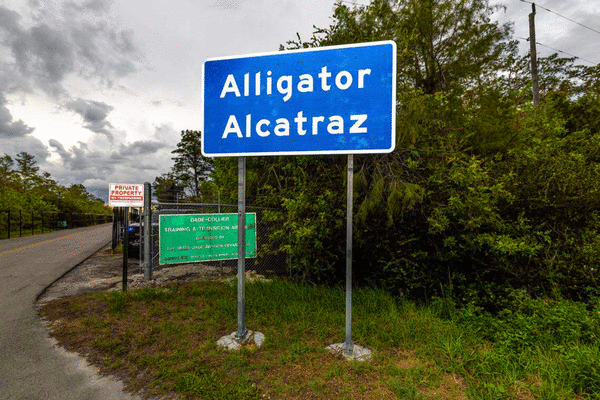
The question of who is in charge of operations at the controversial Everglades detention site known as Alligator Alcatraz continued to loom large Tuesday in Miami federal court as appellate judges weighed whether to overturn a lower court’s decision last summer that required the site be briefly shut down.
The three-judge panel of the Eleventh Circuit Court of Appeals questioned environmental groups and government lawyers about the extent of federal involvement and control over the facility, where contractors overseen by the Florida Division of Emergency Management hold immigrant detainees for the U.S. Department of Homeland Security.
The judges zoomed in on the level of federal involvement needed to trigger a federal law that would subject the complex of tents and trailers, built on an airstrip in the Big Cypress National Preserve, to an environmental review.
“As I understand it, this is state property. It’s owned by the state, controlled by the state. They built the facility. If they tomorrow want to use it for hurricane relief, they could decide to do so,” said Chief Justice William H. Pryor.
The lawyers for the state and federal governments argue that an August preliminary injunction issued by District Judge Kathleen Williams effectively requiring the site to be shut down was an overreach because it subjected Florida to federal laws that did not apply. The state, they say, cannot be subject to the National Environmental Policy Act.
State lawyers said the Dade-Collier Training and Transition Airport, where the detention center was built last year in a matter of days, is subject to state rules and can be used for whatever the state considers necessary. Even if the state hypothetically did secure federal funding, that did not mean the facility’s hasty construction violated federal environmental law.
“Even with funding under the major federal action definition, I don’t think that would qualify, because they haven’t shown federal control,” said Jesse Panucci, the lawyer for the state. “This is still a state facility under state control.”
The lawyer for the federal government said there had been no “formal commitment to fund this project” when part of the airstrip was transformed into a tent city. They repeated previous statements that any funding would not be for construction but for per diem expenses for housing detainees.
Lawyers for the conservation groups and the Miccosukee Tribe faced tough questions from the panel about whether the lower court’s preliminary injunction — which they hope the appellate court will reinstate — conflicts with the Secretary of Homeland Security’s duties regarding immigration enforcement.
Judge Pryor said the federal laws that govern immigration detention restrict federal courts from interfering “when the Secretary has decided on the place to detain immigrants,” especially in actions like environmental review as required by NEPA.
“What this injunction is doing is restraining the operation of that which the Supreme Court says, regardless of the claim, doesn’t matter,” Pryor said.
Lawyers for the environmental groups argued that the detention site is operated under an agreement with the federal government, and detainees are considered subjects of the federal government, not the state. They said that should make the facility’s construction subject to federal law.
Pryor, who was appointed to the bench in 2004 by President George W. Bush, pushed back, saying that the state controls the site and could use it for multiple purposes, including immigration or hurricane relief.
“They have the control. They can use it as an immigration facility. They can use it for helicopter training. They could relinquish it to the county. They control it,” Pryor responded.
Paul Schwiep, the lawyer for Friends of the Everglades and the Center for Biological Diversity, countered that Florida could change its mind on the project, but the facility was propped up to serve a federal function on immigration.
“This facility would not exist but for immigration enforcement. The federal government has outsourced immigration detention to the state of Florida,” Schwiep told the panel.
Judge Nancy Abudu, a Joe Biden appointee on the panel, asked whether the application of the law differed when the standard applied to the detainees held at the facility under federal authority versus the construction of the site, which was a state prerogative.
Judge Abudu hinted at the detainees themselves as a sign of federal control within the facility, implying they would be subject to federal law. She agreed with her colleagues on the bench that the state could always change its mind in holding them.
“Once a state decides it’s going to do something that triggers federal law, it can always decide it doesn’t want to do that, but once it does decide to do that, it has to comply with federal law,” Abudu said. “I’m not hearing anything from either side that says that that is not the case.”
There is no timeline for when the appellate judges will rule.
©2026 Miami Herald. Visit at miamiherald.com. Distributed by Tribune Content Agency, LLC.






Comments