Chicago school board approves resolution against federal tax-credit scholarship program
Published in News & Features
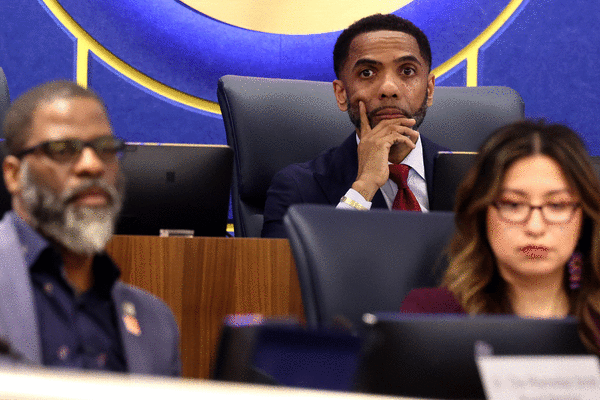
CHICAGO — The Chicago Board of Education approved a resolution Wednesday calling on Gov. JB Pritzker to reject the Trump administration’s federal tax-credit scholarship program and oppose diverting public funds to private education.
Pritzker has yet to decide whether to opt into the program, which has stirred fierce opposition from public school advocates and the Chicago Teachers Union.
“Public dollars are for public schools. Point blank, period,” said appointed board member Karen Zaccor, who represents District 4A on the North Side. “We are the stewards of those public dollars. Money pays for what we give our students — so this is about the students.”
But in a contentious debate prior to the vote, some elected board members questioned whether a resolution was the most effective avenue for advocacy.
“It’s a politically-motivated resolution, and politics don’t belong in a boardroom,” said Ellen Rosenfeld, District 4B. “Let’s go build relationships. Let’s go talk to the governor and ask him to oppose it.”
Others pushed back. “If you don’t want to do politics, then you shouldn’t be on the school board because everything here is political,” said board member Jitu Brown, who represents District 5A on the West Side.
Under the program — part of the sweeping One Big Beautiful Bill Act — donors can receive a dollar-for-dollar tax credit for up to $1,700 for contributions to scholarship-granting nonprofits. Those groups can then use the money to provide scholarships for private school tuition and other education-related expenses, including homeschooling costs.
Republicans and religious conservatives have long championed voucher-style programs, arguing that they expand parental choice and give low-income students access to a better or more specialized education outside of their neighborhood school.
In theory, some Chicago Public School students could also receive scholarship funding for resources such as tutoring or after-school activities. But federal officials have yet to clarify whether that money must first flow through outside organizations or whether public districts can access it themselves.
Elected board member Therese Boyle, who abstained on the vote, said those outstanding questions are why she is hesitant to make a collective board statement. She suggested the issue could be instead added to the board’s legislative agenda, which outlines the district’s advocacy priorities ahead of each state legislative session.
“I’m still learning about it, and it’s very complex, which is probably why Pritzker hasn’t made a decision yet, I’m guessing,” said Boyle, who represents District 9B on the Southwest Side. “I feel like I don’t know all the ins and outs.”
Before the vote, Rosenfeld motioned to postpone the resolution indefinitely. The motion failed, with seven votes in favor — all from elected members — and 11 votes against from members backed by CTU, allowing the resolution to proceed.
In the final vote, three elected members abstained: Rosenfeld, Boyle and Che “Rhymefest” Smith. A spokesperson for Pritzker did not immediately respond to a request for comment.
Donors can claim the tax credits beginning in January 2027. In participating states, students whose family income does not exceed 300% of their area’s median income are eligible for scholarships, amounting to $252,000 in Cook County.
Experts told the Tribune that it is slightly unusual for a local school board to make a collective statement on a federal policy. But they also noted that the program could impact the district’s funding streams, and that there are few levers for a school board to make its voice heard.
“Generally a good governance practice on a school board is institutional neutrality,” said Michael Ford, a professor of public administration at the University of Wisconsin at Oshkosh. “But Chicago is a bit of an outlier when it comes to politics, given the size and complexity of both the board and the district.”
The majority of Chicago’s hybrid school board was either elected with the support of CTU or appointed by Mayor Brandon Johnson, a former CTU organizer. The union is staunchly opposed to the tax-credit program.
“We need to create more revenue opportunities to advocate together, collectively … not poke holes that are even bigger in our budget than currently exists,” CTU Vice President Jackson Potter said prior to Wednesday’s vote.
An earlier draft of the One Big Beautiful Act mandated state participation, but that requirement was later dropped. So far, more than half of governors have indicated their intent to participate, mostly in Republican states. Several Democratic governors who previously opposed the program have said they are reconsidering.
Pritzker appears to be taking a more cautious, wait-and-see approach. But in February, he sent a lengthy message to Comptroller Susana Mendoza warning that the scholarships could go to private schools that “teach values that are racist or antisemitic or Anti-American.”
Mendoza, a fellow Democrat, had penned an opinion piece in the Tribune expressing support for the program.
Even Illinois residents who oppose Trump “must recognize that Illinois benefits from recapturing federal tax incentives,” Mendoza wrote back to Pritzker. “Opting out means our Illinois children lose.”
At a press conference last week, Pritzker again appeared to express skepticism with the program, referencing the ongoing debate over whether it could also fund resources for public school students.
“We really don’t know what the rules are going to be, and whether public school students truly could benefit from it, or if that’s just an afterthought,” Pritzker said.
Illinois previously ran a similar initiative, Invest in Kids, which gave a 75% income tax credit for donations of up to $1 million made to support private school scholarships. State legislators sunsetted the program in 2023.
_____
Tribune reporters Jeremy Gorner and Olivia Olander contributed.
_____
©2026 Chicago Tribune. Visit chicagotribune.com. Distributed by Tribune Content Agency, LLC.





Comments