US, Iran prepare for talks with Lebanon conflict unresolved
Published in News & Features
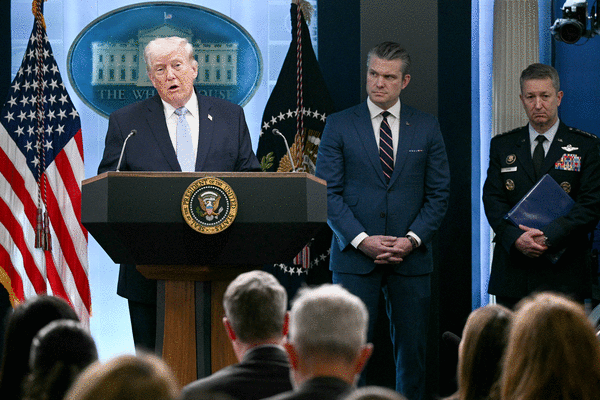
The United States and Iran prepared for peace talks in Pakistan with a fragile ceasefire largely holding, though issues such as Israel’s offensive in Lebanon and the opening of the Strait of Hormuz remain unresolved.
U.S. Vice President JD Vance is expected to lead the American delegation in discussions scheduled for Islamabad on Saturday, while Iranian officials were due to arrive in the Pakistani capital on Thursday. Both sides appear to have paused strikes across the region after President Donald Trump’s announcement of a truce after nearly six weeks of fighting.
The exception is in Lebanon, where Israel’s ongoing campaign against Tehran-aligned Hezbollah risks undermining the negotiations. Israel’s military on Thursday told residents in eight Beirut neighborhoods to leave ahead of strikes, after a major operation that killed more than 200 people the previous day.
Israeli Prime Minister Benjamin Netanyahu said he agreed to hold direct talks with Lebanon about the conflict, with the focus on disarming Hezbollah. Trump called the Israeli leader on Wednesday and asked him to scale back strikes to ensure the success of negotiations with Iran, NBC reported, citing an unidentified senior administration official.
Iranian President Masoud Pezeshkian said Israel’s strikes in Lebanon are a “clear violation” of the ceasefire and “will render negotiations meaningless.”
Meanwhile, the Strait of Hormuz remains effectively shut as shipowners await clarification on the status of the key waterway. Iran’s Ports and Maritime Organization published two safe routes for shipping, according to state media, though traffic remains a fraction of pre-war levels.
Trump vowed to keep troops in the Persian Gulf ahead of the talks in Pakistan, “until such time as the REAL AGREEMENT reached is fully complied with.” He added that the Strait of Hormuz would soon be open and safe to use.
Iran effectively shut down Hormuz, where roughly a fifth of the world’s oil and liquefied natural gas typically flows, after the U.S. and Israel began airstrikes on Feb. 28. Control over the waterway — and safe passage for tankers — will be a major focus of talks as fears linger of a global energy supply crisis.
Markets reflected the lingering uncertainty, with oil prices rebounding after Wednesday’s steep declines and stocks falling. Brent crude traded about 2% higher at $97 a barrel at 4:53 p.m. in London on Thursday.
While sporadic airstrikes were reported in Iran and across the Middle East in the early hours of the ceasefire, there were no reports on Thursday. That narrowed the international focus on Lebanon, where Israel revived its campaign against Hezbollah after the militant group started firing rockets across the Israel-Lebanon border at the start of the war.
The two sides previously engaged in a full-blown conflict for about two months in 2024, before a tentative ceasefire in November of that year. The Lebanese government has pledged to disarm Hezbollah, but hasn’t succeeded and the group refuses to do so.
Vance said Israel had agreed to “check themselves a little bit in Lebanon” to support negotiations. Hezbollah said it fired rockets toward Israel in response to Wednesday’s assault.
European Union Foreign Affairs Chief Kaja Kallas said Israel’s right to defend itself doesn’t justify “inflicting such massive destruction in Lebanon,” warning that the offensive is hurting peace talks.
U.K. Foreign Secretary Yvette Cooper is also pushing for Lebanon to be included in the truce accord, while China said Lebanese “sovereignty and security should not be violated.”
The war in the Middle East has claimed more than 5,500 lives, according to governments and non-governmental agencies. More than 3,600 people have been killed in Iran, the U.S.-based Human Rights Activists News Agency estimates, while more than 1,700 people have died in Lebanon, the government says.
Israel said it’s killed more than 1,400 Hezbollah militants, including 200 on Wednesday.
Israel has reported about three dozen deaths, and a similar number have been killed across the Gulf Arab nations, government reports show. There have also been several dozen casualties in Iraq. Thirteen American troops have been killed, according to U.S. Central Command.
Iran’s safe routes in Hormuz were established to avoid the potential presence of mines in the primary traffic lanes and all ships are asked to coordinate with the Islamic Revolutionary Guard Corps until further notice, state-run Nour News reported.
More than 800 freighters are stuck inside the Persian Gulf, mostly waiting to leave, and owners and insurer groups have warned that more details will be needed to determine if safe transit is possible.
Just three ships were observed leaving the region on Wednesday, ship-tracking data compiled by Bloomberg shows. In normal times, about 135 vessels cross daily.
Trump’s ceasefire announcement Tuesday night marked a retreat from threats to unleash massive devastation on Iran, easing fears of a protracted global energy crisis. Oil prices plunged more than 17% on news of the agreement, the biggest one-day drop since 2020.
Trump made conflicting claims about the deal, including suggesting a joint U.S.-Iran toll system for ships in Hormuz. His press secretary, Karoline Leavitt, said that proposal hadn’t been accepted.
Trump also said Iran had undergone a “regime change,” even though there have been no signs this week that new leadership had taken hold. He indicated the U.S. would use its 15-point plan as the basis of negotiations with Tehran, while remaining open to sanctions relief.
Iran’s demands include its continued control of Hormuz, acceptance of its nuclear-enrichment activities, the lifting of all primary and secondary sanctions, and a withdrawal of U.S. combat forces from the region, according to a statement by its Supreme National Security Council carried by state media.
Trump reiterated there would be no uranium enrichment, while Israeli Prime Minister Benjamin Netanyahu said highly enriched uranium would be removed from Iran, one way or another.
The United Arab Emirates called for a “sustained approach” to address Iran’s full range of threats, including its nuclear capabilities and ballistic missiles.
©2026 Bloomberg L.P. Visit bloomberg.com. Distributed by Tribune Content Agency, LLC.






Comments