Easter again? Orthodox Christians are celebrating the holiday this week
Published in News & Features
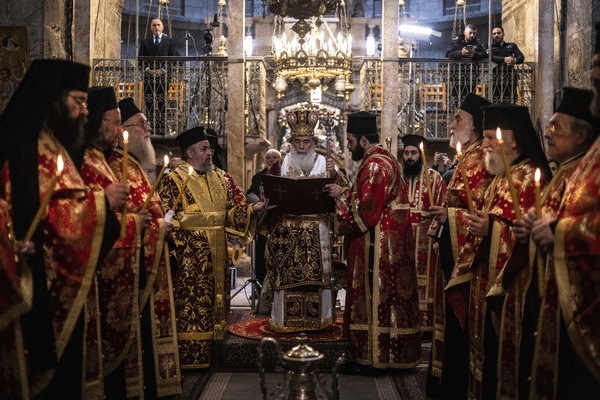
Nearly 90% of the world’s Christians celebrated the most important holiday in their faith last Sunday, but for those in the Eastern Orthodox tradition — including about 20,000 in the Baltimore area — Easter, or Pascha, takes place this weekend. Fr. Louis Nopros is used to the theological quirk.
Nopros, 69, is the head priest at St. Demetrios Greek Orthodox Church in Parkville, one of four Greek Orthodox churches (and 16 Eastern Orthodox churches of any description) in the area. Now in his 30th year at St. Demetrios, he still enjoys the denomination’s elaborately solemn, ultimately joyous way of marking the occasion, which rarely coincides with Western Christianity’s Easter.
In a conversation with The Sun, Nopros explained how church fathers split from Catholicism over doctrinal matters in the 11th Century; how Russian, Ukrainian, Syrian and other cultural traditions intertwined with Orthodox liturgical practices, and how the Greek Orthodox church took root in Baltimore amid a wave of immigration from Greece in the early 20th Century.
Mostly, he focused on the Orthodox Easter season, a seven-week stretch that begins with Lent and ends in a night of feasting and partying. The interview was edited for length and clarity.
Most Christians celebrated Easter last Sunday. Why are the Orthodox celebrating it this weekend?
One reason has to do with our differing calendars. Easter (in both traditions) is the first Sunday after the first full moon after the Spring Equinox. Western Christianity uses the Gregorian calendar and sets March 21 as the Spring Equinox. We use the (older, less widely used) Julian calendar, and our equivalent of (their March 21) falls on April 3 on the Gregorian calendar. So Orthodox Easter usually happens later — sometimes weeks later.
Easter is important to all Christians, but Orthodox Christians seem to celebrate the season with a special intensity. Why?
It’s the journey of our lord and savior (and) his passion all the way through Holy Week. We recount each stage of it. It’s a walk with Christ through his (suffering) until his crucifixion and resurrection. That’s the intent of these services. And we do it every year.
How does it start?
We fast for 40 days even before Holy Week. We avoid all meats and poultry. Some elderly people, and monks in monasteries, go as far as fasting from dairy products.
Holy Week starts on Palm Sunday … That night, and Monday and Tuesday nights, we do gospel readings that tell what happened in the days before he was crucified.
On Wednesday, we have the healing service of Holy Unction. Those who have been chrismated or baptized in the Orthodox church are anointed with holy oil. That takes a couple of seconds! I have to have two services to handle everyone who comes.
Some of the more spectacular events happen after that. What are some highlights?
On Thursday (evening), we have the Service of the 12 Gospels. Passages from all four gospels are read. We pause at the sixth, and I take the cross — a big 8-foot crucifix, with (an icon of) Jesus on it, and a crown of thorns, and parade it around the church. I put it in the middle of the solea (a marble area in front of the altar), and people come forward, bow down, light a candle, and kiss the feet. That’s when he was crucified…
On Friday, in the middle of an (evening) service, we’ll take (the icon of Jesus in a decorated symbolic tomb) and process outside. Everyone goes all around the church, holding candles. We stop at four stations, do some petitions, bring that icon of Jesus back in, and put it on top of the altar until Pentecost.
At midnight (on Holy Saturday), that’s the apex of the whole week. The church holds about 450 people, but we’ll have about 600 or 700 there. We’ll process outside, where there’s a little stage set up for two priests. That’s where we sing the hymn “Christ Has Risen From the Dead,” showing his victory to all his people. That’s the end of Holy Week.
And then there’s the feasting on lamb and other foods that many have heard about.
The mood is very happy, especially for those who have fasted for almost 50 days! The feasting represents joy and happiness, essentially because before he was resurrected, our lord went down to Hades, trampled down the doors, brought up Adam and Eve, and cleansed us from original sin. We’re not in darkness anymore!
The Greek Orthodox Church saw a roughly 22% attendance decline between 2010 and 2020 in the U.S., according to one survey, but it has strong roots in Baltimore. How’s it doing at St. Demetrios?
When I came here (in 1996), we had about 250 families. Right now we’re at about 450. That’s not a very large growth, but it’s a steady growth. A lot of that has to do with the reception of converts into our faith. I’d guess that about 30% of the people in church on Sundays are converts.
The majority of funerals in recent years have been for Greek immigrants from the 1940s through the 1960s. Immigration from Greece has not stopped, but we’re not seeing hundreds and hundreds coming in every month. The lifestyle in Greece has changed; people don’t want to work as hard as the earlier immigrants did.
Where do you see Eastern Orthodoxy going in the next few decades?
The church has been around for 2,000 years. I’m sure we’re not the worst thing that ever happened to the church! I think it’s going to survive despite us human beings, both clergy and laity. Jesus won’t let that happen!
_____
©2026 Baltimore Sun. Visit baltimoresun.com. Distributed by Tribune Content Agency, LLC.





Comments