Mayor Mamdani's first 100 days: Big plans, relationship building and incremental action
Published in News & Features
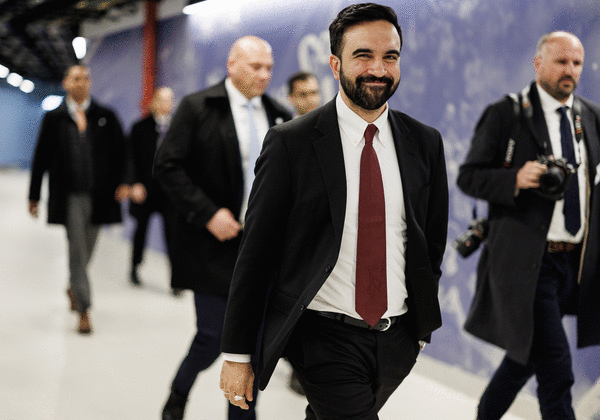
NEW YORK — New York City Mayor Zohran Mamdani came into office on New Year’s Day with big plans, lots of enthusiasm and the mammoth challenge of putting his lofty campaign promises into action.
One hundred days later, the mayor has made headway on some of those campaign pledges, but he’s backpedaled or moderated his stance on others.
Mamdani has also spent much of his effort directing New Yorkers’ attention to the nuts and bolts of city government, like filling potholes and enforcing workplace regulations, carting a jumbo calendar to his news conferences across the city to highlight his work in his first stretch of governance.
“Too often, we’ve seen New Yorkers regard City Hall as something that is, at best, uninterested in the struggles of their life, and we have sought to show an administration that is ambitious, that is unapologetic and that is relentless,” Mamdani said at a news conference on Thursday.
The 34-year-old democratic socialist has set clear, lofty priorities and promised a “new era” for the city — but those changes could be threatened by economic uncertainty, a fiscal crisis and the general grind of bureaucracy.
Although he’s still riding a wave of popularity, city dwellers can be fickle when it comes to mayors. Polls released this week found Mamdani’s approval rating at 42%, per a poll from Emerson College — lower than that of former mayors Eric Adams and Bill de Blasio at the same point in their tenures.
Here’s a look of some of the dynamics at play during Mamdani’s first 100 days.
—Relationship with Trump
What was anticipated to be perhaps one of the biggest challenges facing Mamdani after he was elected has, at least for now, been almost a nonfactor.
The night before the general election, the president took to Truth Social to declare that, if Mamdani were to become mayor, “this once great City has ZERO chance of success, or even survival!”
But the president’s threats dissipated after meeting the mayor at the White House in November, and the mayor has seemingly managed to stay in the good graces of Trump, who earlier this year praised Mamdani’s “really good personality” and “tremendous assets.” At a second Oval Office meeting in February, Mamdani appealed to Trump’s ego with a mock-up front page of The New York Daily News, as he pitched the president a plan to build a massive affordable housing project in Sunnyside, Queens.
“No one expected it,” Democratic strategist Trip Yang said. “Trump during the general election campaign threatened federal funding to New York City, called Mamdani a communist. And they ended up being the best of buds.”
—Budget wrangling in Albany and NYC
Mamdani has been sounding the alarm about a fiscal crisis and a $5.4 billion budget gap the city is struggling to fill. The mayor’s challenge lies in getting the city back on a stable financial footing and in funding the expensive programs he’s promised.
Much of the mayor’s ambitious agenda falls under the purview of the governor and state lawmakers, including his pledge for free buses and universal childcare. While lobbying Albany to send the city more cash in order to deliver on some of those priorities, Mamdani has maintained a friendly relationship with Gov. Kathy Hochul and other state lawmakers.
“The past several mayors have had a very contentious relationship with governors in the past and Albany, in general, and I think this mayor has been intelligent in cultivating a more positive one,” state Sen. Michael Gianaris told the Daily News, citing Mamdani’s “tactful lack of confrontation.”
Mamdani has stayed away from publicly bashing the governor, including by sitting out a recent “Tax the Rich” rally in the Bronx — although in February he floated the possibility of raising the city’s property tax rate if Hochul didn’t send more money the city’s way in order to fill the budget gap.
That proposal, in turn, set off a fight with City Council Speaker Julie Menin, who’s positioned herself as a moderate Democrat foil to the mayor. Menin called the property tax hike proposal “unacceptable” on Wednesday, a week after her team released a budget response detailing alternative paths to plugging the budget hole.
—Managing lefty priorities and moderating his stances
Mamdani, taking with him a slew of advocates-turned-government officials, has had the challenge of running a massive bureaucracy with a leftist mindset. In the process, he’s moderated some of his hard-left stances.
He’s wavered on his pledge to disband the New York Police Department’s Strategic Response Unit — though on Thursday, Mamdani said he’s “deeply committed” to taking the unit off protest responses — and stepped back from his promise to totally eliminate the gang database kept by the Police Department. Those positions put him at odds with his police commissioner, Jessica Tisch.
Mamdani’s also done an about-face on the city’s rental assistance program, CityFHEPs, angering progressive allies.
Gustavo Gordillo, co-chairperson of NYC-DSA, the local chapter of Democratic Socialists of America, applauded Mamdani for making a “lot of progress” on key campaign pledges, like universal childcare, and he noted the mayor also installed an Office of Community Safety, a step toward his promise of a city agency that would handle mental health emergency responses, as well as a slew of prevention programming.
“Overall, I feel good about his commitment to the movement,” Gordillo said in an interview. “I think that he knows that, in order to pass his agenda, he needs to build an agitational outside force or at least allow other people to do it or encourage it. He knows that he can’t win the affordability agenda by himself. …We’ve had challenges, but I wouldn’t say there are really major disappointments at this point.”
Bill Bratton, who served as NYPD commissioner under ex-Mayor de Blasio, said that if Mamdani indeed does move to “totally disband” the SRG or nix the gang database, “that would be a phenomenal stressor” to his relationship with the Police Department.
“It’s too soon to really make any judgment on him in the sense of public safety,” Bratton added. “Good news is he appointed Jessie (Tisch). Good news is they appear to be getting along fairly well. There’s been no public controversies.”
—Incremental progress on campaign promises
Mamdani’s other cornerstone pledges are still up in the air: Whether a rent freeze is enacted for rent-regulated tenants is in the hands of the city’s Rent Guidelines Board, of which Mamdani appointed a majority.
And the mayor told Politico this week that he is “absolutely committed to making buses fast and free” but acknowledged it wouldn’t happen this year.
Arguably, Mamdani’s most significant policy win in his first 100 days as mayor was a deal with Gov. Hochul to embark on a dramatic expansion of free child care, as he promised New York families on the campaign trail.
Just more than a week into his administration, Hochul gave Mamdani $73 million in state funding to launch this fall the first 2,000 seats in childcare for 2-year-olds, known as “2-K.” That investment was set to grow in the program’s second year to include 12,000 2-year-olds.
Despite that early victory, Mamdani still has a long way to go to realize the lofty goals for youngsters that drove parents to the polls last November: He’s yet to secure funds beyond the 2027-28 school year, despite his pledge to fully roll out the program by the end of his first term.
So far, Hochul, who is up for reelection this fall, has declined to raise taxes on the wealthy, to set up the type of revenue raiser that could be needed, if not to keep the program going, then to expand it to infants as young as six weeks old, as Mamdani promised as a candidate.
(Cayla Bamberger contributed to this report)
©2026 New York Daily News. Visit nydailynews.com. Distributed by Tribune Content Agency, LLC.




Comments