Sonic boom Saturday served up by SpaceX launch on NASA cargo mission
Published in News & Features
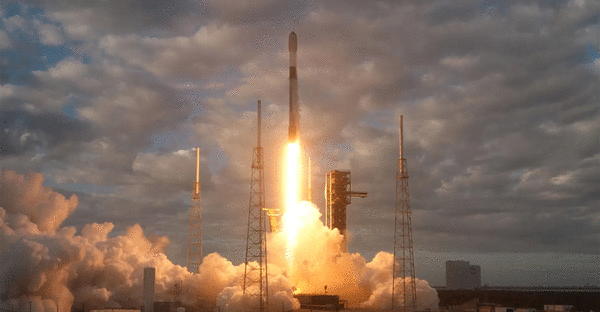
ORLANDO, Fla. — People in Central Florida who slept in Saturday morning may have received a sonic boom wake-up call.
SpaceX launched a Falcon 9 rocket from Cape Canaveral Space Force Station’s Space Launch Complex 40 on a resupply run to the International Space Station hitting liftoff at 7:41 a.m.
The first-stage booster for the flight didn’t land offshore, though, with SpaceX bringing it back to the recovery site adjacent the launch tower at SLC-40. The booster, made its seventh trip to space hit Landing Zone 40 about eight minutes after liftoff.
“There is the possibility that residents of Brevard, Orange, Osceola, Indian River, Seminole, Volusia, Polk, St. Lucie, and Okeechobee counties may hear one or more sonic booms during the landing, but what residents experience will depend on weather and other conditions,” SpaceX had posted in a media alert.
The launch was the 26th on the Space Coast this year with most coming from SpaceX. Others have included NASA’s Space Launch System rocket on the Artemis II mission on April 1, which landed safely Friday night off the coast of California, and both a United Launch Alliance Vulcan and Atlas V rocket. Blue Origin had been gearing up for its first launch of the year and third ever of its New Glenn rocket.
It had originally announced a target launch date of April 10, but has yet to update a new launch date amid a separate incident at its manufacturing site that caused some damage to a building. SpaceX, meanwhile, could launch its first Falcon Heavy rocket since the Europa Clipper mission of late 2024, before the end of the month, but has not nailed down a date yet. When it does, it could be the sixth orbital rocket handled by the Space Force from KSC and Cape Canaveral this year.
For this flight, SpaceX is continuing its role as replacement rocket for Northrop Grumman’s inactive Antares rockets that used to fly from Virginia. While that company works with a new version with Firefly Aerospace, SpaceX has since 2024 been the launch service provider to send up Northrop Grumman’s Cygnus cargo spacecraft to the space station.
The NG-24 resupply mission is using the Cygnus XL spacecraft, which will be grappled by the station’s Canadarm2 robotic arm. At the controls will be NASA astronaut Jack Hathaway who flew to the station as part of the SpaceX Crew-12 mission earlier this year. He will install it to the station’s Unity module’s Earth-facing port for cargo unloading.
The spacecraft will remain at the space station until October, after which it will be loaded with trash to be burned up in Earth’s atmosphere. This is the 24th Cygnus spacecraft built, but 23rd to launch after the NG-22 mission was canceled when its spacecraft was damaged during a shipping incident.
The spacecraft is named the S.S. Steven R. Nagel, who died in 2014. Nagel flew on four space shuttle flights between 1985-1993 logging more than 723 hours in space.
On board is about 11,000 pounds of science and supplies, the largest of the station’s resupply vehicles. It’s only the second Cygnus XL to fly after an initial trip to the station in 2025.
Among the research coming on board is a new module for the Cold Atom Lab, which is used to tackle experiments on general relativity, planetary composition and dark matter.
Also flying up are investigations on blood stem cell production in microgravity, how radio signals sent from Earth change coming through the upper atmosphere, and how spaceflight impacts gut microbiomes in live animals — in this case, roundworms.
Another compact exercise system called the the European Enhanced Exploration Exercise Device will be added to the regime on board as well. It was developed by the European Space Agency and NASA as the agencies seek to find effective, space-saving equipment to keep astronauts active and healthy on long-term missions.
“By enabling a broader and more adaptable range of resistance exercises, this device combines cycling, rowing, and resistance training in addition to the ability to perform rope-pulling and climbing movements, even when unpowered,” according to a NASA update.
©2026 Orlando Sentinel. Visit orlandosentinel.com. Distributed by Tribune Content Agency, LLC.






Comments