More than 16,000 immigrants in Illinois may lose food assistance in the coming months
Published in News & Features
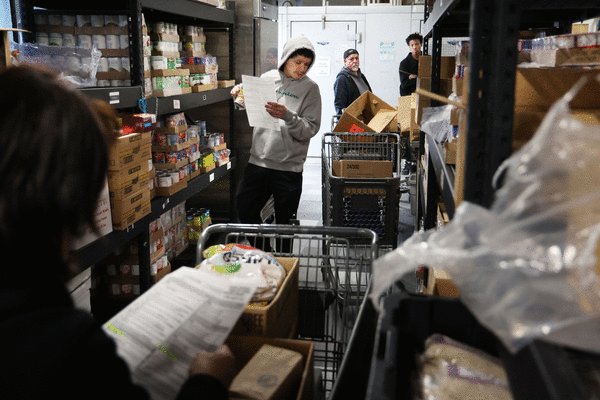
CHICAGO — Roughly 16,000 immigrants, including victims of domestic violence, may lose access to crucial food assistance in Illinois as a result of federal eligibility changes that took effect April 1.
Immigrants — including refugees, asylum-seekers and survivors of human trafficking — are no longer eligible for the Supplemental Nutrition Assistance Program, commonly known as SNAP. Thousands are expected to start losing benefits upon their semiannual redetermination.
The tighter restrictions on food and health assistance benefits are dictated by the “One Big Beautiful Bill,” the Trump administration’s economic policy package passed by Congress in July. As a result, thousands of immigrants relying on the benefits now face the risk of hunger and sickness, experts say.
“I mean, fundamentally, this means that people are gonna go hungry,” said Nolan Downey, senior director of policy at the Greater Chicago Food Depository, calling the recent budget bill’s changes to SNAP eligibility for immigrants a “dramatic departure from long-standing policy in this country.”
Immigrants who will remain eligible for SNAP are certain green-card holders, Cuban and Haitian entrants and those residing under the Compact of Free Association, among other categories of lawfully permanent residents. Immigrants without legal status have never received SNAP benefits.
For many immigrants who come to the U.S. lawfully, food assistance is crucial, experts say.
“These are folks who, when they get here, really are in need of some additional support because a lot of them don’t even have work authorization yet,” Downey said.
Asylum-seekers can typically apply for a work permit within 150 days after submitting their application.
Changes in work requirements for SNAP eligibility, including an 80-hours’ work per month minimum, are also expected to affect around 211,000 people in Illinois relying on food benefits, regardless of immigration status.
SNAP benefits work by loading around $200 a month on average onto an electronic benefits transfer card that people can use to purchase groceries at qualifying stores. Last year, a total of about 2 million people received SNAP assistance in Illinois.
That assistance is a lifeline for many and the new restrictions could leave people in dire straits.
“That could mean the difference between having food on the table — and then not, and going hungry,” said Nina Sedeño, senior immigration policy analyst at the Latino Policy Forum.
The Greater Chicago Food Depository expects to see a surge in food assistance requests beginning in May after people use up the last of their food benefits, Downey said. He said that food banks can provide some relief, but cannot replace SNAP.
“For every meal that we provide as a food bank, SNAP provides nine,” Downey said, citing data from Feeding America, the country’s largest hunger relief organization.
Some immigrants may be eligible for state-funded programs that provide food benefits such as the Victims of Trafficking, Torture, and Other Crimes program, but advocates believe the funds are insufficient and could run out soon.
On Thursday, Chicago Mayor Brandon Johnson’s office announced a mutual aid initiative supporting 67 community-based organizations with a $4,500 microgrant to expand food access and other services. The city grants are in partnership with the Greater Chicago Food Depository and aim to counter the Trump administration’s “devastating” cuts to food aid, according to the news release.
“At a time when families need more support, the federal government has abandoned its most basic responsibility by gutting the SNAP program, putting millions of people at risk — Chicago refuses to accept that,” Johnson said in the release.
The new nutrition restrictions come at a time when health coverage such as Medicaid and Affordable Care Act subsidies are also being stripped away from lawfully present immigrants.
“It’s a cascade of impacts on these same families, who are really going to be struggling as a result of a lot of these federal policy changes,” Downey said.
Medicaid is no longer expected to cover categories of lawfully present immigrants such as asylees, refugees and humanitarian parolees starting Oct. 1, 2026, affecting about 10,000 people in the state, according to the Illinois Department of Healthcare and Family Services.
Eligibility is also tightening in the health marketplace because of Trump’s budget bill. Noncitizens with incomes 100% at or below the federal poverty level and who are in a Medicaid five-year waiting period are no longer eligible for tax credits to help purchase marketplace health coverage more affordably, affecting more than 1,000 Illinois enrollees, according to Get Covered Illinois, the state health insurance marketplace.
The state of Illinois ended its health benefits for more than 30,000 adult immigrants in July. Gov. JB Pritzker’s office moved to strip the benefit, calling it a costly strain on the state budget.
“The impact is dire,” said Edith Avila Hesser, health justice and policy director at the Illinois Coalition for Immigrant and Refugee Rights about the loss of health benefits among certain immigrant populations. “We are talking about a population who has historically already experienced a significant amount of barriers to accessing health care.”
Immigrants who no longer qualify for health coverage are left with few options, including charitable clinics, federally qualified health centers or the emergency department, which can rack up significant out-of-pocket costs and increase ER wait times.
Hospital bills for uninsured patients can be around $10,000 to $30,000, said Irma Barrientos, program manager for healthy families and successful children at Mano a Mano Family Resource Center, which serves more than 15,000 community members in Lake and McHenry counties.
Uninsured patients can go to charitable clinics for health services but medications are paid out of pocket, Barrientos said.
“That’s unaffordable,” Barrientos said.
While patients with no coverage may be eligible for emergency Medicaid or hospital financial assistance to help cover costs, advocates warn that obtaining approval for it is not easy because of documentation requirements and difficulties navigating the application process.
Some are too afraid to go to the hospital at all for angst sown during Operation Midway Blitz, the federal mass deportation campaign that took place in Chicago last year.
“The fear tactics worked,” Barrientos said.
Holding off from screening and preventive care, some patients are only going to the emergency room when their illnesses become acute, which can be more costly and riskier for their health.
“We’re going to see a population that is increasingly getting sicker,” she said.
Immigrants are also seeing their federal housing assistance threatened.
A recent proposal from the U.S. Department of Housing and Urban Development seeks to limit public housing to citizens only, which advocates fear could lead to tens of thousands of people being evicted from their current residences.
The rule targets mixed-status households, in which some members are citizens and some are not, and prevents the entire household from receiving housing.
In Illinois, about 300 mixed-status households could be evicted, according to estimates from the nonpartisan Center on Budget and Policy Priorities.
“It puts families into an impossible housing decision, because then they have to choose between family separation or eviction that could potentially lead to homelessness,” said Anna Arzuaga, senior housing policy analyst at Latino Policy Forum.
The rule disproportionately affects Latino communities, advocates say, which represent 86% of people living in mixed-status families nationwide.
“This proposal is saying that if there is one person who is undocumented, everyone should be evicted,” said Lizette Carretero, director of financial wellness at The Resurrection Project, a Chicago nonprofit.
A HUD news release makes the motive — the truth of which is disputed — behind this rule clear: to remove undocumented immigrants from federal housing assistance. But experts say it’s already illegal to provide housing assistance.
“HUD’s proposed rule will guarantee that all residents in HUD-funded housing are eligible tenants. We have zero tolerance for pushing aside hardworking U.S. citizens while enabling others to exploit decades-old loopholes,” said HUD Secretary Scott Turner in a February news release.
Under current HUD guidance, mixed-status households receive partial subsidies based on how many members qualify for assistance. For example, if three out of four household members qualify for housing assistance, that household would receive 75% of the subsidy they would have gotten if all four members qualified.
The Center on Budget and Policy Priorities estimates that 79,600 people in the U.S. live in mixed-status households, 52,600 of whom are citizens.
“This proposed rule would make local housing agencies part of federal immigration enforcement efforts, and that’s not their job,” said Bob Palmer, the policy director for Housing Action Illinois.
In addition to penalizing mixed-status families, advocates say the rule has other problems. They worry it will place an undue burden on housing authorities that have to implement the rule and citizens who will have to provide documents, such as a passport, proving their status.
There are also concerns of potential data-sharing between HUD and the Department of Homeland Security at a time fraught with mass deportation campaigns, said Arzuaga.
“There is concern that there is data sharing that could put mixed-status families in a situation where they’re fearful that DHS enforcement may be involved,” Arzuaga said.
©2026 Chicago Tribune. Visit chicagotribune.com. Distributed by Tribune Content Agency, LLC.






Comments