Trump vows to blockade Hormuz after US-Iran peace talks fail
Published in News & Features
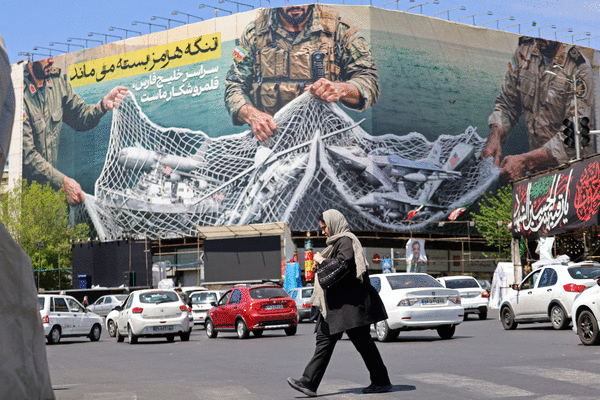
President Donald Trump said the U.S. will begin a full naval blockade of the strategic Strait of Hormuz and threatened to retaliate in the event of Iranian resistance, escalating a standoff that has already brought the waterway to a near standstill and disrupted global energy supplies.
The president’s announcement came hours after the U.S. and Iran failed to reach a deal in direct talks in Pakistan, jeopardizing hopes of turning a fragile ceasefire into a lasting end to a war that has claimed thousands of lives. The negotiations collapsed because of differences over the nuclear issue, Trump said in a Truth Social posting on Sunday.
The U.S. military said Sunday that it would begin the blockade at 10 a.m. New York time on Monday.
“The blockade will be enforced impartially against vessels of all nations entering or departing Iranian ports and coastal areas, including all Iranian ports on the Arabian Gulf and Gulf of Oman,” U.S. Central Command said in a statement.
The failure of the U.S. and Iran to reach a peace deal, along with Trump’s threats, leaves the ceasefire clinched last week in limbo. Trump said the U.S. will interdict any vessel that has paid a toll to Iran for safe passage through Hormuz and will clear mines in the strait, through which about a fifth of global oil and liquefied natural gas flowed before the war.
“Effective immediately, the United States Navy, the Finest in the World, will begin the process of BLOCKADING any and all Ships trying to enter, or leave, the Strait of Hormuz,” Trump said earlier Sunday. “Any Iranian who fires at us, or at peaceful vessels, will be BLOWN TO HELL!”
He added, without elaborating, that other countries would participate in the blockade. Such a move will likely have a greater impact on Iran, which has accounted for a large share of oil exports through the waterway since the start of the war.
Iran’s Islamic Revolutionary Guard Corps responded to Trump’s call for a blockade by saying that any military vessels attempting to approach the strait “under any pretext” would be considered a violation of the ceasefire, according to Iranian state TV.
A full blockade of the strait will add further pressure to global oil markets, particularly China, Iran’s main buyer, by choking off the remaining trickle of shipments that have continued to move through the waterway. Oil futures ended last week 30% above where they were before the war, while traders are paying record amounts north of $140 a barrel for some real-world cargoes as they scramble for supplies.
The Trump administration used a similar approach against Venezuela earlier this year — effectively enforcing a blockade against its sanctioned crude on the open seas before its January capture of Nicolas Maduro.
A blockade of the Hormuz strait is a less risky alternative to a military operation to seize Kharg Island, Iran’s critical oil export hub, said Dennis Ross, a former U.S. diplomat and Middle East envoy.
“Kharg Island for them is what they need to be able to hold. We can seize it, but then our forces would be quite vulnerable,” Ross said Sunday on Fox News. “This is a much smarter move than seizing Kharg Island.”
The lack of a deal will likely jolt markets and lift demand for safe haven assets on Monday, analysts said.
“Hope had been cautiously rising last week but this could set us back to levels that we were trading at prior to the ceasefire announcement,” said Nick Twidale, chief market analyst at AT Global Markets in Sydney. “I would think we will see oil open higher alongside the dollar.”
Vice President JD Vance, who led the American delegation in the peace talks in Pakistan, said Sunday before returning home that Iran declined to commit to not pursuing a nuclear weapon.
“We leave here with a very simple proposal, a method of understanding that is our final and best offer,” Vance said. “We’ll see if the Iranians accept it.”
The lack of a deal is “bad news for Iran much more than it is bad news for the U.S.,” Vance said. “We’ve made very clear what our red lines are, what things we’re willing to accommodate them on, and what things we’re not willing to accommodate them on.”
“And we’ve made that as clear as we possibly could, and they have chosen not to accept our terms,” he said.
A U.S. official, speaking on condition of anonymity on Sunday, said it was clear to the U.S. team that the Iranian delegation didn’t understand the U.S.’s main objective, which was to guarantee the Islamic Republic would never obtain a nuclear weapon. The official said the Iranians must recognize the military situation doesn’t reflect the demands they made in the talks.
The two sides reached an understanding on various issues but disagreements remained “on two or three key points,” Iran’s Foreign Ministry Spokesman Esmail Baghaei said.
“It was natural that one should not have expected to reach an agreement in a single session from the outset,” he said on state television after the talks. “Diplomacy never ends” and Iran will “continue to pursue national interests under all circumstances,” he added.
Pakistan called on both sides to maintain the ceasefire, saying it would continue to facilitate discussions between the U.S. and Iran in the coming days.
On Saturday, direct talks between the two sides started at 5:30 p.m. in the Pakistani capital. A team of technical experts had joined the meetings after the first hour, with discussions focused on the Strait of Hormuz, a potential ceasefire extension and phased sanctions relief, according to a US official and a Pakistani official familiar with the matter.
Trump, who has said that curbing Iran’s nuclear ambitions was a reason for the war, said on Sunday that Iranian leaders “want money and, more importantly, they want Nuclear.”
“So, there you have it, the meeting went well, most points were agreed to, but the only point that really mattered, NUCLEAR, was not,” Trump said on his social media. “Additionally and, at an appropriate moment, we are fully ‘LOCKED AND LOADED,’ and our Military will finish up the little that is left of Iran!”
Speaking separately to Fox News’ Sunday Morning Futures, Trump repeated his belief that the Iranians will eventually “give us everything we want” and that they’ll “come to the table” on the nuclear program. When asked if the U.S. will destroy Iran if the country does not give up its nuclear ambitions, he said: “yeah, I will if they don’t give that plan up.”
Parliament Speaker Mohammad-Bagher Ghalibaf, the head of the Iranian delegation, had been wary of the negotiations before they began, saying on his arrival in Islamabad that “we have goodwill, but we do not have trust.”
Iran has also insisted that a ceasefire in Lebanon should be a pre-condition for talks. The Israel Defense Forces over the weekend continued their attacks on Hezbollah in Lebanon, where it is fighting a parallel war against the Iran-aligned militant group. More than 200 strikes were carried out to attack Hezbollah’s infrastructure and provide air support for Israeli ground troops in southern Lebanon, the IDF said on Saturday.
Israel’s Prime Minister Benjamin Netanyahu, who was not a party to the Islamabad negotiations, said enriched nuclear material should be removed from Iran, with or without an agreement. Israel has accused Iran of pursuing nuclear weapons, an allegation that Tehran denies.
The war in the Middle East has claimed more than 5,600 lives, according to governments and non-governmental agencies. More than 3,600 people have been killed in Iran, the U.S.-based Human Rights Activists News Agency estimates, while more than 2,000 people have died in Lebanon, the government says.
Israel said it’s killed more than 1,400 Hezbollah militants, including 200 last Wednesday.
Israel has reported about three dozen deaths, and a similar number have been killed across Gulf Arab nations, government reports show. There have also been several dozen casualties in Iraq. Thirteen American troops have been killed, according to U.S. Central Command.
____
(With assistance from Jennifer A. Dlouhy, Alex Longley and Courtney Subramanian.)
©2026 Bloomberg L.P. Visit bloomberg.com. Distributed by Tribune Content Agency, LLC.




Comments