More ICE detainees are being taken to San Diego County hospitals, data show
Published in News & Features



SAN DIEGO — Local hospitals are treating significantly more U.S. Immigration and Customs Enforcement detainees under the Trump administration, federal data show.
At least 59 ICE detainees received care at San Diego County hospitals from January to mid-October of last year, up from 29 during the entire prior year, according to ICE agency data obtained by the Deportation Data Project via a public record request and analyzed by The San Diego Union-Tribune.
Nationwide, hospital ICE detentions rose from about 1,300 in 2024 to 1,900 from January to mid-October of 2025, the data show. ICE has since stopped releasing data detailing detentions at hospitals in response to the project’s record requests, so such data is not available after October.
In most cases, an ICE hospital detention means somebody who was already in ICE custody was taken to the hospital in need of medical care, hospitals say. In a few cases, a detainee in local law enforcement custody may be transferred to ICE custody while they are already at the hospital.
Officials say ICE does not arrest people at hospitals, but some local hospitals have policies anyway to minimize front-line workers’ interaction with federal agents. Policies instruct them to share no patient information with agents and block them from accessing non-public areas of the hospital unless they have a judicial warrant.
Hospitalizations of ICE detainees have risen as ICE arrests have skyrocketed under the Trump administration. In the San Diego region, last year’s ICE arrests rose by more than 1,300% from 2024.
A Department of Homeland Security spokesperson said the agency does not arrest anyone at hospitals, but it takes detainees to hospitals for medical care.
“ICE does not conduct enforcement at hospitals — period,” the spokesperson said in an email. “We would only go into a hospital if there were an active danger to public safety.”
The spokesperson added: “Of course, if we have a detainee we need to take to the hospital for medical care, we have officers accompany them for their monitoring, safety of the staff, and the public. This is standard procedure for all law enforcement agencies.”
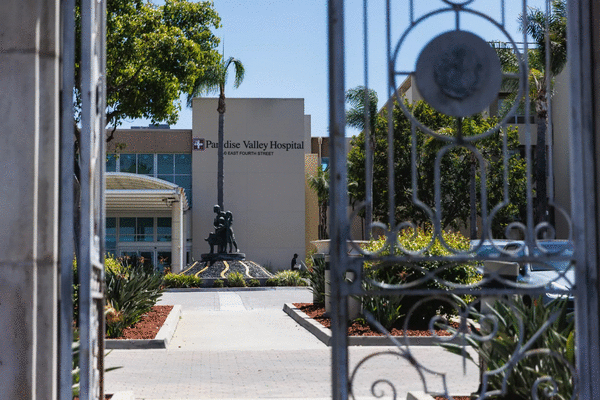
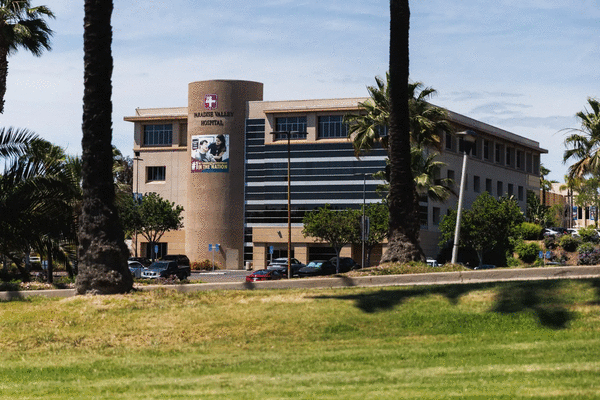
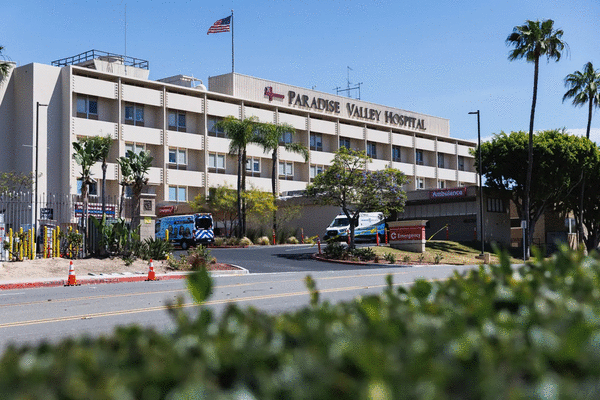
Paradise Valley Hospital in National City has seen the most ICE detainees in San Diego County, with 34 from January to October 2025, according to the data. Sharp Chula Vista Medical Center had 11, while Alvarado Parkway Institute in La Mesa had 10 and UC San Diego Medical Center had four.
“We comply with all applicable patient privacy laws, including Senate Bill 81, which prohibits health care facilities from granting immigration enforcement access to patients or nonpublic areas without a valid judicial warrant or court order and requires patient immigration status to be treated as protected information,” Sharp said in a written statement.
Like Sharp, Paradise Valley said in a written statement that it does “not allow ICE on our property without a judicial warrant.”
ICE agents do accompany detainees when they receive care, but must “remain with their patients and are not allowed to walk around our hospital facility,” said Paradise Valley media representative Ben Macapugay in an email.
Given San Diego’s proximity to the border, local hospitals have regularly received federal immigration detainees, most often transported by agents of the U.S. Customs and Border Patrol, for decades.
The matter reached an inflection point after the first Trump administration increased the height of the section of the border wall in San Diego County, which was completed in late 2019. With the number of traumatic injuries attributed to falls increasing rapidly, the number of Border Patrol transports to hospital intensive care units reached new highs.
With changes in border policy at the start of the second Trump administration, however, the number of falls has decreased.
Instead, anti-ICE activists are concerned that poor conditions at detention centers could be contributing to hospitalizations.
“Conditions are so deplorable and don’t have adequate resources to help people that are in need of medical attention, and so we’ve seen people be transported (to hospitals) to get them access to health care,” said Benjamin Prado, program coordinator for the U.S.-Mexico Border Program of the American Friends Service Committee, who helps conduct local ICE patrols.
ICE detainees have complained of poor-quality food, lack of medical attention and other health issues as several detention centers have exceeded their contractual capacity under President Donald Trump. Meanwhile 33 people died in ICE custody last year, as reported by the federal agency.
Last month, San Diego County sued federal agencies and private prison operator CoreCivic, which runs ICE’s Otay Mesa Detention Center, to conduct a full health inspection of the facility after county officials said ICE denied them the opportunity. More recently, San Diego congressional Reps. Sara Jacobs and Mike Levin went on a pre-planned oversight visit of the center. Levin reported the center’s clinic has 13 health care staff, including two doctors, for a facility that has housed more than 1,500 detainees at once under Trump.
A spokesperson for CoreCivic said its detention centers have on-site medical clinics staffed with licensed providers and all detainees have daily access to sign-ups for medical care. Spokesperson Brian Todd said Otay Mesa was recently reaccredited by the National Commission on Correctional Health Care for meeting the commission’s care standards, and CoreCivic’s detention centers undergo regular reviews and audits.
“The health and well-being of the individuals entrusted to our care is our top priority. We take seriously our responsibility to adhere to all applicable federal detention standards in our ICE-contracted facilities, including (Otay Mesa Detention Center),” Todd said in an email.
The Trump administration’s stated determination to ramp up immigration enforcement in American cities prompted local hospitals to proactively issue guidance to their staffs in early 2025.
UC San Diego Health, which cared for four ICE detainees in 2025 and two the year prior, according to the deportation database, emphasized in a written statement that its policies have remained largely the same since early 2025.
A policy memo, obtained by the Union-Tribune in early 2025, instructs the health system’s risk management department to take the lead on interactions with all federal agents, instructing mainline workers to “neither confirm nor deny the presence of a patient to an agent.” The university confirmed Thursday that these instructions have not changed.
“UC San Diego Health, like other hospitals in our binational region, has long-standing relationships with a variety of law enforcement groups, including Border Patrol, as the agency transports immigrant patients in need of immediate medical and surgical care to area hospitals,” UCSD’s statement said. “We value our partnership and medical teams who strive to ensure that anyone who receives care in our facilities does so in a safe and respectful environment.”
Alvarado Parkway Institute, a private mental health care provider with hospitals in La Mesa, El Cajon and San Diego, is listed as providing care to 10 ICE detainees in 2025 and one in the year prior.
Patrick Ziemer, the institute’s chief executive officer, said in an email that like the others who have received ICE patients, privacy protection is an absolute requirement.
“We also do not allow law enforcement seeking an individual to enter our facilities without a search warrant signed by a judge,” Ziemer said. “While there is so much happening in the world, our team is keeping our focus on our patients.
“Helping them heal and their overall well-being is our highest priority.”
©2026 The San Diego Union-Tribune. Visit sandiegouniontribune.com. Distributed by Tribune Content Agency, LLC.






Comments