Trump says Iran to suspend nuclear program, won't get funds
Published in News & Features
WASHINGTON — President Donald Trump said Iran agreed to suspend its nuclear program indefinitely, and will not receive any frozen funds from the Untied States.
Trump said in a phone interview Friday that a deal to end the war, which the U.S. and Israel began with Iran in late February, is mostly complete. Talks over a lasting agreement will “probably” be held this weekend, the president said.
“Most of the main points are finalized. It’ll go pretty quickly,” Trump said.
Iran has yet to comment on any deal beyond the Strait of Hormuz opening, nor on claims made by Trump on Thursday that Tehran had offered concessions — including over the key issue of its nuclear program.
Oil, fuel and natural gas prices plunged on hopes that the latest developments would mean more energy supplies can finally transit safely through the strait.
Brent crude fell more than 10% to trade below $89 a barrel by 12:41 p.m. in New York and wiped out most of its gains since the onset of the war. Diesel prices in Europe and the U.S. led the move lower in the energy complex.
Trump said he hasn’t decided who would lead a U.S. delegation for talks with Iranian officials to sign an agreement. Asked if he would travel to Pakistan, which hosted the last round of negotiations, the president said, “I may.”
JD Vance led discussions with Iranian officials last weekend, and Trump said the vice president, his son-in-law Jared Kushner, and envoy Steve Witkoff were candidates to attend additional talks.
The president denied that the moratorium on Iran’s nuclear program would expire after 20 years. Asked if the program will completely halt, Trump responded “No years, unlimited.”
While details of any emerging deal remained murky and unconfirmed, items under discussion bear some similarities to the deal that Trump unilaterally withdrew the U.S. from in 2018.
At the time, Trump called the 2013 Joint Comprehensive Plan of Action the “worst deal ever” as it granted sanctions relief in exchange for Iran’s agreement to limits on uranium enrichment.
One proposal under discussion is for the U.S. to release $20 billion in frozen Iranian funds in return for Tehran giving up its stockpile of enriched uranium, Axios reported, citing two U.S. officials and two additional sources briefed on the talks whom it didn’t identify.
Trump pushed back on that idea in the phone interview, repeatedly saying “no” when asked if he would release the $20 billion in assets — or any Iranian funds at all.
The situation in the vital Hormuz waterway remained uncertain Friday. The Islamic Republic earlier said it would open the strait for the duration of the 10-day ceasefire between Israel and Lebanon.
Trump hailed that move, but indicated that a U.S. blockade on vessels transiting to and from Iranian ports would stay in place until a broader deal between Washington and Tehran was “100%” agreed.
Iran said through its semi-official Fars news agency that it will close the strait again if the blockade remains in place. Transiting vessels must coordinate with Iranian forces, semi-official Tasnim added.
Many traders and analysts remain skeptical that flows can resume meaningfully and quickly since the U.S. blockade persists and Iran is yet to confirm whether the strait would be open to all traffic beyond the ceasefire.
About a fifth of the world’s oil and liquefied natural gas flowed through the waterway before the war. Its effective shuttering for the duration of the conflict has stoked a global energy crisis and stoked fears of a worldwide slowdown and rampant inflation.
The U.S. imposed its own blockade Monday, while Iran has insisted it wants to maintain control of the strait in the longer term and is working on legislation to charge tolls.
Trump has repeatedly predicted that the war was close to an end, but Friday’s developments, on the back of the ceasefire between Israel and Lebanon, have raised hopes in global markets of a resolution.
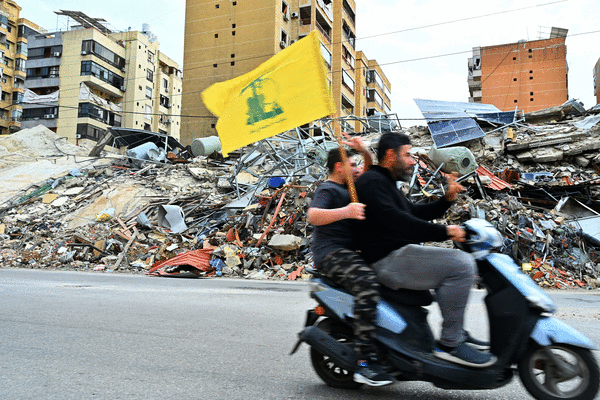
The U.S. president sought to differentiate the two, saying in the phone interview that the Lebanon ceasefire was “a totally separate deal” and “not tied to the Iran deal.” Still, Israel’s military campaign in southern Lebanon against Hezbollah, an Iranian proxy, had been a major impediment to a broader deal. That ceasefire on Friday was holding.
While the truce did not mention Hezbollah, the militant group stopped launching rockets into Israel overnight.
Trump said U.S. officials would work with both sides to secure a lasting deal.
“We’re going to get along hopefully with everybody, and we’re going to straighten out Lebanon,” the president said. “We’re not going to be bombing the hell out of Lebanon, not going to let anybody do that.”
Still, Israeli Prime Minister Benjamin Netanyahu’s office on Friday said their country had “not yet finished the job” against Hezbollah. The goal is to dismantle the group and “this will not be achieved tomorrow,” it added.
The Israeli military has occupied large parts of southern Lebanon during the campaign, which local authorities say has killed more than 2,000 people and displaced a million more.
Trump said Thursday he planned to host talks with Netanyahu and Lebanese President Joseph Aoun at the White House, saying it could happen over the next week or two.
_____
(With assistance from Justin Sink, Devika Krishna Kumar and John Bowker.)
©2026 Bloomberg L.P. Visit bloomberg.com. Distributed by Tribune Content Agency, LLC.






Comments