US seizes Iranian Ship in blockade, casting doubt on peace talks
Published in News & Features
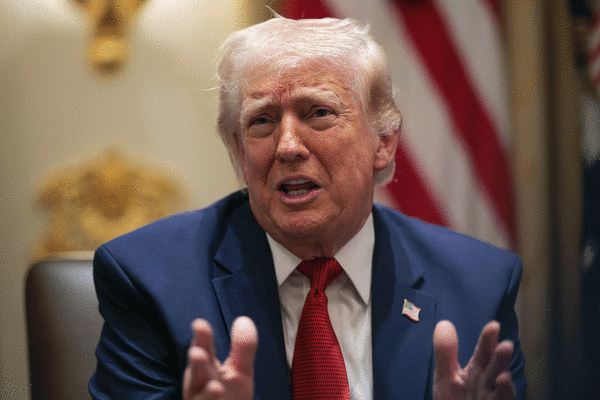
President Donald Trump and Iranian officials offered disparate views on the next stage of the war, casting uncertainty over whether the two sides would meet for peace talks with a ceasefire set to expire in the coming days.
Tensions in the war ratcheted up over the weekend as the U.S. Navy fired upon and boarded an Iranian-flagged cargo ship in the Gulf of Oman, the first seizure in the U.S. blockade of the Strait of Hormuz.
That critical waterway for energy shipments remained closed early Monday after confusion over the weekend about whether tankers could transit the strait. Iran had initially said ships could pass before abruptly stopping traffic through the waterway less than 24 hours later.
Trump, who on Friday said a deal with Iran was all but agreed, threatened on Sunday to destroy every power plant and bridge in Iran if negotiations fail. Iranians have denied conceding to several of the points the U.S. president has said are part of the plan, including the end of their nuclear program and handing over stockpiles of enriched uranium to the U.S.
The halt of nearly all traffic in the Strait of Hormuz combined with the cloudiness about the state of U.S.-Iran diplomacy weighed on financial markets Monday. U.S. stock futures fell and oil surged, with global crude benchmark Brent jumping over 7% to around $96.80 a barrel.
It’s also unclear whether Iranian and U.S. officials will meet in Islamabad, Pakistan before a fragile 14-day ceasefire is set to expire on Tuesday. Vice President JD Vance, special envoy Steve Witkoff and the president’s son-in-law Jared Kushner are scheduled to leave for Islamabad Monday night for talks on Tuesday, a White House official said.
Trump said he sees a chance for a deal, an assertion countered by Iranians who said there was no “clear prospect” for an agreement. Iranians have also denied that they will participate in talks with the U.S. in Islamabad.
The weekend developments illustrate the erratic nature of the war and the diplomacy around ending it, with Trump and Iran making contradictory statements within hours. Israel also continues to fight in Lebanon, despite a ceasefire announced last week.
“U.S. overreach, unreasonable and unrealistic demands, frequent changes in positions, continuous contradictions, and the continuation of the so-called naval blockade, which is considered a violation of the ceasefire agreement, along with threatening rhetoric, have so far hindered the progress of the negotiations,” according to a report from Iranian State TV.
U.S. Central Command, which oversees military operations in the Middle East, issued a statement saying that the seized Iranian ship, known as Touska, failed for six hours to comply with warnings to stop. The Navy ordered the ship to evacuate its engine room before firing several rounds from a 5-inch MK45 gun into the engine room to disable the ship. U.S. Marines boarded the vessel and took control, Centcom said.
Trump said in a social media post that the ship, the Touska, “tried to get past our Naval Blockade, and it did not go well for them.”
Trump said the ship was under the Treasury Department’s sanctions and that the U.S. now has possession of it.
“We’re offering a very fair and reasonable DEAL, and I hope they take it because, if they don’t, the United States is going to knock out every single Power Plant, and every single Bridge, in Iran,” Trump said in a social media post earlier Sunday. “NO MORE MR. NICE GUY!”
Iran will respond soon to the U.S. action, Iranian news outlet Press TV reported, citing the country’s military command.
Meanwhile, Iran also set out new fee rules and said the parliament was working to pass a law to manage the Strait of Hormuz, including prohibiting ships affiliated with Israel and that ships from “hostile countries” would not be allowed to pass without permission from the Supreme National Security Council.
The standoff over Hormuz — through which about a fifth of the world’s oil and liquefied natural gas flowed before the U.S.-Israeli war on Iran began — threatens to deepen the global energy crisis and is undermining Trump’s weekend prediction of a quick end to the conflict.
The situation in the Strait of Hormuz and plans for future peace talks are shifting rapidly. Late Saturday, Iran’s Parliament Speaker Mohammad Bagher Ghalibaf — who led the Iranian delegation in talks with the U.S. this month in Pakistan — said that while gaps “remain significant,” the negotiations are making progress.
The U.S. naval blockade is allowing ships carrying non-Iranian cargo to depart the Persian Gulf but not any ships that left Iranian ports, which led to the Islamic Republic re-closing the strait.
The Islamic Revolutionary Guard Corps’ navy issued a statement Saturday afternoon warning vessels not to leave their anchorages in the Persian Gulf and the Sea of Oman, and that approaching the strait “will be considered cooperation with the enemy, and the violating vessel will be targeted.”
“It is impossible for others to pass through the Strait of Hormuz while we cannot,” Ghalibaf said in a televised address.
The Joint Maritime Information Center, an international group that shares information about shipping routes, reported multiple attacks by Iranian forces on vessels in the strait as well as the presence of mines and said the overall risk level was “critical.”
The U.K. Navy said a tanker was approached by IRGC gunboats before being fired at on Saturday, adding that the targeted vessel and its crew were safe. A container ship was hit by an unknown projectile in a separate incident off the coast of Oman, it said. And India said its ships were also fired upon.
_____
(With assistance from Patrick Sykes, Jon Herskovitz, Eltaf Najafizada, Dan Williams, Weilun Soon, Sara Gharaibeh, Omar Tamo and Valentine Baldassari.)
_____
©2026 Bloomberg L.P. Visit bloomberg.com. Distributed by Tribune Content Agency, LLC.





Comments