Plan to protect Miami-Dade from storms: $4.5 billion to elevate thousands of homes
Published in News & Features
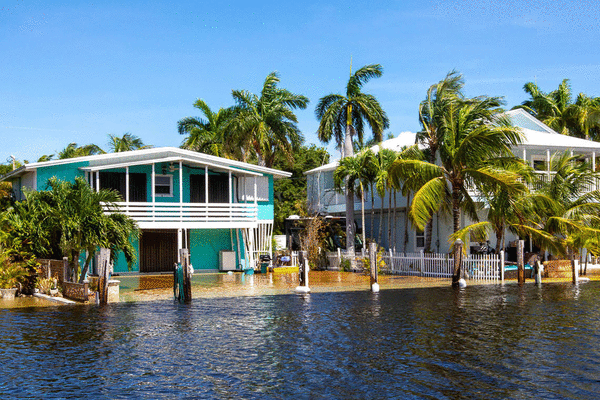
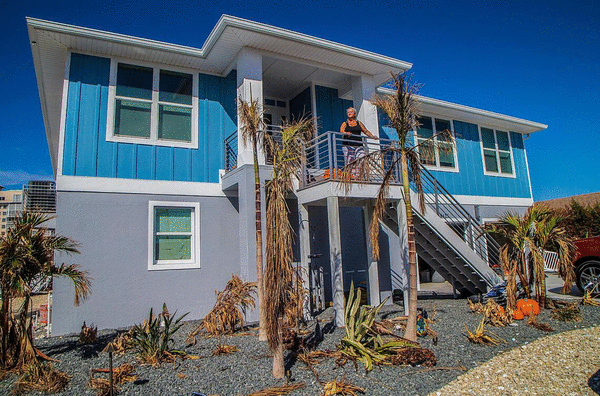

MIAMI — The federal government says it will cost $4.5 billion to elevate and floodproof more than 3,000 homes and buildings in Miami-Dade, part of a massive plan to help protect the region from the stronger hurricanes and higher sea levels of the future.
A newly issued plan from the Army Corps of Engineers, the construction arm of the federal government, calls for raising thousands of homes, including more than a thousand in Homestead and more than 400 each in Cutler Bay and Miami Beach. It also covers protecting 275 businesses and crucial government buildings from rising waters, including fire stations and wastewater treatment plants.
On the fastest timeline, construction could begin as soon as 2032. Protecting all 3,200 properties is expected to take 16 years, at least. Getting there would require Congress to fund the design of the project in 2028 and then continue shelling out cash for waves of construction for more than a decade afterward.
Without it, the Corps calculated, Miami-Dade could be at risk of more than $54 billion in economic damages. That’s homes swept away by floodwaters, business halted when storms strike and plummeting property values.
The federal government paid for this most recent report, a product of the long-running Miami-Dade Back Bay Coastal Storm Risk Management (CSRM) Study. And it would pick up the lion’s share of the tab for anything built based on the study — 65%. That would leave Miami-Dade to foot the rest of the bill, around $1.3 billion in cash.
Controversial from the start
The study is the latest iteration of one that began after Hurricane Irma struck in 2017. The Corps initially proposed a plan to protect Miami-Dade with miles of tall concrete walls along the coast. It was quickly shot down by residents and officials, who called it ugly and asked instead for a more plant-based solution, like mangroves.
At one point, Miami’s Downtown Development Agency paid a consultant to develop images of the 6 to 13 foot proposed walls covered with graffiti and trash. A commissioner referred to it as “the Berlin Wall.”
After years of back-and-forth, the Corps decided to split the study into two. Part one, released this month, only deals with raising homes and floodproofing important community buildings like evacuation shelters and police stations.
The more controversial part two, which will come up with a structure to protect the coast from storm surge, has been shelved for now. Work is also underway on a nature-based pilot project.
Going up
With at least two feet of sea level rise expected by 2060 and an average elevation of six feet above sea level, thousands of Miami-Dade properties are at risk of being flooded either multiple times a year or permanently.
For this study, the Corps found more than 3,000 properties at “high risk” of destructive flooding in the next few decades. When expanding to medium risk, the number leapt to more than 6,000. That also ratcheted up the cost to north of $6 billion, so the Corps decided to stick with just the most vulnerable ones.
Around 275 properties would be “dry floodproofed,” which involves things like temporary or permanent flood barriers and water pumps. About 175 of those are commercial businesses, warehouses, government buildings and churches. The rest are considered critical infrastructure, like wastewater treatment plants.
But the other 3,200 properties are targeted for elevation, which involves keeping the home pretty much as-is, but jacking it up with heavy machinery and building a new, taller foundation.
Elevating those buildings is a no-brainer. Already, the building code requires new development to build higher. And in other spots in Florida, like the Keys and Tampa Bay, residents are choosing to elevate their existing homes several feet to keep them safe from floods.
Single-family home elevation is less popular in Miami-Dade, although a few projects are underway. Per the study, some properties may only have to come up a few feet; the maximum for elevation appears to be 12 feet.
The Corps plan involves elevating 2,800 single-family homes, as well as 430 multifamily buildings. Multifamily building elevation is rare, even in flood-prone coastal areas. In this plan, the Corps said it is referring to quadplexes or smaller, not towering condominium buildings.
The plan also included a breakdown of which areas are targeted for these elevations, which indicates the areas with properties at the highest risk of flooding.
During a meeting on Thursday, officials said that the first step toward shovels in the ground involves selecting a smaller portion of the suggested work list to start with.
“We will be in the near future working with the county to identify which components… to move forward,” said Justine Woodward, environmental lead for the project and a biologist for the Army Corps’ Norfolk District.
From there, Corps and County officials said it’s an open question of who will get to manage the elevation program itself. In Norfolk, Virginia, where the Corps completed a similar study, the city of Norfolk is managing the elevation of around 1,000 properties.
$4.5 billion — or more
That’s a tremendous price tag.
In 2020, the initial draft version of the plan included six miles of concrete walls, mangrove plantings in South Dade and elevating thousands of homes and buildings. Back then, the Corps estimated that would cost $4.6 billion.
Fastforward six years, and the estimated cost solely to elevate and floodproof thousands of properties (with no big walls or gates or tree plantings) is, once again, around $4.5 billion.
That number is a pretty rough estimate. Reaching that number requires 100% of the targeted buildings to agree to elevation or floodproofing. Elevating a home can take several months, and while this project would foot the entire bill for elevation, the pot of cash does not cover the costs of finding another place to live during construction.
Also, the Corps can only accept homes to elevate that are already fully up to the latest version of the building code. If the property has outdated wiring or has an unpermitted garage-turned-bedroom — not an uncommon issue in Miami-Dade — the owner would need to fix that (at their own expense) before they would be accepted for elevation.
The Corps and County said they did not have an estimate of how many of these properties eyed for elevation are out of compliance with the building code. However, Christian Kamrath, resilience program manager for Miami-Dade’s Department of Environmental Resources Management, said the county is looking into any funding or programs it can use to help residents afford any necessary code fixes.
“We know the costs can be high and there may be other things involved,” he said. “But we’re going to do everything we can to make it viable for folks.”
Kamrath said the county has been in talks with Harris County, Texas, which elevated thousands of homes following Hurricane Harvey, as well as the state-funded home raising program, Elevate Florida, for tips and advice.
“It’s definitely a big lift,” he said.
©2026 Miami Herald. Visit at miamiherald.com. Distributed by Tribune Content Agency, LLC.






Comments