Big Sur fire: Highway 1 closes again as firefighters use 'dragon eggs' to slow spread of the Timber fire
Published in News & Features
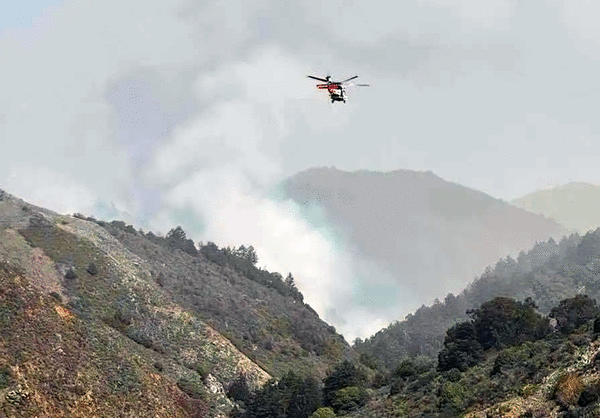
Five days after the California Highway Patrol and Caltrans reopened Highway 1 in Big Sur as fire crews made progress battling the Timber fire, they closed it again Thursday, this time as part of a new strategy to slow the stubborn blaze.
At 1 p.m., the winding, scenic road was closed over a five-mile stretch through the heart of Big Sur from just south of Andrew Molera State Park to the Big Sur Deli, near Sycamore Canyon Road, to allow firefighters to position engines and other equipment on the roadway and begin backburning operations.
Monterey County Sheriff’s officials told residents who remained to have up to 7 days of food on hand in case the road is closed that long.
Adding another layer of complexity, on Thursday afternoon the National Weather Service issued a red flag warning for the Santa Cruz Mountains, Big Sur and the Salinas Valley from 3 am to 5 pm Friday due to increased risk of lightning, gusty winds and isolated thunderstorms from the remnants of former Tropical Storm Iselle off the Mexican Pacific coast.
A common technique in wildland firefighting, backburning occurs when crews deliberately set fires between containment lines and the leading edge of a fire to burn brush and grasses in a controlled way, starving the main fire of fuel as it advances.
The Timber fire reached 19,269 acres Thursday — triple the size from a week ago — and was 21% contained. It continues to burn at a moderate pace mostly eastward into the remote Ventana Wilderness. But the northern flank in recent days, driven by hotter, drier weather, has pushed toward Mount Manuel, a prominent peak near Highway 1, which is bringing it closer to the most populated and famous parts of Big Sur.
Rather than wait for the flames to jump over the ridges, said Adrienne Freeman, a US Forest Service spokeswoman, hundreds of firefighters Thursday and Friday planned to burn vegetation in a controlled way to reduce the chances the wildfire could suddenly race out of control and threaten homes and businesses.
“We are bringing fire down to the coast carefully,” she said. “We will walk the fire down the hill until we have consumed the vegetation. That takes the energy away.”
Dozens of fire engines, helicopters, and crews with hose lines were planned to be present to reduce the chances of the backburning jumping containment lines, she added.
On Wednesday night, fire crews used similar tactics on the fire’s southeastern edges. They started backburns with a device called a “Terra Torch” that shoots flaming gel up to 50 feet. They also used drones to drop “dragon eggs” ping-pong ball-sized spheres containing flammable chemicals that start controlled fires. The drones use heat sensors to track where flames are moving, reducing the need to use helicopters or firefighters.
Since the fire began Aug. 8 near Timber Top, a popular camping spot in Los Padres National Forest a few miles south of the community of Big Sur, fire crews from around California have kept it from burning any homes or other structures. There have been no fatalities. Its cause remains under investigation. Given its current behavior, Freeman said, fire commanders do not believe famous sites like Pfeiffer Big Sur State Park, the Nepenthe restaurant or the Post Ranch Inn are facing greater danger than they were a few days ago.
Still, the renewed closure of Highway 1 brought new headaches for visitors and Big Sur’s struggling businesses, many of which were just starting to reopen in recent days. July and August are usually the biggest tourist months in Big Sur, when crowds of people from the Bay Area, Southern California and around the world come to enjoy its breathtaking scenery, hiking trails and beaches.
“The good news is that it’s not like the fire suddenly jumped the lines and we had to evacuate,” said Randy Vasquez, a manager at the Nepenthe restaurant on Thursday.
“We understand why they closed the road,” he added. “We know that it’s a necessity. If that’s what the firefighters have to do, it’s what they have to do. We’re going to survive. But it is tough on the employees. We’re hanging in there.”
Meanwhile Thursday, a second much smaller fire, the Plaskett fire, began in a more rural area of the Los Padres National Forest farther south near Gorda and Willow Peak close to the Monterey-San Luis Obispo border. That fire was 140 acres on Thursday, with air tankers and helicopters dropping water and retardant to limit its spread.
Craig Clements, director of San Jose State University’s Fire Weather Research Lab, said the Timber fire has been burning mostly at low intensity, almost performing like a controlled burn. That’s in part because of mild weather during its first two weeks, and because much of it is burning over terrain where there have been other fires in recent years, leaving less vegetation to burn explosively now.
“These landscapes are adapted to fire,” he said. “They need fire. It is going to be better in the long run. Allowing it to burn at a lower intensity will limit the potential for a high-intensity fire in the future.”
On Thursday, there were 1,228 firefighters working on the blaze, with 14 helicopters, 87 fire engines, and 13 bulldozers.
Big Sur has seen three massive fires in the past 18 years, each of which burned for more than a month and charred more than 100,000 acres.
Forest Service commanders Thursday said they hope to keep the Timber fire contained to a vast area where several of those other historic fires were stopped. They are now using bulldozers to reopen old containment lines. The goal, they said, is to stop the fire north of Nacimiento Ferguson Road, south of Carmel Valley Road, east of Highway 1, and west of Millers Ranch, a remote area 5 miles east of Tassajara Hot Springs and 7 miles west of Highway 101 in the Salinas Valley.
Clements said it is likely the fire will burn for a long time given how remote, steep and inaccessible the Big Sur wilderness is.
“It could burn until it rains,” he said. “That might be weeks. That’s the way a lot of these fires end up. They get mostly contained, and then the weather finally puts them out.”
©2026 MediaNews Group, Inc. Visit at mercurynews.com. Distributed by Tribune Content Agency, LLC.






Comments