Missouri's gerrymandered map faces final test as state Supreme Court weighs referendum
Published in News & Features
KANSAS CITY, Mo. — At long last, the fate of Missouri’s gerrymandered congressional map is coming into view.
It’s now in the hands of the Missouri Supreme Court.
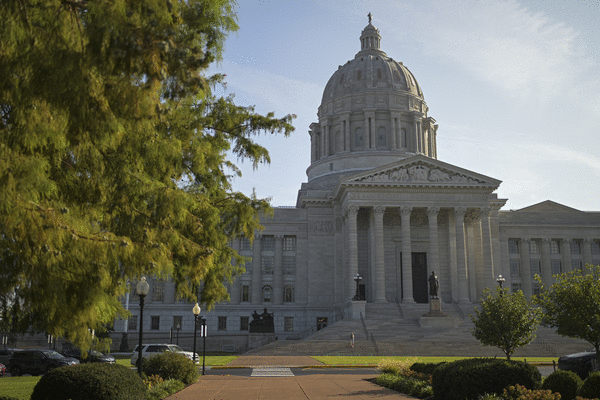
The state’s highest court on Wednesday heard arguments over whether a referendum campaign seeking to strike down the map can reach the November ballot, a high-stakes decision that could effectively decide the future of Kansas City’s representation in Congress.
The case centers on Republican Secretary of State Denny Hoskins’ extraordinary decision last month to block the campaign and declare it unconstitutional. The campaign, called People Not Politicians, is asking the court to reverse that move, put the new map to a statewide vote on Nov. 3 and block it from being used in the election.
The looming decision is virtually certain to generate national attention amid a bitter fight for control of Congress this year. At the core of the case is Missouri’s congressional map, which lawmakers passed last year under pressure from President Donald Trump.
The map splits Kansas City into three Republican-leaning districts. The goal is to oust Democratic U.S. Rep. Emanuel Cleaver and allow Republicans to pick up seven of Missouri’s eight congressional districts.
Wednesday’s arguments also came amid a race against the clock. State law bars judges from adding or removing items from the statewide ballot after Sept. 8, a deadline that ensures the Supreme Court will rule quickly.
The Missouri Supreme Court will determine whether the referendum seeking to overturn the map can appear on the November ballot. Neil Nakahodo, The Kansas City Star
The case pitted attorneys for the referendum campaign against the Missouri Attorney General’s Office, which is representing Hoskins, and two high-profile Republican attorneys.
Marc Ellinger, a prominent Missouri GOP attorney, and John Gore, a former Department of Justice official, intervened in the case on behalf of three Republican organizations, illustrating the national implications of Missouri’s map.
Inside the arguments
Chuck Hatfield, an attorney for the referendum, argued that Hoskins had no authority to reject the referendum from the ballot. Nothing in state law or the Missouri Constitution bars citizens from holding a referendum on redistricting.
“This analysis, in my view, is really, really simple,” Hatfield told the court. “Under Missouri law, we look at the plain language of the Missouri Constitution. The plain language is that the people have the right to the referendum on any act of the General Assembly.”
Missourians have voted on redistricting in the past. Hatfield has previously pointed to a 1922 referendum on redistricting in which Missouri voters rejected a map drawn by state lawmakers.
The court’s decision will mark the culmination of the fight against the map. Campaigners raced across the state last year and collected more than 305,000 signatures to strike the map down at the ballot box.
If the state’s highest court rules that the referendum must appear on the ballot, the court will likely weigh whether the new map can be used in the November election. The court previously ruled that it was “impossible to say” whether it was in effect or not until Hoskins certified the referendum.
Missouri Solicitor General Louis Capozzi, meanwhile, argued that the new map should not be subject to a statewide vote. If the court ruled in favor of People Not Politicians, Capozzi said, that decision would create chaos for the upcoming November election.
He pointed specifically at the possibility of Missouri using the new, gerrymandered map in the August primary and then using the state’s previous map in November.
“No court in any state at any time in U.S. history has been given that remedy,” Capozzi said. “This court should not be the first.”
Chief Justice W. Brent Powell appeared skeptical of the arguments regarding the consequences of the looming decision. He said the only question in front of the court was whether Hoskins was right to reject the referendum from the ballot.
“Let’s be honest,” Powell said, “if this had been brought to us earlier, then we could be in a situation where we could be deciding this in time for the primary election.”
Powell then reiterated that the court had already ruled in a previous case that the new map would not be in effect if the referendum was certified for the ballot.
Capozzi, however, pushed back and refuted Powell’s framing of that ruling, a remarkable argument that suggested Missouri officials might still try to use the new map in the November election even if the court rules that the referendum must be on the ballot.
Gore, from Jones Day, a national firm with strong ties to the Trump administration, also argued against the lawsuit on behalf of the Republican National Committee, National Republican Congressional Committee and the Missouri Republican State Committee.
Gerrymander opponents rally outside Supreme Court
As the arguments unfolded inside the state Supreme Court, supporters of the referendum gathered outside.
They hurled chants, held up signs, played music and gave speeches against what they called an attack on democracy. The group also held up large red numbers, 305,968, showing how many signatures the campaign turned in to force a statewide vote on the map.
One sign said, “LET THE PEOPLE VOTE.” Another said “Stop the politicians’ power grab.”
“The justices’ job is to make sure that we’re following the law,” said Richard Von Glahn, the campaign’s executive director. “They should declare what the law is and, if needed, instruct the attorney general and secretary of state to start following the law.”
Hoskins has repeatedly used the powers of his office to block the referendum ahead of the 2026 midterms and has recently taken to social media to boast about the case.
The Republican election official previously tossed out nearly 90,000 of the campaign’s signatures. He waited until the day of the Aug. 4 primary election to reject the referendum for the ballot. And he pressed forward with the new map despite legal questions about whether it was in effect or not.
In addition to Wednesday’s arguments about the fate of the referendum, the Supreme Court also heard a separate case that will decide whether Hoskins was right to reject the campaign’s signatures.
Meanwhile, Republican Attorney General Catherine Hanaway filed a federal lawsuit to block the campaign in October, claiming that voters do not have the power to hold a referendum on the state’s congressional districts. She also alleged — without evidence — that the campaign was working with undocumented immigrants.
Hatfield, the campaign’s attorney, emphasized that Missouri’s mid-decade redistricting push had thrust the state, its courts and voters into uncharted waters.
“It was an extraordinary session to do an extraordinary thing in an extraordinary way,” Hatfield said.
But, he said, People Not Politicians followed the law.
“My client did what has been done before and what the plain language of the Constitution says they can do in this extraordinary situation,” he said.
_____
©2026 The Kansas City Star. Visit at kansascity.com. Distributed by Tribune Content Agency, LLC.




Comments