Crude tops $101 as US-Iran war escalates with tankers targeted
Published in News & Features
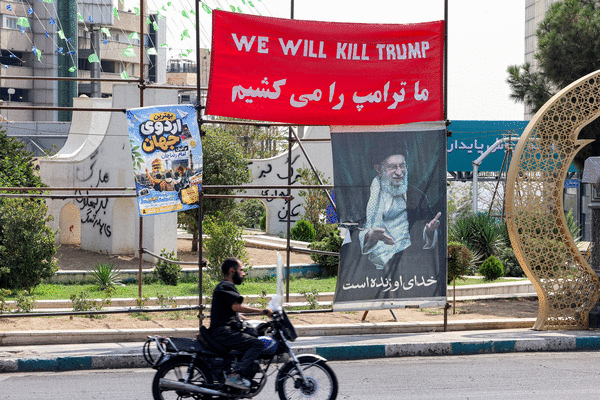
Brent oil topped $101 a barrel for the first time since July, as escalating attacks across the Middle East heightened concerns about further disruptions to energy flows out of the crude-rich region.
The global crude benchmark rose over 3% in New York, while West Texas Intermediate traded near $96. The U.S. military said it destroyed five Iranian tankers in response to attempts to hit a U.S. Navy warship with ballistic missiles overnight. Iranian media said Tehran targeted two U.S. warships and eight oil tankers in the Persian Gulf. There was no immediate confirmation of those attacks.
The conflict has disrupted shipping through the crucial Strait of Hormuz chokepoint, though millions of barrels a day of crude flows on tankers sailing undetected have helped keep prices in check. It’s unclear how the latest flareup may affect those ‘dark’ transits.
The escalation also comes as Yemen’s Iran-backed Houthi militants target energy facilities in Saudi Arabia. Alerts of “potential danger” sounded in the south of the country on Wednesday, a day after the region came under attack. European natural gas prices traded at their highest level since 2023 as the Iran war drives up energy costs just as the winter heating season approaches.
Meanwhile, there’s been a pickup in Chinese crude purchases so far this month. A buying hiatus from the world’s largest importer had been one of the key factors keeping a lid on prices, and the resumption has some key market gauges trading at their strongest levels in weeks.
“While the level of market deficit in crude has eased amid a stabilization of higher dark flow volumes, the market remains tight overall,” said Ryan McKay, senior commodity strategist at TD Securities. “Further tightness could still materialize amid these renewed attacks and as signs grow that China is becoming more active in the market.”
Brent is up around 65% this year. Apart from a brief spike in July, however, futures had traded below the three-digit mark for more than three months as Persian Gulf producers managed to increase exports.
Technical factors also amplified oil’s rally. Trend-following commodity trading advisers added long positions to sit at 91% long in Brent and WTI, compared with 45% and 36%, respectively, on Aug. 31, according to data from Kpler’s Bridgeton Research Group. The robot traders are known for their tendency to exacerbate price swings.
About 10 million barrels a day have been crossing the waterway, roughly half of pre-war levels, Russell Hardy, chief executive officer of trading house Vitol Group, said on Tuesday. He added that an exact figure is hard to quantify and volumes aren’t guaranteed to leave every day.
Refined products such as diesel, on the other hand, have rallied much harder as the Middle East conflict and the Russia-Ukraine war combine to tighten supplies. That threatens to bring about a fresh round of inflationary costs for the world’s central bankers.
“The fundamental picture for products remains bullish with global inventories and reserves deteriorating,” said Darrell Fletcher, managing director for commodities at Bannockburn Capital Markets.
Before the Iran war, about a fifth of the world’s oil and liquefied natural gas passed through Hormuz to global customers.
Despite the ongoing flow of tankers with their transponders switched off, vessels face a persistent threat of attack. Kuwait Petroleum Corp. is sending tankers through the strait “whenever it is safe,” an official said on Wednesday.
The continued disruption means inventories have continued to decline across the globe. Analytics firm Vortexa sees the amount of oil on ships at sea down by more than 150 million barrels since the middle of July.
©2026 Bloomberg L.P. Visit bloomberg.com. Distributed by Tribune Content Agency, LLC.






Comments