Immigrants endure thunderstorms, hourslong lines at Miami immigration court
Published in News & Features
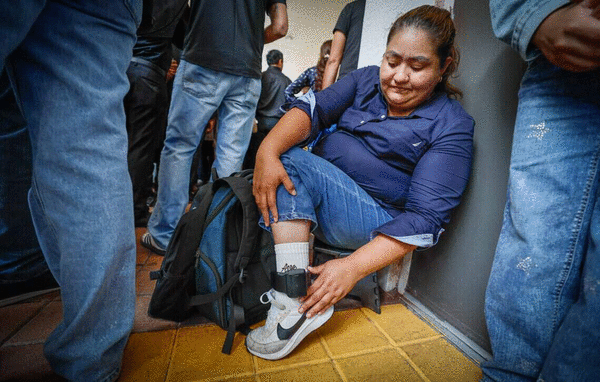





MIAMI — Mayerling Alvarado came prepared.
She packed food and water, shielded herself from the scorching sun with a big blue umbrella, and took in the water views from her foldable chair.
But this was not a recreational outing.
Alvarado had set herself up to wait for hours outside of Miami’s immigration court last week to support her husband, whose virtual hearing — originally set for 2027 — was rescheduled and changed to an in-person appointment in front of a judge.
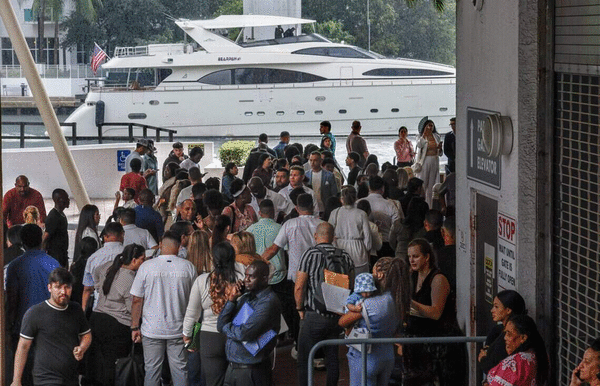
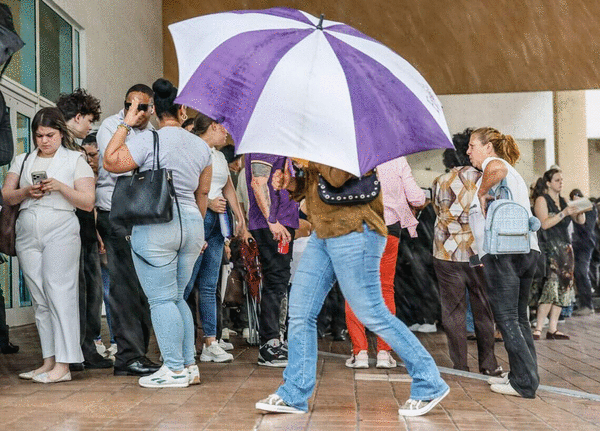
The Nicaraguan couple arrived around 4 a.m., fresh off Alvarado’s graveyard shift at her cleaning job. When it rained, they huddled with others under the courthouse entrance, stifled by the heat of bodies and the subtropical humidity.
Her husband’s hearing was at 1 p.m. But they couldn’t risk missing the appointment.
“We prefer to come in early and lose a day of work. The last thing we want is to be deported,” said Alvarado, 38.
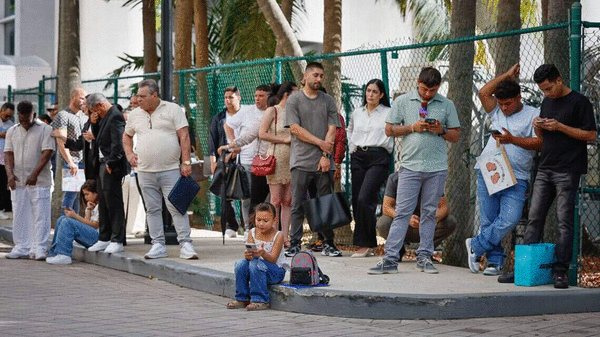
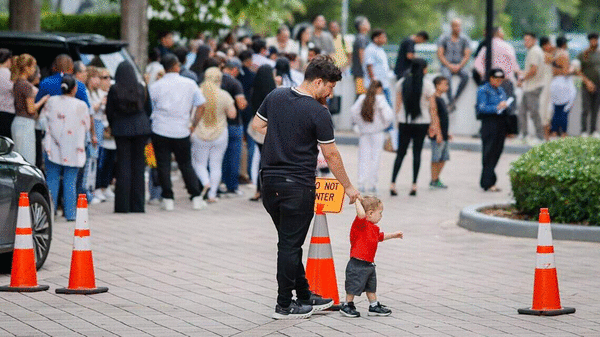
The immigration court in downtown Miami, at 333 S Miami Ave., has long been infamous for having the largest backlog of pending cases in the country. But in recent weeks, hundreds, if not thousands, of immigrants — babies, children and elderly adults included — have waited for hours outside its doors to attend routine hearings. They endure extreme heat, punishing tempests and gusts of wind in the process.
Experts say several factors under President Donald Trump’s mass deportation agenda have contributed to the long lines, including cases being assigned earlier dates, a ramp-up of immigration arrests, and “mega master” hearings, where as many as 150 people are scheduled with a judge in one day to clear dockets.
As of Sept. 8, immigrants have been required to show up for their immigration cases in person, doing away with virtual hearings, a COVID-era vestige that allowed people to attend hearings without missing work, traveling long distances or risking detention.
“When the Trump administration came in, they decided everybody is a priority. And they clogged the system with a lot of cases,” said Elina Santana, a Miami-based immigration attorney. “So there’s a lot more active cases than ever before.”
The Executive Office for Immigration Review, the Justice Department division that runs immigration courts, declined to comment. Under the Trump administration, the agency has hired more judges and boasted of a reduction of pending cases. It has also arrested people in courthouses nationwide, until a federal judge barred authorities from doing so.
“It’s really just a mass deportation machine, and it seems they are just trying to erode due process wherever they can to be able to say they deported more people than ever before,” said Santana, who is also the former chair of the South Florida chapter of the American Immigration Lawyers Association.
The immigration review office acknowledges in its own manual that there can be delays as a result of mandatory security screenings. But immigrants in Miami are forced to wait hours before guards let them get screened, letting people into the lobby to scan their items through the X-ray machines in groups around the time of their hearings.
Grace Willberg, a South Florida immigration attorney, has been to the court in recent weeks. She says she’s seen the lines go as far as down the block to the nearby hotel. One of her clients, a young mother of two who lives in Stewart, got there at 5 in the morning for her 8 a.m. hearing.
“I had heard about these long lines, but I didn’t believe it until I saw it,” Willberg said.
More rain
One morning last week, security guards came out and asked if there was anyone else with earlier appointments still outside. If immigrants don’t show up to their hearings, judges often order them deported.
Maidelyn Cruz had set up camp right next to Alvarado and Mendez, the Nicaraguan couple. She brought along a foldable chair, a table and an umbrella. She had an assortment of snacks for her 7-year-old daughter, who bounced up and down the short white wall that separates the courthouse from the Miami River.
They had come all the way from Tampa for the hearing, resting at a friend’s house before heading to the downtown courthouse. But sleep was hard to come by, with her daughter’s asthma acting up and the anxiety of the hearing the following day.
“The first court was easy because it was coming in on my schedule and there was no issue,” said Cruz. “Today I’ve been here since 3 a.m. with my daughter. It’s truly horrible.”
When Cruz arrived in the U.S. from western Cuba five years ago, border agents gave her a document known as an I-220A. Lawyers estimate hundreds of thousands of Cubans were given the document when they arrived at the U.S.-Mexico border. But an immigration board of appeals ruled that Cubans cannot use the I-220As to obtain a green card, leaving many people from the island in a legal limbo, with limited options to stay in the U.S. legally.
Trying to become a green card holder as the options for Cubans and other immigrants in the United States narrow has been difficult, Cruz said. The Trump administration had also paused immigration applications for Cubans and others for several months, though a federal judge lifted the freeze this summer.
“You feel you are in jail,” said Cruz. “You have a work permit and that helps a lot…but I came all the way from Tampa praying no one would stop us.”
As the morning wore on, the crowd got bigger. Around 11 a.m. the gray skies erupted in a furious downpour. The palm fronds that adorn the court’s cul-de-sac whipped in the wind. Those awaiting hearings huddled under the building’s entrance to shield themselves from the rain. But the massive portico did not protect them from the lashing rain. Thunder furiously cracked as lightning lit up the sky.
“Do not bunch up over here,” one guard barked at the crowd. “This is a mess!”
Inside the court, the hallways were quiet. But some courtrooms were so full the benches couldn’t fit another person. Inside Judge Thomas Ayze’s courtroom, staffers handed documents to immigrants in a room filled with nearly two dozen people. The walls and the back of benches had samples of court documents and a QR code for address changes.
In Judge Monica Neuman’s court, a toddler with braids walked in between the rows of benches and dropped milk on the carpet. She jumped and mumbled as she walked out with her mother.
‘A huge hardship’
Lawyers say that the hours-long waits to get into court is not just an uncomfortable experience. People must skip work, find transportation and childcare, and pay for gas and parking. Some people must also find housing if they come from elsewhere in the state, since the only two immigration courts in Florida are in Miami and Orlando.
”It’s a huge hardship. Not just financial hardship, but finding someone to bring you, all at what is last-minute for some of them,” said Santana, the attorney. She had to help arrange transportation to Miami for one of her clients, a teenager from Fort Myers.
And even though Immigration and Customs Enforcement agents are not allowed to carry out arrests in court anymore, immigrants who have to show up in person for hearings run the risk of being detained while in transit.
The federal government has been rescheduling court dates and switching virtual hearings to in-person with little notice. Lawyers say immigrants have been accidentally skipping their hearings because they don’t know they are happening earlier than they had been originally scheduled.
Since mega masters hearings began in May, immigration data researchers found that the number of people ordered deported when not showing up for a hearing has skyrocketed.
The changes are also overwhelming for judges and attorneys. Several lawyers told the Herald that they are not letting clients go to court alone, so they now must show up in person, when before they could attend the hearings virtually.
On Wednesday last week, Daimara Hechevarria Tamayo huddled under the covered driveway with her cousin, Claudia, a Cuban immigrant who was given I-220A paperwork when she arrived in the U.S. Security guards were telling people that they had to come earlier if they wanted to get in, she told the Herald. They had arrived at 9 a.m. for a 1:30 p.m. appointment.
Hechevarria, who is a U.S. citizen, came to the United States 10 years ago through a family reunification process. She described her own immigration case back then as easy, and said she obtained her green card quickly after arriving.
Now, she says, she cannot recognize the United States.
“This is not the country of freedom that I came to 10 years ago.”
©2026 www.detroitnews.com. Visit at detroitnews.com. Distributed by Tribune Content Agency, LLC.






Comments