NY attorney general goes to court to protect Queens burial ground of 300 freed Black slaves
Published in News & Features
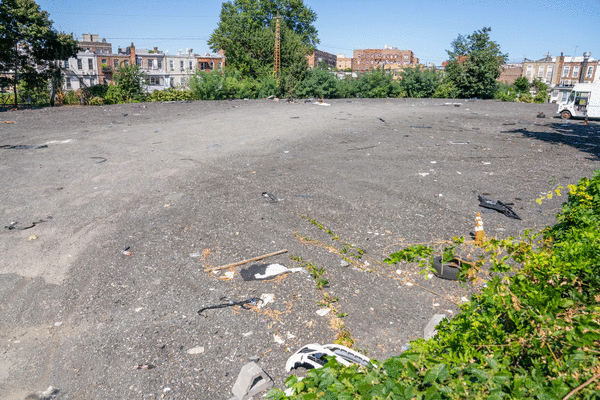
NEW YORK — Attorney General Letitia James‘ office has gone to court to protect a plot of Queens land where 300 freed Black slaves are buried that is about to be auctioned off — and make sure that whoever purchases the parcel knows what they are buying.
The attorney general’s office filed a motion Friday to intervene in the pending foreclosure sale for the property at 47-11 90th St. in Elmhurst. The AG is also seeking a court order that would require any prospective buyer to be notified of the human remains at the site and their legal obligations to protect them before they can take ownership.
“Every New Yorker deserves to rest in peace, and that includes the people buried on this land generations ago,” James said in a statement. “My office will not allow a foreclosure sale to become yet another disrespectful event in this burial ground’s unjustly troubled history.”
“We are going to court to make sure whoever buys this property knows exactly who is buried there and is aware of their legal obligation to protect them,” she said.
At the same time that the AG’s office went to court, Queens Borough President Donovan Richards held a press conference at the site on Friday, demanding that the city purchase the property and convert it to greenspace and a memorial for those buried there.
More than 300 people, many formerly enslaved Black New Yorkers, are believed to be interred in the burial ground, which dates back to 1818. At the time, Elmhurst was once known as Newtown, a community of Black residents.
In 1828, a group of freed slaves formed the United African Society of Newtown, building a church and formalizing a local burial ground on the site that had been informally used for the previous decade.
That group later became St. Mark African Methodist Episcopal (AME) Church, which owned the property until it was sold when the church moved to Jackson Heights in the 1930s.
The burial ground was eventually forgotten until at least 2006, when the City of New York placed restrictive declarations on the site to protect those buried there.
For the last year, the site was covered with asphalt and used as a tow pound, officials said. The New York City Department of Buildings deemed the tow pound illegal and ordered the parking lot to shut down, issuing multiple violations against the owner, including for illegal use as a parking and storage lot, unsafe conditions, and an excessive accumulation of tires.
A condo plan for the property was stopped in 2011 when construction workers using a backhoe unearthed the remains of an iron coffin containing the remains of a young black woman who died before the Civil War. Archaeologists working on the remains at the time said that hundreds of bodies were likely buried on the site.
Several years ago, 90 Queens, Inc. defaulted on its mortgage, and the party that acquired that mortgage, 90 Street Realty, LLC, is now proceeding with a foreclosure action against the property. Attempts to reach 90 Street Realty LLC were unsuccessful Friday.
A court-appointed referee is expected to sell the property at public auction.
In the motion filed in Queens Supreme Court, the AG’s office wants to make sure that anyone purchasing the property knows of the human remains buried underneath and their legal obligations to protect them before they can take ownership.
New York’s Unmarked Burial Site Protection Act, enacted in 2023, makes it illegal for anyone who discovers a burial site to remove, relocate, handle, or otherwise disturb human remains found there until specific legal procedures for identifying and notifying descendants and culturally affiliated groups are completed. The attorney general is authorized to take legal action against anyone who violates this law, which carries potential criminal penalties.
_____
©2026 New York Daily News. Visit nydailynews.com. Distributed by Tribune Content Agency, LLC.





Comments