Lib Dems fight for a breakthrough in Britain's fractured politics
Published in News & Features
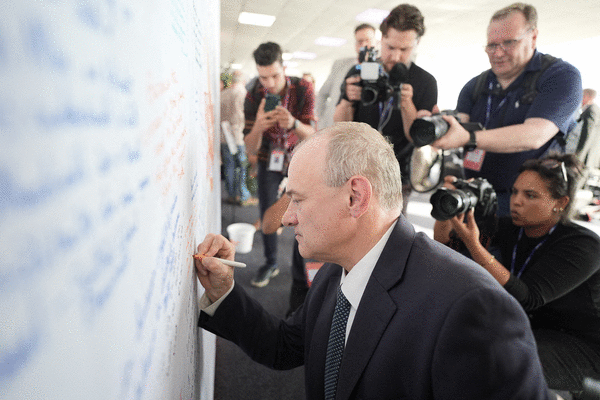
As the Liberal Democrats gather for their annual conference in Brighton this weekend, leader Ed Davey is under pressure to answer a simple question: Why isn’t Britain’s third-largest political party doing better?
Despite winning more than 70 seats at the last general election, a Lib Dem record, the centrist party’s poll ratings have been stagnant in the two years since, while the likes of Nigel Farage’s Reform UK and Zack Polanski’s Greens have pulled ahead and increasingly dominate voters’ attention. The new Labour government under Andy Burnham has enjoyed a poll bounce too.
That’s led to grumbling among some Liberal Democrat MPs and activists, who are frustrated at the party’s lack of a national breakthrough and want to see Davey take clearer, bolder stances on the big issues affecting voters. Davey is planning to use the conference to begin detailing the party’s pitch for the next general election, including a focus on the cost of living, economic growth and reforming the political system, according to people familiar with the matter.
The party finds itself “caught in a difficult political purgatory,” said Alex Bogdan, research director at Ipsos, a polling firm. “They’ve yet to find their firm place in our increasingly fragmented politics.”
As the traditional third party of UK politics, the Lib Dems’ performance is often an important factor in the outcome of elections. A strong showing can take seats from its two dominant rivals and increase the prospect of a hung parliament where the Lib Dems have the chance to act as kingmakers, just as they did in 2010 when they formed a coalition government with the Conservatives.
‘Unholy alliance’
Davey kicked off the conference with a flurry of calls to reduce taxes, including cutting fuel duty by 10 pence ($0.13) per liter and reducing value-added tax on public charging of electric vehicles.
“Donald Trump’s idiotic war with Iran – cheered on by Kemi Badenoch and Nigel Farage – is making it far more expensive for people to get around,” Davey said. “Liberal Democrats are taking the first concrete step to lower your tax burden and put money back in your pocket.”
Another of Davey’s key messages at the conference will be to talk up the threat of a Reform-Conservative coalition after the next election, a bid to lure moderate Tory voters who might be alarmed at the prospect of Farage as prime minister. Davey will give his keynote speech on Tuesday afternoon.
“An unholy alliance between Farage and Badenoch is the only way either can get into power,” Davey said in an emailed statement ahead of the conference. “A bigger Orange Wall is the only thing that can stand between Britain and this dangerous experiment,” he said, referencing the party’s historical colors.
Under Davey, the party has become associated with his regular photo stunts — he’s fallen off a paddleboard, bungee-jumped and ridden rollercoasters — as a way of grabbing the media’s attention in Britain’s crowded politics. He’s also taken a fiercely critical line against U.S. President Donald Trump, voicing opinions privately held by many Labour MPs, and continually championed a closer relationship with the European Union.
On the economy, Davey’s party wants to hike capital gains tax to fund social care. It also supports higher taxes on banks and lower taxes on most workers’ incomes. Britain’s tax-free personal income allowance should rise “when the public finances allow,” the party said in its 2024 manifesto.
One Liberal Democrat MP, speaking on condition of anonymity, said the party isn’t coming up with enough fresh and interesting ideas to make a splash in the media, and the party isn’t taking full advantage of its biggest-ever cohort in Parliament. Another party insider said there are growing internal calls for Davey to give a clearer articulation of what a Lib Dem government would do.
According to Bloomberg’s latest composite poll, a rolling 14-day average using data from nine polling companies, the Liberal Democrats are on 11%, compared with the Greens on 10.3%, Tories on 20%, Reform on 23.3% and Labour on 25.4%.
“Ask people what Britain would look and feel like after 10 years of Liberal Democrat government and many would struggle to answer,” Lib Dem MP Roz Savage wrote in an essay for the Compass think tank ahead of the party’s conference. Savage said the party’s policies “do not add up, in the public imagination, to a coherent picture of the country we are trying to create.”
To be sure, other party officials and MPs said criticism of Davey is overblown — he deserves credit for leading the Lib Dems to their strong result in 2024 and still enjoys the backing of his MPs, they say — and downplay the significance of the party’s laggard position in the polls. They point to how the Lib Dems converted an 11% polling position prior to the 2024 vote into more than 70 seats, compared with Reform, who were on 16% in the polls but only managed to return five MPs.
“We were really efficient in the way that we converted our votes into seats in the last general election,” said Richard Foord, the Liberal Democrat MP for Honiton and Sidmouth, speaking in a phone interview. “We’re confident that we can do it again.”
In another strong contrast with Reform, the Lib Dems are planning a big push on closer ties with the European Union at their Brighton conference. Daisy Cooper, the party’s Treasury spokesperson, said they will propose joining a single market, a new customs union with the bloc and a new defense alliance, and she will reveal a 30-page ‘growth plan.’
“Britain belongs at the heart of Europe, and we will take her there,” Cooper said in her keynote speech on Sunday. A new deal with the EU “could turbo-charge our economy and start to reverse the economic damage of Brexit,” she said.
For several decades the Lib Dems — and their predecessor Liberals — provided a refuge for voters fed up with the duopoly of the Conservatives and Labour. In today’s fractious environment they have to contend with other, more populist parties intent on breaking the two-party system.
“We are in a very noisy oppositional field,” Foord said. “Sometimes it’s the people who’ve got wild, outlandish policies who get the headlines — but I do reckon people will gravitate back to our sensible, pragmatic vision for the country as the election nears.”
_____
(With assistance from Alex Morales.)
_____
©2026 Bloomberg L.P. Visit bloomberg.com. Distributed by Tribune Content Agency, LLC.



Comments