Pastor accused in Haiti president's murder was sidelined by plotters, defense says
Published in News & Features
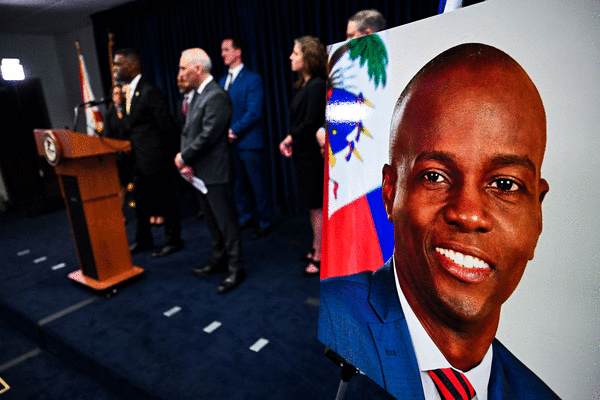
In the days before Haitian President Jovenel Moise was gunned down inside his second-floor bedroom, tensions were mounting in South Florida among the men involved in the plot to overthrow him.
Investors were pulling out, leaving the group short of cash. Thousands of dollars for a hotel bill in Port-au-Prince was going unpaid, as were the salaries of the squad of former Colombian soldiers deployed to Haiti. And disillusionment was growing with the Haitian-American pastor whom the men had initially backed to replace the president.
A review of Haiti’s 1987 Constitution had made it clear that as a naturalized U.S. citizen and someone who had not resided in Haiti for the previous five years, Christian Emmanuel Sanon was ineligible to serve as president or even as a cabinet minister. It also became apparent he had neither the pull nor financial resources the men believed he had when they began recruiting Colombian military veterans.
Arcángel Pretel Ortiz, an FBI informant who had helped recruit the squad of commandos, had learned of the constitutional obstacles after consulting with an Ecuadorian lawyer, José Antonio Corrales.
But Pretel, the owner of Counter Terrorist Federal Academy in Doral, wasn’t quite ready to let Sanon know he and others involved in the plot had abandoned him and were now eyeing a new candidate.
By June 10, 2021, they had settled on Windelle Coq Thélot, a former justice of Haiti’s Superior Court who had emerged as an adversary of Moise as he faced anti-government protests about alleged corruption in his government and the end of his presidential term.
“This is the name of the new president,” Pretel wrote in a text message on June 10, 2021, identifying Coq Thélot, also nicknamed “the girl” and “Diamante,” or Diamond.
Ten days later he made clear that Sanon was to be kept in the dark about their switch.
“Sanon cannot know we are talking to Diamond,” Pretel wrote to retired Colombian Army Col. Germán Alejandro Rivera García, who was known as Capt. Mike.
“Of course that is obvious,” Rivera said. “All of this is our secret.”
Pretel disparaged Sanon by calling him “old” and “fat” in a text message, in which he also repeatedly referred to him with an expletive.
Sanon’s exit as the group’s preferred candidate has become central to his defense in his federal conspiracy trial in Miami over the July 7, 2021, assassination of Moïse.
On Tuesday, as the jury trial resumed for a third week before U.S. District Judge Jacqueline Becerra, Sanon’s attorneys sought to establish that their client had been pushed aside by the other conspirators and was excluded from critical discussions before and immediately following the attack.
Their opportunity came during the cross-examination of Elizabeth Riddell, an FBI case manager who had extracted messages and other data from the cellphones of defendants in the case.
“Did you see the conversation between the other participants with (Pretel) where they talk about the rat?” Zeljka Bozanic, one of Sanon’s defense lawyers, asked Riddell.
She then asked whether Pretel ever refers to a rat in his conversation with Sanon, to which Riddell replied, “I do not know.”
“The rat” was the conspirators’ nickname for Moise, and the term appeared repeatedly in their discussions about removing him from power.
Riddell’s cross-examination offered a glimpse of the defense’s strategy in a case that has now expanded dramatically since Pretel and three others were found guilty in May of conspiracy to kidnap or kill a foreign leader, conspiracy to provide material support to kill Haiti’s president, and conspiracy to lead a military expedition against a friendly nation.
Sanon, 67, had originally been scheduled to stand trial alongside the other men, but his case was separated because of medical issues. Since then federal prosecutors have expanded their prosecution, filing a superseding indictment last month that added 29 defendants.
Among those charged in the latest indictment are individuals accused of fraudulently obtaining pandemic-era and other government loans, and using the proceeds to help finance the operation through Worldwide Capital, a Miramar company owned by Walter Veintemlla, who also was convicted in May.
Also indicted is a former assistant to Sanon, Ashkard Pierre, who is fighting extradition to the United States from Canada; 17 Colombian former soldiers accused of participating in the assault, and Joseph Félix Badio, a former Haitian government official accused of playing a central role in the conspiracy.
Badio and the Colombians were transferred to Miami on Sept. 20 from Haiti, where a parallel prosecution has languished.
Complicated case
During a separate hearing Tuesday involving the court-appointed attorney for Badio, Lauren Field Krasnoff, and prosecutors, Becerra acknowledged the complications posed by the United States’ own expanding prosecution, including request for co-counsel and the likelihood that Badio, for example, would soon go to trial.
“I could be wrong on that,” Becerra said of the prospects of Badio going on trial next year. The judge noted that she would soon schedule a status hearing between defense lawyers and prosecutors because realistically, lead Assistant U.S. Attorney Sean T. McLaughlin can’t try all 29 newly charged defendants “at the same time.”
Becerra also raised questions about legal representation for the Colombian defendants, each of whom had recently been found to be indigent by the court and was provided counsel. She cited comments made by the country’s president, Abelardo de la Espriella, who recently indicated in a social media post that his government was interested in helping the men and their families financially.
“It appears that 17 lawyers might not be necessary at all because the government of Colombia is interested in providing a defense,” said Becerra, who also cited a Miami Herald article on the offer in her latest order.
In the ruling, Becerra ordered each of the defendants to provide notice to the court no later than Monday about whether financial support is being offered to them or to anyone on their behalf, such as family members, by the government of Colombia or any other entity.
The issue of counsel has become particularly sensitive, with some of the lawyers representing the Colombians seeking additional court-appointed lawyers to assist them. Becerra has so far denied such requests, but during the hearing Tuesday, she acknowledged that some defendants, particularly Badio, might require co-counsel because of the complexity and volume of evidence.
Lawyers for some of the newly indicted defendants in the case have complained about lack of access to their clients, who are currently being held in 6-foot-by-6 foot cells in a facility where there is currently a tuberculosis outbreak. The facility, the Special Housing Unit, is located across the street from the federal courthouse in downtown Miami.
Paul Petruzzi, who represents Samir Handal, a Haitian businessman who owned the home where Sanon lived in Port-au-Prince and is accused of knowing in advance that Moïse would be killed, said he plans to file a motion to move his client for medical reasons.
Sanon’s defense
Unlike the defense presented during the first trial, Sanon’s lawyers have not focused on who killed Moise or whether he was already dead when the Colombian commandos, accompanied by two Haitian Americans, stormed his residence.
Instead, they have emphasized Sanon’s absence from the operation and his being sidelined by the group.
During hours of questioning, Bozanic walked Riddell through text messages, cellphone logs and group chats. The exchanges, she suggested, showed that Pretel and James Solages, one of the two Haitian Americans who joined the Colombians and has been described by prosecutors as Sanon’s “underling,” had developed their own close relationship and were communicating independently of the pastor.
By July 6, the day before the assassination, the financial pressure was intensifying. In one exchange, Pretel asked Veintemilla to send something to Sanon.
“I am not even talking to Sanon anymore,” Veintemilla replied.
He then questioned why Pretel wanted him to contact Sanon. “Didn’t you say he no longer had any involvement?” Veintemilla asked.
Pretel then answered back it was because Sanon was the one “responsible for mobilizing” the Colombians.
The exchange illustrates what has long been a central question in Sanon’s case: Does his apparent exclusion from the final stages of the plot mean he ceased to be part of the conspiracy, or does he remain criminally responsible for helping set it in motion?
Prosecutors have contended that Sanon was more than an unwitting political hopeful. On Wednesday as questioning of the FBI case agent continued, prosecutor Jason Wu suggested that even as the group began making overtures to Coq Thélot, they were still in contact with Sanon and discussing a future role for him in a new Haitian government.
One exchange showed that a week after Pretel asked another Sanon associate dabout whether the pastor would be willing to work with Coq Thélot, there was a conversation about Sanon joining Solages at a meeting in Port-au-Prince.
Wu also brought up a message from June 9, weeks before the assassination, in which Pretel discussed “the rat” with Sanon. Wu also suggested in his questioning that Sanon participated in discussions about the violent overthrow of Moïse and had himself used threatening language when referring to the president.
The defense, however, suggested that as the operation unfolded the pastor was increasingly isolated from Pretel and others making the decisions.
She also highlighted group chats from which Sanon was excluded. She also brought up conversations with Antonio “Tony” Intriago, Pretel’s business partner, in which the pastor seemed to be out of the loop.
After the assassination, text messages also showed that while the group in South Florida closely followed news coming out of Haiti, they depended heavily on Sanon and Solages for information on the ground.
©2026 Miami Herald. Visit at miamiherald.com. Distributed by Tribune Content Agency, LLC.





Comments