Crime is down in Minnesota but public safety is an election issue again. What are candidates saying?
Published in News & Features
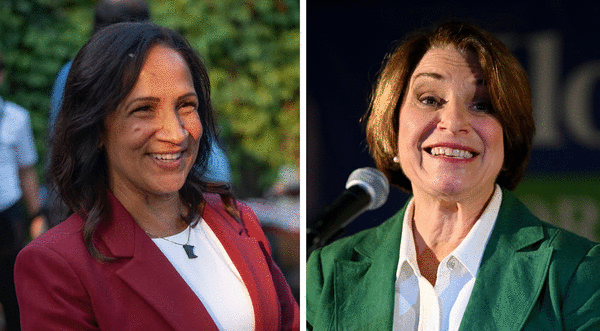
Violent crimes like murder and assault have steadily declined in Minnesota after reaching a pandemic-era peak in 2021. But that hasn’t stopped public safety from being thrust to the center of elections for top statewide offices in recent weeks.
After a series of suburban shootings and an alleged ISIS terror plot at the Mall of America where an undercover FBI employee provided a teenager with a weapon before making an arrest, Republican candidates for governor and U.S. Senate have elevated safety as a campaign issue.
It’s a shift in messaging less than a month out from Election Day in races that have so far been defined by candidates’ plans to address widespread government fraud or their relations to President Donald Trump.
Recent shootings at an Eden Prairie High School homecoming football game, outside an Edina church and late at night in a Bloomington neighborhood involved Somali Minnesotans — and Republican candidates have pressed their Democratic-Farmer-Labor opponents to weigh in on the matter.
“I would have acted as soon as we saw these problems emerging,” GOP gubernatorial candidate and state House Speaker Lisa Demuth said Monday at a news conference with the Police Officers Federation of Minneapolis. “When I’m governor, crises like we see with Somali gangs will be addressed head-on instead of just hoping that the gang violence will go away on its own.”
DFL candidates for statewide office have avoided ethnic characterizations of recent violence, largely sticking to their existing public safety priorities like expanding gun control.
The governor’s race has seen the most engagement on public safety from both sides, with Democratic U.S. Sen. Amy Klobuchar and Demuth holding press events and issuing new policy proposals to combat crime and gang violence.
“No parent should have to worry about their kids’ safety when they go to a homecoming game or go to the mall,” Klobuchar said Oct. 9 in an appearance with public safety officials and Ramsey County Attorney John Choi. “Minnesotans should feel safe and our law enforcement should have the support they need to keep Minnesotans safe and put criminals behind bars.”
Klobuchar has engaged the issue more directly than other top DFL candidates and has a record as being “tough on crime” during her eight years as Hennepin County attorney before she was elected to the U.S. Senate in 2006.
Her proposals on public safety include a “Regional Gang Violence Task Force” led by the Minnesota Bureau of Criminal Apprehension, a ban on so-called assault weapons and more investment in local law enforcement.
Demuth has called for higher penalties for fleeing officers or assaulting them, increased sentences and no early release for people who are convicted of three or more violent crimes, and boosting safety at the University of Minnesota’s Twin Cities campus, among other measures.
A few days after Klobuchar announced her gang task force proposal, Demuth also announced that if elected, she would push to create a regional gang task force under state supervision, a plan the Minneapolis police union said it backed.
Besides press events announcing public safety priorities, Demuth held a roundtable discussion in Eden Prairie following the shooting at the high school’s homecoming game on Oct. 2.
U.S. Senate
The Senate race — where DFL Lt. Gov. Peggy Flanagan and Republican Michele Tafoya, a former NFL sideline reporter, are seeking to succeed Democratic U.S. Sen. Tina Smith — has also seen increased discussion on public safety this month, though largely from the GOP side.
Speaking with reporters Tuesday on her public safety agenda, Tafoya said she didn’t agree with Trump’s recent attacks on Somali Minnesotans, which she described as “scapegoating.” Still, she accused Flanagan of “ignoring” the problem.
“A politician who cannot even say the phrase ‘Somali gang violence’ will never fix this problem,” said Tafoya, flanked by members of the Minnesota Police and Peace Officers Association, which has endorsed her candidacy.
Tafoya’s plan involves “naming” the source of recent crime and disrupting online gang activity. Local law enforcement has blamed social-media conflicts for recent violence.
Flanagan has mostly avoided wading any further into the renewed public safety debate amid fresh Republican challenges on the issue. She hasn’t gathered reporters to discuss policy proposals and hasn’t made any significant shifts in her campaign messaging.
She and DFL Attorney General Keith Ellison have stayed focused on their existing proposals, like gun-control measures, rather than boosting enforcement or penalties for offenders.
In response to Tafoya’s criticisms on public safety, Flanagan’s campaign issued a statement saying she had “been in communication with Drew Evans, Superintendent of the Minnesota Bureau of Criminal Apprehension, about ongoing efforts to address gang violence,” and pointed to state investments in local law enforcement during her tenure as lieutenant governor.
Flanagan also noted Tafoya’s endorsement by Trump, who said Minnesotans should “fight back” against Somali immigrants, whom he blamed for fraud and crime in Minnesota. She and others have characterized Trump’s statements as incitement of discrimination against Somalis.
“We need leaders in Washington who will stand up to Trump and keep people safe, not someone who turns a blind eye to his dangerous actions because it’s politically advantageous,” Flanagan said in a statement.
Many DFL elected officials and Somali community leaders have spoken out against generalizations about them following violence among youth gangs.
At a community meeting on the issue earlier this month, Edina Mayor James Hovland acknowledged that law enforcement concerns about a Somali youth gang problem were founded, but warned against “blaming a group of people.”
Attorney general race
Ellison has described Trump’s comments blaming Somalis for fraud and violence in Minnesota as “scapegoating” and has continued to focus on his existing efforts when asked about his office’s role in public safety.
“The No. 1 cause of death of people under 18 is guns,” Ellison told reporters earlier this month, highlighting his lawsuits against gun manufacturers and sellers. “If you are not talking about gun violence prevention, you are not talking about public safety.”
Ellison sued Fleet Farm in 2022, accusing the retailer of negligently selling a gun that was ultimately used in a downtown St. Paul bar shooting that killed one and injured 14 others. Fleet Farm settled with the state earlier this year for $1 million and agreed to change gun sale policies.
Under Ellison’s direction, Minnesota also sued gun manufacturer Glock for making pistols that can be converted into fully automatic weapons. That lawsuit is ongoing.
Ron Schutz, a Republican attorney challenging Ellison in the attorney general race, has not rolled out a detailed public safety plan in recent weeks like the candidates for governor, but says he’d push to take a more active role in prosecutions if elected.
The attorney general is not primarily a public safety-oriented office, but it can take over criminal cases at the governor’s direction. In one case, Gov. Tim Walz removed Hennepin County Attorney Mary Moriarty from a murder case after outcry from the victim’s family over plea deals she offered to the teenage defendants.
Schutz, who is endorsed by the Minnesota Police and Peace Officers Association, says he would press the next governor to use that power more often in cases he believes local prosecutors have not pursued aggressively enough.
Fraud has been the main issue on the campaign trail so far, but recent shootings have likely put some voters on edge, he said.
“I think that that’s an issue on people’s minds,” Schutz said. “You send your kid to a high school football game? Do you worry about a gang shooting out front?”
Crime down overall
In 2025, Minnesota experienced several high-profile violent events, including the assassination of former Democratic House Speaker Melissa Hortman and her husband, Mark; the shootings of Democratic state Sen. John Hoffman and his wife, Yvette; and the shooting at Annunciation Catholic School in Minneapolis.
More recently, shootings involving Somali youth gangs have dominated headlines. But despite recent events, violent crime has been on the decline in Minnesota for several years since peaking in 2021.
That year, Minnesota had 204 murders, breaking the state record for the second year in a row. The number of murders has dropped each year since, with 132 in 2025.
Violent crime dropped 13% in Minnesota last year, according to the Bureau of Criminal Apprehension’s annual statewide crime report released in September. Overall violent crime has decreased by 25% since 2021.
Minnesota followed national trends at the beginning of this decade when it saw record numbers of murders for two years in a row. Levels of violent crime have fallen off since, though they haven’t fully returned to pre-pandemic-era levels. In 2019, for instance, there were 117 murders. The year before, there were 104.
________
©2026 MediaNews Group, Inc. Visit at twincities.com. Distributed by Tribune Content Agency, LLC.





Comments