Colorado Gov. Jared Polis' final budget proposal sets up hard questions for lawmakers, next governor on healthcare cuts
Published in News & Features
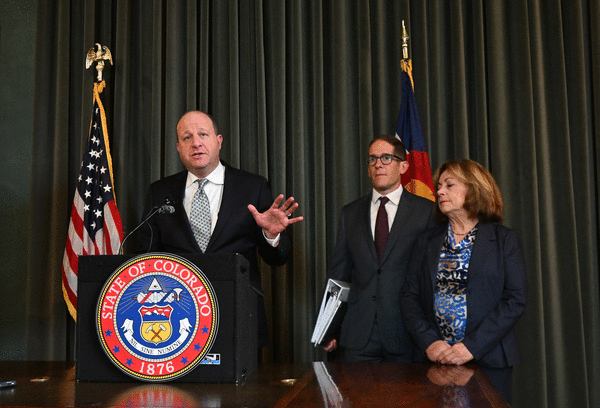
DENVER — Colorado Gov. Jared Polis unveiled his final budget proposal on Monday, teeing up some hard decisions on healthcare cuts for the state’s next chief executive and the legislature to consider next year.
Polis, a Democrat, is term-limited and will leave office in January. This is his eighth and final budget proposal as governor. While he is legally bound to present a spending plan for the state’s 2027-28 fiscal year, which starts in July, it will ultimately be up to the legislature to craft and pass the budget.
The next governor will also have an opportunity to weigh in during the General Assembly’s legislative session, which runs from January to May. The major-party candidates in Tuesday’s gubernatorial election are Attorney General Phil Weiser, a Democrat, and former nonprofit ministry leader Victor Marx, a Republican.
Still, Polis’ budget plan provides an early look at some of the decisions lawmakers will likely contemplate to close a projected $1.5 billion shortfall next year. Colorado law requires the legislature to pass a balanced budget.
The bulk of those decisions will center around the state’s Medicaid program, which continues to see ballooning costs that, if not tamed, risk crowding out other state spending.
“We want to make sure that healthcare costs don’t grow faster than other costs because, very simply, if they do … that means there’s less money for the other things like education, (or) for housing (or) public safety,” Polis said.
Medicaid — which provides health coverage to roughly 1 in 5 low-income Coloradans — has seen its cost far outpace the growth rate of state spending allowed under the 1992 voter-approved Taxpayer’s Bill of Rights, or TABOR. That constitutional amendment caps the growth of government revenue using a formula that takes population growth and inflation.
Myriad factors are driving the cost increase. Lawmakers have expanded coverage in recent years while demands for expensive services, like long-term care for older people, have risen. The program has also been criticized for administrative oversights that have led to multimillion-dollar payment errors and instances of fraud.
If left unchecked, Polis said, Medicaid spending would grow by 15% next year, roughly triple the projected rate for overall government spending allowed under TABOR. His budget proposal would bring that down to 4.3%.
His plan includes a slew of recommended general fund reductions, including cuts to long-term services, eliminating adult dental coverage and reinstating prior authorization requirements for behavioral health services.
Polis said lawmakers would also have to navigate federal funding pressures as a result of the major tax and spending law passed by congressional Republicans last year, dubbed the One Big Beautiful Bill Act. That includes cuts to the Supplemental Nutrition Assistance Program, the largest food assistance program, that will be based on each state’s SNAP payment error rate. That takes effect next October.
Mark Ferrandino, the executive director of the governor’s Office of State Planning and Budgeting, said the change could cost the state over $100 million in the 2027-28 fiscal year’s budget. But potentially most or all of that could be covered by additional funding from the state’s universal free school meals program.
State voters in 2025 supported twin ballot measures that lowered the amount high earners can deduct from their incomes to raise more money for the program, while raising the program’s TABOR limit on revenue. Excess money was also allowed to be used to cover SNAP costs.
Lawmakers, however, will likely need to go back to voters to increase the program’s revenue collection limit again, since initial projections were not high enough. State officials say about $30 million in expected program revenue would have to be refunded to taxpayers if the cap is not raised.
Polis wants lawmakers to place a measure on the November 2027 ballot to do so.
Education remains a bright spot in an otherwise largely bleak spending environment for the state. Polis’ budget plan would increase general fund dollars for K-12 by $125 million, as part of the state’s continued implementation of a new school funding formula passed in 2024.
His budget again calls for privatizing Pinnacol Assurance, which serves as the workers’ compensation insurer of last resort for the state. Polis’ budget projects that doing so could bring a windfall for the state, including an additional $100 million to create a trust fund for childcare. The idea has proved to be a thorny issue in the legislature, however, which has rebuffed past attempts to spin off Pinnacol.
The state’s budget outlook could look vastly different next year depending on the outcome of major tax measures in Tuesday’s election.
Proposition NN, which was placed on the ballot by Democratic lawmakers, would raise around $500 million next year for K-12 education by allowing the state to keep excess revenue that would otherwise be refunded to taxpayers. (That annual revenue could eventually grow to $2 billion, according to analysts.)
And Amendment 87, which is backed by liberal groups, would institute a graduated income tax that would raise taxes on higher earners while cutting them for the majority of Coloradans compared to the state’s current flat tax rate. The measure is projected to raise roughly $2 billion in its first year that would be dedicated to healthcare, education and childcare.
Polis supports Prop NN but is opposed to Amendment 87.
If one or both measures pass, their fiscal impacts will be reflected in his updated budget proposal on Jan. 2, Polis said — more than a week before the new governor is sworn in.
©2026 MediaNews Group, Inc. Visit at denverpost.com. Distributed by Tribune Content Agency, LLC.






Comments