Her son was raped, murdered. Newsom's death row decision brings 'soul-hurting pain'
Published in News & Features
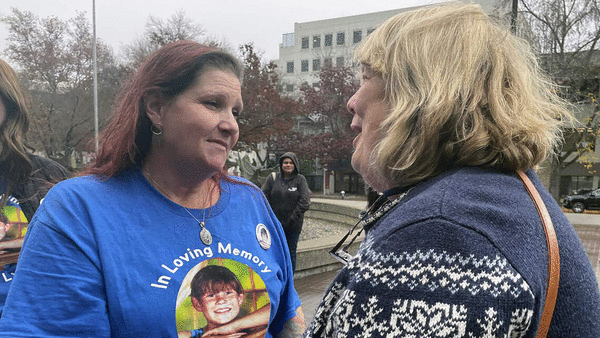



SACRAMENTO, Calif. — Among the 548 inmates sentenced to death in California is Robert Rhoades, who abducted 8-year-old Michael Lyons as he walked home from school in Yuba City on May 16, 1996, then tortured and raped him before stabbing him more than 70 times.
Michael was found dead the next day, his body recovered from brush along the banks of the Feather River.
Michael’s mother, Sandy Friend, was outraged by Gov. Gavin Newsom’s decision Thursday to commute the death sentences of all 548 condemned inmates to life in prison without the possibility of parole.
“I feel a deep, soul-hurting pain and an angry, screaming feeling inside,” Friend said in a statement to The Sacramento Bee. “We fought for justice, and now one man has swiped away these monsters’ true sentences in one moment, just like the monsters who took our loved ones’ voices and silenced our loved ones.
“Governor Newsom commuted every death sentence in California, and no one contacted me first. Years and years of fighting, by me, by other people, and by families, and now it feels like it means absolutely nothing. He didn’t even take the time to look at each case, or to sit down with the family members who are affected.”
Rhoades’ trial was moved from Sutter Superior Court to Sacramento Superior Court because of intense publicity surrounding the case.
Less than a year ago, Friend had to relive her son’s murder in a Sacramento courtroom. Rhoades, convicted and sentenced to death in 1999, had filed numerous appeals over the following decades. Under Senate Bill 483, a California law passed in 2022, Rhoades secured a resentencing hearing in Sacramento Superior Court in late 2025.
The law allowed inmates to seek resentencing to remove certain sentencing enhancements. In June 2025, however, the California Supreme Court clarified that SB 483 applied only to portions of death row inmates’ sentences unrelated to their death sentences.
A week before Christmas 2025, a judge reaffirmed Rhoades’ death sentence.
As Rhoades appeared in court virtually via Zoom from prison, Sacramento Superior Court Supervising Judge Kenneth Brody told the victim’s family: “I see how you still come to court to fight for Michael, but you shouldn’t have to. You deserve finality.”
Friend thought she had it.
“Michael was not a number on a death row list,” Friend’s statement continued. “He was a little boy. He was my son. He had a voice, and that voice deserved to be heard, just as the voices of the hundreds of other victims and their loved ones deserved to be heard.”
Addressing other victims’ families, Friend said: “I feel your pain, your anger and the shattering of your peace.”
She called Newsom’s decision a “slap in the face to the justice system” and a “disgrace,” concluding: “I will never stop fighting for Michael and for the other victims.”
District attorneys throughout California expressed opposition to Newsom’s commutation of death sentences, including Sacramento County District Attorney Thien Ho.
“Any discussion about ending California’s capital punishment must begin with the victims, their families, and the communities forever impacted by the most heinous crimes,” Ho said in a statement. “Justice requires case-by-case consideration, not one-size-fits-all decisions.”
Mass commutations are at odds with the will of California voters, Ho claimed, pointing to the 2016 approval of Proposition 66, which sought to speed up the process of capital punishment trials and ensuing executions.
Voters also in 2016 rejected Prop. 62, which would have repealed the death penalty. Prop. 66 passed with about 51.1% voting in its favor; Prop. 66 failed, with about 53.1% voting against it.
Newsom by executive order in 2019 instituted a moratorium on California executions, calling the state’s death penalty system “unfair, unjust, wasteful (and) protracted.” The state’s most recent death penalty execution happened in 2006.
The California District Attorneys Association said in a statement Thursday afternoon that it “strongly condemned” Newsom’s decision.
“With the stroke of a pen, Governor Newsom has disregarded the decisions of hundreds of jurors and judges, and the anguish of families who lost loved ones to the worst crimes imaginable,” said Jeannine M. Pacioni, the association’s president and Monterey County district attorney. “These sentences were not handed down lightly.”
Greg Totten, the association’s CEO and former longtime Ventura County district attorney, also criticized the decision and its effect on victims’ families.
“The governor acknowledges in his own letter that this decision will reopen painful wounds for victims’ families,” Totten said in a statement. “Yet he made this sweeping decision without giving those families or the prosecutors who represented them an opportunity to weigh in.”
Yolo County District Attorney Melinda Aiello, in a separate statement posted to social media, apologized to the families of two law enforcement officers whose killers were sentenced to death: California Highway Patrol Officer Andrew Stevens and Yolo County Sheriff’s Office Deputy Antonio Diaz.
Brendt Volarvich shot and killed Stevens in November 2005 after the officer pulled him over in rural Yolo County. Marco Topete shot and killed Diaz in June 2008 after fleeing an attempted traffic stop in Dunnigan. Volarvich and Topete were sentenced to death in 2008 and 2012, respectively.
“My heart breaks for the victims impacted by the Governor’s decision to move to commute all death sentences,” Aiello wrote. “We will not stop fighting for our victims.”
©2026 The Sacramento Bee. Visit sacbee.com. Distributed by Tribune Content Agency, LLC.



Comments